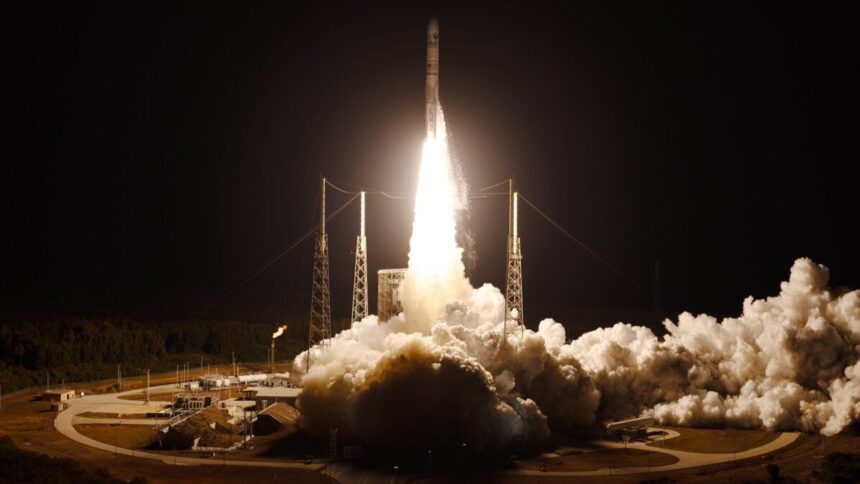
A United Launch Alliance (ULA) rocket had a bumpy ride delivering its national security payload to geosynchronous orbit, releasing a cloud of debris reminiscent of an anomaly that tainted an earlier launch by the same vehicle.
ULA launched its Vulcan Centaur rocket on Thursday at 4:22 a.m. ET from Cape Canaveral Space Force Station in Florida. The rocket was carrying a satellite for the U.S. Space Force, part of a constellation designed to monitor activity in geosynchronous orbit.
Although the rocket managed to deliver its payload to the designated orbit, social media users were quick to point out an unusual plume of debris escaping one of the solid rocket boosters. The rocket may have lost one of its booster nozzles shortly after liftoff and appeared to slightly roll along its axis before quickly recovering and reaching its destination.
Uhhh….that’s not great. Looks like Vulcan may have lost one of its SRB nozzles again… A burnthrough happens at T+0:29, and then looks like the full nozzle falls off at T+1:06. Vulcan also had this issue on the Certification-2 mission.
📸 https://t.co/QwC08n4J6Q & ULA pic.twitter.com/NTFxkqKvn0
— Lukas C. H. (@GewoonLukas_) February 12, 2026
Flight turbulence
ULA later confirmed that Vulcan did suffer an anomaly during Thursday’s launch, and that the company is looking to identify the root cause.
“Early during flight, the team observed a significant performance anomaly on one of the four solid rocket motors. Despite the observation, the Vulcan booster and Centaur performed nominally and delivered the spacecraft directly to geosynchronous orbit,” Gary Wentz, ULA vice president of Atlas and Vulcan Programs, said in a statement. “We will conduct a thorough investigation, identify root cause, and implement any corrective action necessary before the next Vulcan mission.”
The U.S. Space Force mission is Vulcan’s fourth launch overall, and the second under the National Security Space Launch program.
Double anomaly
Observers of Vulcan’s recent flight may have had a case of rocket malfunction deja vu. The rocket experienced a similar anomaly in October 2024, suffering an issue with one of its solid rocket boosters that resulted in a cloud of plume shortly after liftoff.
The earlier anomaly occurred during Vulcan’s second test flight, whose main purpose was to secure certification from the U.S. Space Force to carry national security missions. Engineers traced the anomaly to a malfunctioning insulator, which failed to protect the nozzle’s metallic structure from the booster’s exhaust, thereby resulting in the nozzle failure.
The booster anomaly resulted in months of delays before the Space Force finally gave ULA the green light to begin launching its missions. Vulcan launched its first military payload in August 2025, carrying an experimental navigation satellite developed by the Air Force Research Laboratory, called NTS-3, to geostationary orbit.
Vulcan is a mostly expendable heavy-lift launch vehicle that was first conceived in 2006, borrowing design elements from both ULA’s Atlas V and Delta IV rockets. The 200-foot-tall (60-meter) rocket can carry up to 25.8 metric tons to low Earth orbit (LEO) and 7 metric tons to geostationary orbit (GEO).
Read the full article here