

Great minds often think ahead of their time. This was certainly true for Thomas Edison, who envisioned the potential of electric vehicles long before they became trendy. But in Edison’s lifetime, rapid technological advances in gas-powered cars pushed his idea—specifically a nickel-iron battery for proto-EVs—into the background. Until now.
In a recent issue of the science journal Small, engineers reported that they had “taken a page from Edison’s book” by developing a nickel-iron battery using novel nanotechnology tools, as they explained in a statement. That said, the reworked battery appears to be more suited to storing solar energy than for powering cars, which was Edison’s original intention. Regardless, the experiment brings the inventor’s ideas back with fresh relevance, even if powered by modern science.
An idea not forgotten
The original design by Edison was a lot clunkier than the new prototype. According to Scientific American, it weighed “124.5 pounds to 186.5 pounds per horsepower hour at its terminals.” It used iron and nickel screens for the anode and cathode, respectively, submerged in a potassium hydroxide electrolyte, as Nuts & Volts explains. It was also potentially hazardous, having a tendency to release hydrogen while charging.
But there were certain aspects of the design that caught the eye of modern scientists, not just those behind the new battery prototype. In 2017, for example, a team based in the Netherlands found a way to utilize the hydrogen leak from Edison’s design to create renewable fuel.
In contrast, the new battery is a more direct reimagination of Edison’s idea, in that it focuses on the battery itself as opposed to its byproducts. The prototype, developed by scientists at the University of California, Los Angeles (UCLA), is a nanocluster of nickel and iron, packed within molecular byproducts from beef production.
The natural skeleton
Yes, you read that correctly—beef production. That may seem like an odd recipe for a battery, but the researchers were inspired by natural processes when formulating their blueprint. Specifically, they took cues from the ways animals form bones and shellfish build their shells. Skeletons are typically formed through the coordinated action of proteins that help the body collect calcium-based compounds.
“Laying down minerals in the correct fashion builds bones that are strong, yet flexible enough to not be brittle,” explained Ric Kaner, study co-author and a biochemist at UCLA. “How it’s done is almost as important as the material used, and proteins guide how they are placed.”
A crinkly nanobattery
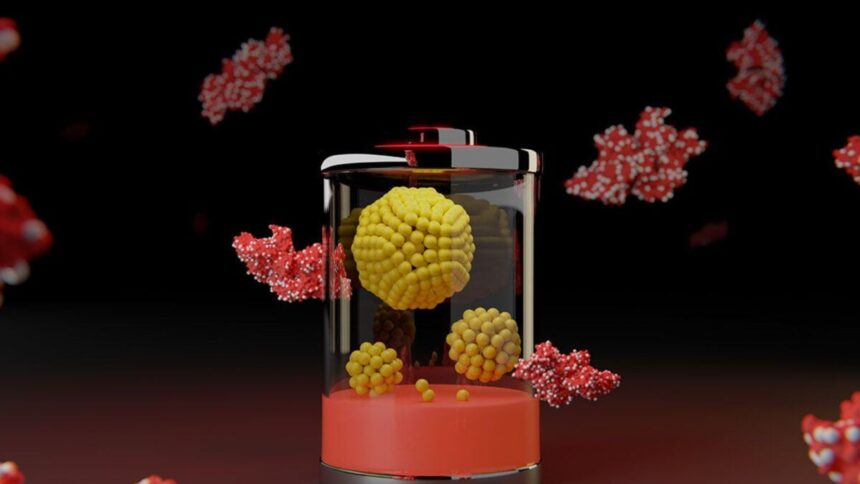
The layout of the battery looks like this: The protein molecules have many nooks and crannies in their folded structure. Researchers added clusters of nickel and iron—corresponding to the positive and negative electrodes, respectively—into the folds, then combined the molecules with an ultrathin sheet made of carbon and oxygen atoms.
Superheating this system stripped away the oxygen and embedded the tiny protein-hosted metal clusters into the material, creating an aerogel-like structure. This arrangement allowed the researchers to maximize the surface area of the battery.
That means “almost every single atom can participate in the reaction,” said Maher El-Kady, study co-author and UCLA biochemist, adding this greatly accelerates the charging and discharging process of the battery.
“People often think of modern nanotechnology tools as complicated and high-tech, but our approach is surprisingly simple and straightforward,” El-Kady said. “We are just mixing common ingredients, applying gentle heating steps, and using raw materials that are widely available.”
A comeback with renewed intentions
In initial tests, the prototype showed it could recharge in mere seconds, successfully repeating its charge cycles 12,000 times. This was equal to more than 30 years of daily recharges, according to the researchers.
However, as the team admits, the battery falls short in matching the capacities of lithium-ion batteries used in electric vehicles. The Edison-inspired battery would be a better fit for storing excess electricity generated by solar farms or as a backup power source at data centers, they said.
Read the full article here