
By using this site, you agree to the Privacy Policy and Terms of Use.
Accept
Tech Consumer JournalTech Consumer JournalTech Consumer Journal
  • News
  • Phones
  • Tablets
  • Wearable
  • Home Tech
  • Streaming
  • More Articles
Reading: This Plant Has Been Hiding a Killer Secret. Darwin Called It 150 Years Ago
Share
Sign In
Notification Show More
Font ResizerAa
Tech Consumer JournalTech Consumer Journal
Font ResizerAa
  • News
  • Phones
  • Tablets
  • Wearable
  • Home Tech
  • Streaming
  • More Articles
Search
  • News
  • Phones
  • Tablets
  • Wearable
  • Home Tech
  • Streaming
  • More Articles
Have an existing account? Sign In
Follow US
  • Contact
  • Blog
  • Complaint
  • Advertise
© 2022 Foxiz News Network. Ruby Design Company. All Rights Reserved.
Tech Consumer Journal > News > This Plant Has Been Hiding a Killer Secret. Darwin Called It 150 Years Ago
News

This Plant Has Been Hiding a Killer Secret. Darwin Called It 150 Years Ago

News Room
Last updated: August 5, 2026 5:37 am
News Room
Share
SHARE

It’s been nearly 150 years since Charles Darwin’s death. Yet, as research out today shows, scientists are still proving some of his educated hunches right.

Researchers at the Florida Museum of Natural History and others seem to have discovered a new carnivorous plant—the same type of plant that Darwin once argued was carnivorous. The team’s discovery should provide more insight into the evolution of these insect-eating oddities, the researchers say.

“This finding adds a new lineage to the pantheon of carnivorous plants,” the researchers wrote in their paper, published Tuesday in the journal Nature Communications.

Darwin’s hunch proved right

In 1875, Darwin published a book all about his experiments with carnivorous plants, titled Insectivorous Plants. In it, he made the case that at least two plant species in the genus Saxifraga were ravenous predators of insects. However, his feeding experiments at the time failed to conclusively demonstrate these plants were bona-fide carnivores, leaving the matter unresolved.

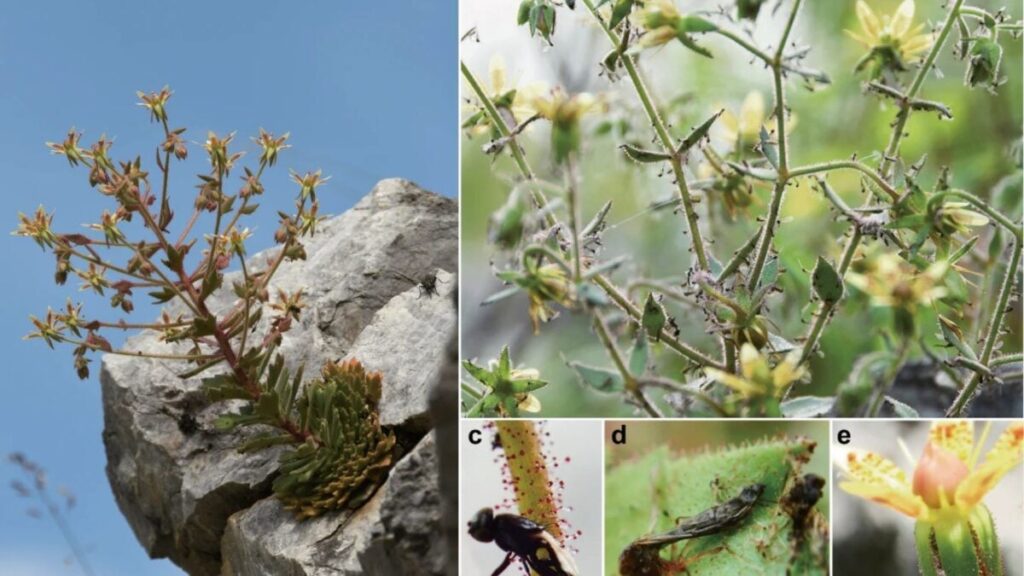
This latest study looked at a different species of Saxifraga (Saxifraga candelabrum), albeit one that shares an important bodily feature with the plants Darwin studied: specialized, glandular hair-like growths on the surface of the plant ostensibly used to trap hapless insects that wander too close. S. candelabrum is a herb native to the Hengduan Mountains in southwest China that cuts across the Tibetan Plateau and the Yunnan–Guizhou Plateau. Like many known carnivorous plants, it resides in soil environments that are lacking in nutrients, perhaps explaining why it evolved a hunger for insects to supplement its diet.

The study team, which included researchers from the Chinese Academy of Sciences, had tools not available in Darwin’s day that helped them solve this mystery once and for all.

Their field experiments with fruit flies showed that S. candelabrum does indeed actively attract and capture insect prey via its glandular hairs. Further analysis found that the plant truly digests the insects it traps and that it absorbs nutrients from them, namely nitrogen. These traits—prey attraction, capture, digestion, and nutrition absorption—are the key criteria for confirming that a plant has the capacity for carnivorous behavior, also known as carnivory, according to the researchers.

“Our findings provide the first definitive evidence of carnivory in Saxifraga, addressing Charles Darwin’s long-standing hypothesis that some Saxifraga species may be capable of carnivory,” they wrote.

What this means

The researchers’ work not only validates Darwin, but it also deepens the questions surrounding carnivorous plants.

Studies have shown that carnivory evolved independently in different lineages or branches (pun intended) of plant life multiple times. The team’s genetic analysis showed that similar mutations in certain genes have arisen across these different lineages, yet they also identified other genes that might be involved in carnivory.

And while S. candelabrum is the only known plant in Saxifraga to be carnivorous, there could be other species as well. Saxifraga plants are also only distantly related to other types of plant carnivores, such as Venus flytraps and pitcher plants. So its mere existence might suggest that “carnivory may be more widespread among [flowering plants] than previously recognized,” the researchers wrote.

Whatever more lessons that are to be learned about carnivorous plants, it’s nice to see that Darwin’s influence on science is still alive and well.

Read the full article here

You Might Also Like

FBI Agent Accused of Stealing $1 Million in Crypto Apparently Missed the Corruption Tutorial

Pluto’s Atmosphere May Finally Be Starting to Collapse

Texas Pauses New Data Center Projects Looking to Connect to the State’s Grid

Spotify Execs Bet People Will Pay for AI Music. Stock Price Plunges

‘The Mummy 4’ Cast Unwraps a Few More Old and New Faces

Share This Article
Facebook Twitter Copy Link Print
Previous Article Pluto’s Atmosphere May Finally Be Starting to Collapse
Next Article FBI Agent Accused of Stealing $1 Million in Crypto Apparently Missed the Corruption Tutorial
Leave a comment

Leave a Reply Cancel reply

Your email address will not be published. Required fields are marked *

Stay Connected

248.1kLike
69.1kFollow
134kPin
54.3kFollow

Latest News

SpaceX Stock Drops After First Earnings Call as Musk Fails to Woo Investors With AI Goals
News
‘The X-Files: I Want to Believe
News
PC Prices Are So Bad Now, Companies Are Selling You Old Components Like New
News
The White House’s New AI Safety Framework Is None of Your Business
News
Destin Daniel Cretton Is as Bummed as You Are That ‘Wonder Man’ Isn’t Coming Back
News
Brand New Day’ Races to the $1 Billion Mark
News
‘Minions & Monsters’ Is Coming Home Faster Than You Can Say ‘Banana’
News
George R.R. Martin Blogs a Melancholy Life Update
News

You Might also Like

News

The Next Xbox Could Be Every Xbox Ever Rolled Into One

News Room News Room 6 Min Read
News

The Explosive Diarrhea Outbreak Has Turned Deadly

News Room News Room 4 Min Read
News

NASA Backs Wild Plan for a Laser-Powered Drone to Explore Giant Caves Below the Moon’s Surface

News Room News Room 5 Min Read
Tech Consumer JournalTech Consumer Journal
Follow US
2024 © Prices.com LLC. All Rights Reserved.
  • Privacy Policy
  • Terms of use
  • For Advertisers
  • Contact
Welcome Back!

Sign in to your account

Username or Email Address
Password

Lost your password?