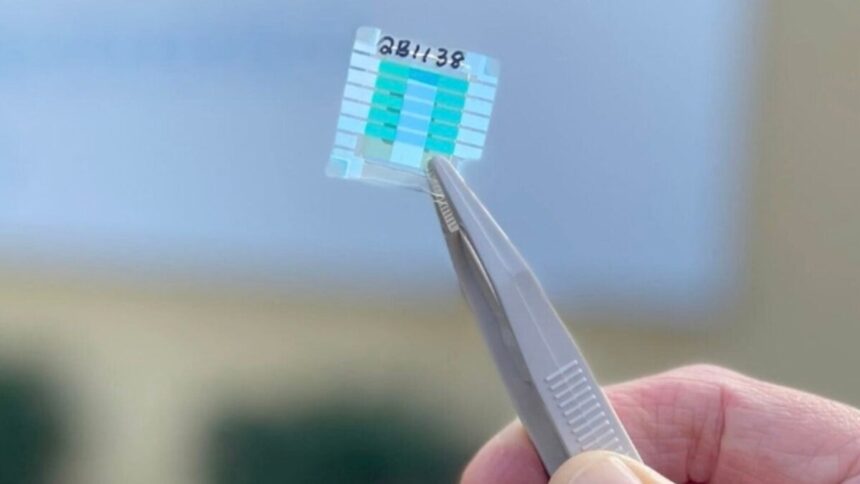
According to physicist Paul Davies, a tried-and-true “quantum” device exploits the odd rules of quantum mechanics to deliver impressive, fairly practical results. And the latest installment in this quantum revolution is the world’s first quantum battery—a prototype for now, but one with a lot of potential.
As a concept, quantum batteries were first proposed in 2013; the idea was that a small quantum mechanical system could temporarily store and transfer energy. But this largely remained a theoretical pursuit until 2018, when an Australian team decided to actually build a working quantum battery. And now, eight years later, the researchers finally believe they’ve found the right blueprint for scalable quantum batteries, publishing their findings in a recent study in Light: Science & Applications.
“My ultimate ambition is a future where we can charge electric cars much faster than [fueling] petrol cars or charge devices over long distances wirelessly,” James Quach, the study’s senior author and a researcher at CSIRO, Australia’s national science agency, said in a statement. “The research validates the exciting potential of quantum batteries for unprecedented efficient and rapid energy storage.”
“Radically different”
Unlike ordinary batteries, whose charging time increases with size, quantum batteries conversely take less time to charge the bigger they get. This “radically different” behavior is the product of collective effects in quantum physics, Quach explained in a column for The Conversation.
“Under the right circumstances, the storage units of quantum batteries don’t act individually but behave collectively,” he wrote. “It is as if each unit somehow knows there are other units around, and their presence makes the unit charge faster. Strange, right?”
Realizing a concept
The new prototype is a sort of metal “sandwich” with multiple layers, each having different functions, such as capturing light, defining the battery’s energy gradient, etc. An earlier iteration of the battery, which Quach’s team demonstrated in 2022, confirmed that, as theoretically predicted, larger quantum batteries do take less time to charge.
The latest proof-of-concept added a layer to extract the energy from the quantum sandwich and convert it into an electrical current, Quach explained. The battery supports wireless charging with a laser and isn’t as dependent on chemical resources as traditional batteries are.
The team also used spectroscopy techniques to confirm that the sandwich acted like a battery, finding that the system stored energy for “six orders of magnitude longer than it took to charge,” the researchers said in the statement.
Coming… not so soon
It’s worth noting that the current capacity of the prototype is a few billion electron volts. For context, the unit scale here is roughly equivalent to that used to refer to the mass of singular protons—so, we’re talking extremely tiny. The battery also holds its charge for a few nanoseconds, which is also not very long.
Quach is aware of this shortcoming, writing in his column that the team’s next steps are to scale up the prototype and extend its charging longevity. Additionally, he noted that quantum batteries could be better for powering quantum devices, like quantum computers, rather than things like smartphones.
That said, the feat is still impressive. Andrew White, a quantum physicist at the University of Queensland who wasn’t involved in the new work, told The Guardian that the proof-of-concept is “a really nice piece of work showing that the quantum battery is more than an idea; it’s now a working prototype.”
“We hope to create a hybrid design that combines the exceptional charging speed of the quantum battery with the long storage time of the classical battery,” he said. “The progress we’ve made is a testament to the century of theoretical work done by quantum scientists before us. Progress takes time—but quantum batteries are certainly on our horizon.”
Read the full article here