
By using this site, you agree to the Privacy Policy and Terms of Use.
Accept
Tech Consumer JournalTech Consumer JournalTech Consumer Journal
  • News
  • Phones
  • Tablets
  • Wearable
  • Home Tech
  • Streaming
  • More Articles
Reading: This Electric Shock Glove Was Invented for Police in the 1930s to ‘Incite Fear’
Share
Sign In
Notification Show More
Font ResizerAa
Tech Consumer JournalTech Consumer Journal
Font ResizerAa
  • News
  • Phones
  • Tablets
  • Wearable
  • Home Tech
  • Streaming
  • More Articles
Search
  • News
  • Phones
  • Tablets
  • Wearable
  • Home Tech
  • Streaming
  • More Articles
Have an existing account? Sign In
Follow US
  • Contact
  • Blog
  • Complaint
  • Advertise
© 2022 Foxiz News Network. Ruby Design Company. All Rights Reserved.
Tech Consumer Journal > News > This Electric Shock Glove Was Invented for Police in the 1930s to ‘Incite Fear’
News

This Electric Shock Glove Was Invented for Police in the 1930s to ‘Incite Fear’

News Room
Last updated: August 20, 2026 10:52 am
News Room
Share
SHARE

Immigration and Customs Enforcement (ICE) officers will soon be getting electric shock gloves that can be used to inflict pain on anyone they choose. The gloves, made by Compliant Technologies, are touted as a way to get compliance without the risk of viral videos where arm-swinging beatings make officers look bad.

The shock gloves have already been used against students at schools in Omaha, Nebraska, though police has said they’ll stop after public outcry. And while the gloves are obviously a dystopian symbol of our modern age, the general idea is much older. In fact, one inventor showed off his shock glove to police in the 1930s.

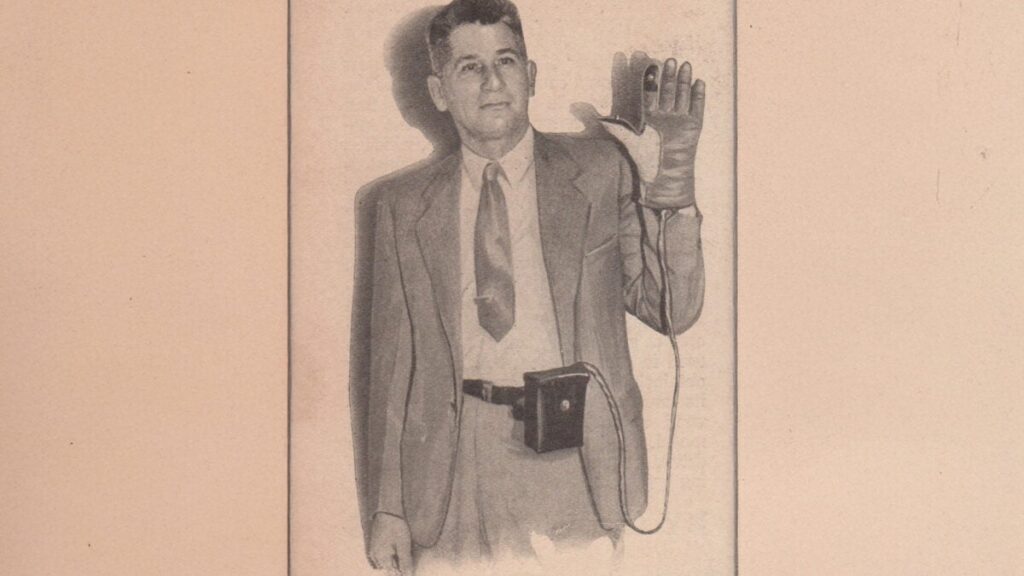
Cirilo Henriquez Diaz, an inventor from Cuba, filed for a patent for his glove in 1932, which was granted the following year. The glove could deliver 1,500 to 5,000 volts as long as the police officer was wearing a small battery pack on his hip. Well, small for the 1930s, as you can see in the photo above from Popular Science, which insisted that it had a paralyzing effect but was considered “humane” because there are “no burns or other after-effects.”

Diaz demonstrated his shock glove for the New York Times in the summer of 1935, which noted at the time that Diaz was 52-years-old and worked as a construction superintendent for the Frederick Shane Company.

Patent for an electric glove in 1933. © U.S. Patent Office

An Associated Press article that appeared in newspapers nationwide in 1935 was arguably the most illuminating in its coverage of the intent behind these gloves. And it also highlighted the contradictions involved.

The AP article, as it appeared in the June 21, 1935 edition of the Wilmington Morning News in Delaware:

An idea born of Ohio mill riots in 1930, a “policeman’s electric glove” for handling disorderly crowds, was demonstrated to police today by Cirilo Henriquez Diaz of Havana, Cuba.

Operated with storage batteries, the glove will incapacitate a person without injuring him, Diaz said.

He promised it would force confessions from recalcitrant prisoners and be of value to prison keepers and asylum attendants.

Its chief value, he claimed, was to incite fear.

Police use of clubs, Diaz said, causes persons to fight back.

It’s unclear which “Ohio mill riots” of 1930 the report refers to. At the start of the Great Depression in 1930, there were a number of labor actions from workers upset about slashed wages and unfair working conditions. But perhaps the bigger question that emerges from the article is how someone can be incapacitated without being injured.

The article may mean that the person feels tremendous pain but won’t have the marks on their body to prove they’ve been harmed. A video on the YouTube page of Compliant Technologies, the company that makes the modern day shock glove (also known as the Generated Low Output Voltage Emitter or G.L.O.V.E.) promotes its product in a similar way.

The video features Compliant Technologies President and COO Dan De La Cruz, who demonstrates the shock glove on a willing participant moaning in pain. De La Cruz says that when cops encounter someone who won’t make their hands available to be handcuffed, they’re “forced to strike them, dig their knees into them, do multiple things…” and “none of this looks good on camera when it finally comes to it.”

The man being shocked, a police officer who volunteered for the video, said “it was horrible,” but De La Cruz tellingly explains, “everything they saw on camera, I didn’t strike you.” The man replies “there’s no blood,” and “no puncture wounds from taser probes,” which would be an obvious indicator of force.

The other notable part of that AP article is the fact that it suggests the electric shocks could be used to get confessions from prisoners. That obviously wouldn’t fly in the 2020s, at least not legally. But the idea that the glove should incite fear seems to be the thing that connects these two devices across those 90 years.

Gizmodo hasn’t found evidence that the 1930s electric shock glove was ever used by police, but the New York Times article says NYPD asked the inventor for price quotes. But if ICE has their way, the long lost descendant of Diaz’s device could be terrorizing immigrant communities in the U.S. in the very near future.

Read the full article here

You Might Also Like

The Best Tech and Gear for Back to School 2026

The Creepy ‘Never After Dark’ Trailer Might Keep You Up at Night

Darth Vader Speaks at City Council Meeting

DOJ Throws Support Behind xAI’s Fight Against Minnesota AI Nudification Ban

NASA’s Swift Is Doomed to a Fiery Death After Rescue Mission Fails

Share This Article
Facebook Twitter Copy Link Print
Previous Article OpenAI’s CFO Reportedly Downplays Importance of IPO to Staff
Next Article ‘The Odyssey’ Is Now the Highest-Grossing R-Rated Film of All Time
Leave a comment

Leave a Reply Cancel reply

Your email address will not be published. Required fields are marked *

Stay Connected

248.1kLike
69.1kFollow
134kPin
54.3kFollow

Latest News

This Robot Vacuum Has a Brush and Mop Pad That Can Reach Places Others Can’t
News
SpaceX Finally Recovers Starship After 24 Days of Tugging It Through Rough Waters
News
‘The Odyssey’ Is Now the Highest-Grossing R-Rated Film of All Time
News
OpenAI’s CFO Reportedly Downplays Importance of IPO to Staff
News
Mars’ Potato-Shaped Moon May Have Gotten Its Youthful Look From a Single Impact
News
Don’t Panic, the Pixel Watch 1 Isn’t Losing Google Health Support
News
People Scalping Movie Tickets Sucks, but Don’t Be Too Worried
News
FBI Warns That Hackers Are Targeting Siemens Equipment Amid Recent Water Plant Breaches
News

You Might also Like

News

An ‘Exercise Pill’ Just Cleared Its First Human Test

News Room News Room 5 Min Read
News

New NASA Images Reveal Crater Left Behind by SpaceX Rocket Impact on the Moon

News Room News Room 4 Min Read
News

What If This Was How You Found Out The Singularity Has Begun?

News Room News Room 3 Min Read
Tech Consumer JournalTech Consumer Journal
Follow US
2024 © Prices.com LLC. All Rights Reserved.
  • Privacy Policy
  • Terms of use
  • For Advertisers
  • Contact
Welcome Back!

Sign in to your account

Username or Email Address
Password

Lost your password?