

Tom Steyer thinks the AI revolution could push a lot of white collar workers out of their jobs, making them unable to pay their bills. But the billionaire gubernatorial candidate in California says he’s got a solution: Institute a special tax on the AI companies and use that to create a sovereign wealth fund to pay for the state’s education needs, job training, and even cash dividends.
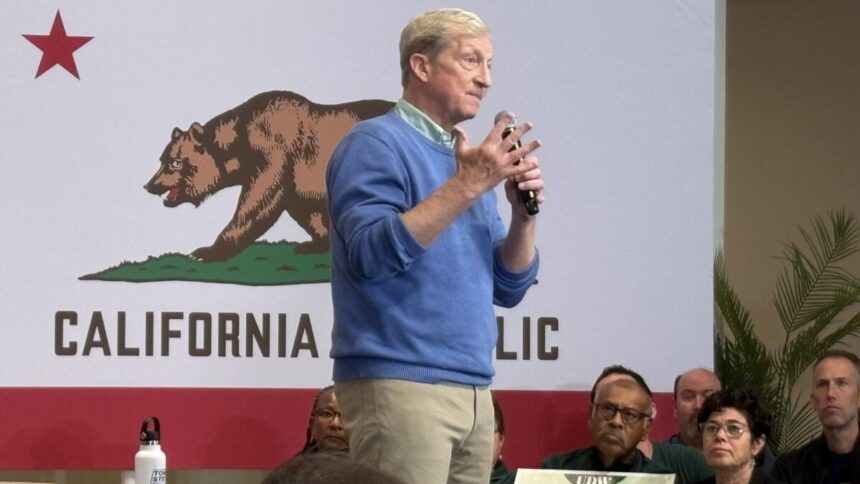
“This is a technology which basically enables a computer to replace the thought of millions of people and then delivers their salaries to the person who owns the computer,” Steyer said recently in front of a crowd of about 100 people.
He was speaking in San Diego, California, on Tuesday night at a town hall event, making his pitch for why he should succeed Gavin Newsom as governor in November’s election. Or, more accurately, why he should be on the ballot at all this fall. Steyer first needs to get through the primary in June, and that’s no small task. Two Republicans are currently leading the pack in polling, and the Democratic candidates like Steyer have split the vote without a clear frontrunner.
Steyer, who’s best known as an environmental activist, calls himself the most progressive candidate in the race and supports Medicare-For-All, abolishing ICE, and higher taxes on the wealthy. He’s worth about $2.4 billion, according to Forbes, so taxing rich people would also include him. Steyer made his money as the founder of the hedge fund Farallon Capital and has a unique plan for AI, which is why Gizmodo figured it would be a good idea to show up Tuesday and see what the man had to say.
When talking about AI, Steyer draws parallels to the 1970s and ’80s, when automobile and manufacturing jobs left the Midwest and the Rust Belt acquired its nickname. He believes that training people in new jobs displaced by AI is the key, noting that plenty of lip service was paid to the idea in the late 20th century but it didn’t really happen. In fact, he said it was the single biggest policy failure of his lifetime.
“We have to have an ownership in this,” Steyer said of the AI revolution, “so that we can afford to make sure that we get people who are having trouble finding a job, connect them to a real job and do the training to get them there.”
Steyer said he believes that we have to think about “AI as a tool for workers, not a replacement for workers,” which drew big applause from the crowd in San Diego. “We cannot have 12 trillionaires and 40 million people who can’t make rent,” said Steyer, also to applause. California is the most populous state in the country with nearly 40 million people. It’s also the state with the most billionaires.
Steyer’s solution from a state government perspective is to tax AI, something he has been more specific about in recent interviews where he says the way to do that is taxing them by the token. His website proposes the creation of a Golden State Sovereign Wealth Fund, a dedicated investment vehicle funded by a token tax on corporate AI use, described as “a fraction of a cent for every unit of data processed by Big Tech.”
If the token tax sounds familiar, that’s because he stole the idea from Anthropic CEO Dario Amodei (who stole it from some economists). Amodei raised the idea in 2025. Steyer hinted it was Amodei’s idea in San Diego on Tuesday, saying, “my proposal is actually one which I know some of the people who run the biggest AI companies think is fair.”
Steyer went on to say that the details of an AI tax will have to be negotiated, though he didn’t elaborate on whether that was a negotiation which would happen with elected representatives at the California State Assembly or with the AI companies.
He said all of it was necessary because, “the people need to own some of this upside so we can protect people from losing their jobs and make sure we don’t get hollowed out by a technology that depends on, actually, the experience, knowledge, and data from the people in this room.”
While Steyer talked about AI, someone in the crowd said “make them pay for the utilities,” a contentious part of the data center build-outs happening across the country that are sending local energy prices soaring. “If we do this right, we’re going to have a sovereign wealth fund that’s going to pay for a lot of it,” Steyer said.
Steyer’s website explains that “California built the AI industry,” a reference to companies like OpenAI and Anthropic, which have their headquarters in the Bay Area.
The billionaire’s AI proposals seemed well received by the crowd in San Diego. But he still has quite a few hurdles in front of him. Most polling of the past month has Republicans Steve Hilton and Chad Bianco in the first and second spots, with Democrats trailing behind. Hilton is a former Fox News host and Bianco is the controversial sheriff of Riverside County.
If the two Republicans manage to maintain that lead in the June primary, it’s entirely possible that Hilton and Bianco could be the only candidates on the ballot, since California has an open primary where the top two vote-getters appear in November, regardless of party. It’s more likely, however, that there will be at least one Democrat on the ballot, provided some people who are splitting the vote drop out before June. Steyer’s competition includes former Democratic congresswoman Katie Porter, Rep. Eric Swalwell, and San Jose Mayor Matt Mahan, among others. It’s Mahan who seems to be attracting the most support from Silicon Valley as he positions himself as a moderate who’s friendly to the tech industry.
Steyer might see himself as the most progressive candidate in the race, but three different people stood up to interrupt him Tuesday night because they were upset with his previous investments in CoreCivic, the private prison company that runs the ICE detention center in nearby Otay Mesa.
Steyer acknowledged that his hedge fund invested in the company, back when it was known as the Corrections Corporation of America, but left the fund in 2012 and says he regrets the investment. Politico reported back in 2016 that Steyer’s fund purchased about $90 million worth of the stock in the mid-2000s. It’s unclear how much money he personally made from the investments, though he scoffed when a protester claimed it was $100 million.
One protester in San Diego asked Steyer to give the money he made to the detainees at the Otay Mesa Detention Center, where well over 1,000 people are held in deplorable conditions. Detainees throw lotion bottles with messages written inside to protesters located outside in an attempt to communicate with the world. They often tell horrifying stories about a lack of fresh food and constant illnesses in what amounts to a concentration camp. Local health officials haven’t been allowed to inspect detainees and have filed a lawsuit.
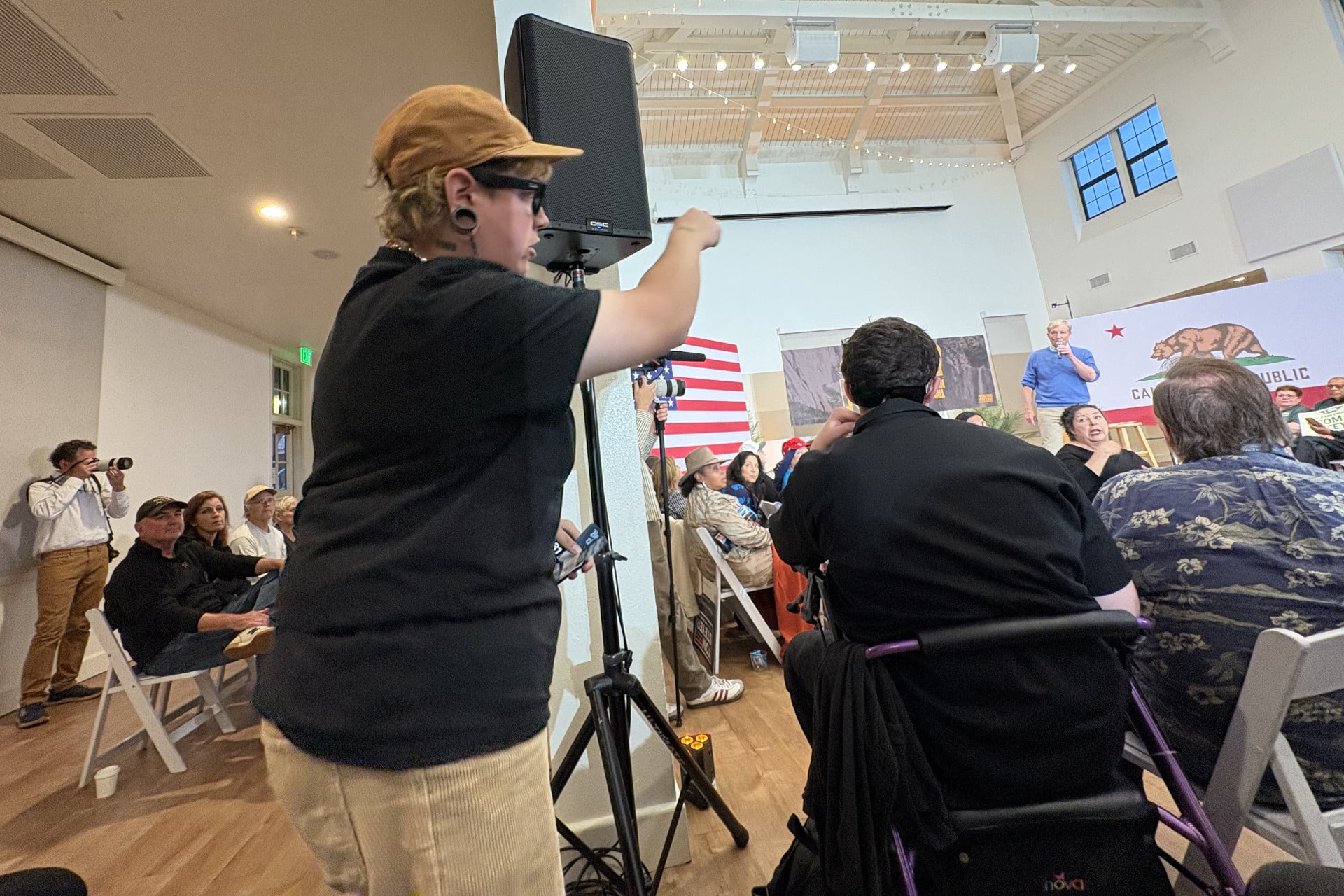
Steyer didn’t commit to giving money to any detainees at Otay Mesa, instead insisting that he broadly planned to give away most of his fortune within his lifetime.
“It was a mistake. We owned hundreds of stocks. We bought it 22 years ago, and over 20 years ago I thought, ‘we should not be doing this. Let’s sell it and get out,’” said Steyer. “And I said at the time, this was just a mistake.”
It’s unclear if the Democratic base in California will believe him, whether it comes to Big Tech or other issues where Steyer has shifted his position recently. The billionaire previously opposed Medicare For All when he ran for president in 2020 but has since changed his mind.
The Steyer campaign didn’t respond to emailed questions from Gizmodo on Wednesday. We’ll update this article if we hear back.
Read the full article here