
The MacBook Neo took the scene last week as Apple’s most back-to-basics laptop. And still, it’s the company’s most innovative design in years. You wouldn’t know it by looking at the MacBook Neo’s calming colors and basic keyboard and mechanical touchpad, but it may be Apple’s new tack, offering better, far more repairable laptops in the future.
The respected repair gurus at iFixit shared its teardown of the MacBook Neo late last week. Surprise, surprise, the $600 laptop is Apple’s “most repairable MacBook… in about 14 years.” Users can get into the laptop by unscrewing the eight pentalobe screws on the backplate. Unlike every other MacBook released since 2020, users don’t need to use a heat gun to melt glue to pry open the shell to look at the components.
See MacBook Neo at Amazon
What’s more, Apple hasn’t used any microcontrollers or other software locks to kill the device if you dare replace any parts outside of an Apple Store. Users can remove the battery by undoing a set of 18 screws. Previous MacBooks from before 2020 had the battery glued down into the case. More modern MacBooks make use of adhesive strips. The keyboard is also replaceable with the exchange of 41 screws. Apple has even more guides for replacing these components on its Support page.
Sorry, the memory isn’t replaceable

Ultimately, your regular MacBook Neo buyer isn’t necessarily the type to dive into laptop repair. That doesn’t mean there won’t be a subset of first-time computer buyers with the inclination to take things apart and see how they work. Repairable computing devices are the modern equivalent of old-timey radios and watches. Budding engineers who can’t help but find how things work will enjoy the MacBook Neo more than if they had tried the same with a $1,100 MacBook Air.
The MacBook Neo’s price is a factor of its design and trade-offs. It feels the most like a premium device of any other budget-end laptop I’ve used. And still, it’s using an iPhone chip—the A18 Pro—and limits itself to 8GB of unified memory and a paltry base 256GB of SSD storage. Neither of those is upgradable. It is those reasons alone why the MacBook Neo shouldn’t be considered among the best examples of repairable design, even though it’s still many times better than Macs from just four or five years ago.
Apple puts a lot of focus on lightweight designs, and the MacBook Neo comes in at 2.7 pounds, the same as a 13-inch M5 MacBook Air. To make a device lighter and more compact, that will necessarily limit the number of screws you can use to hold it together. For example, the MacBook Neo’s mechanical touchpad is cheaper to make and therefore less refined than a haptic Force Touch pad in more expensive MacBooks like the M5 Max MacBook Pro. Stuffing higher-end components inside a shell that still measures 0.61 inches in height will naturally emphasize glued-on backplates and packed-together components.
Great, now make more Macs repairable
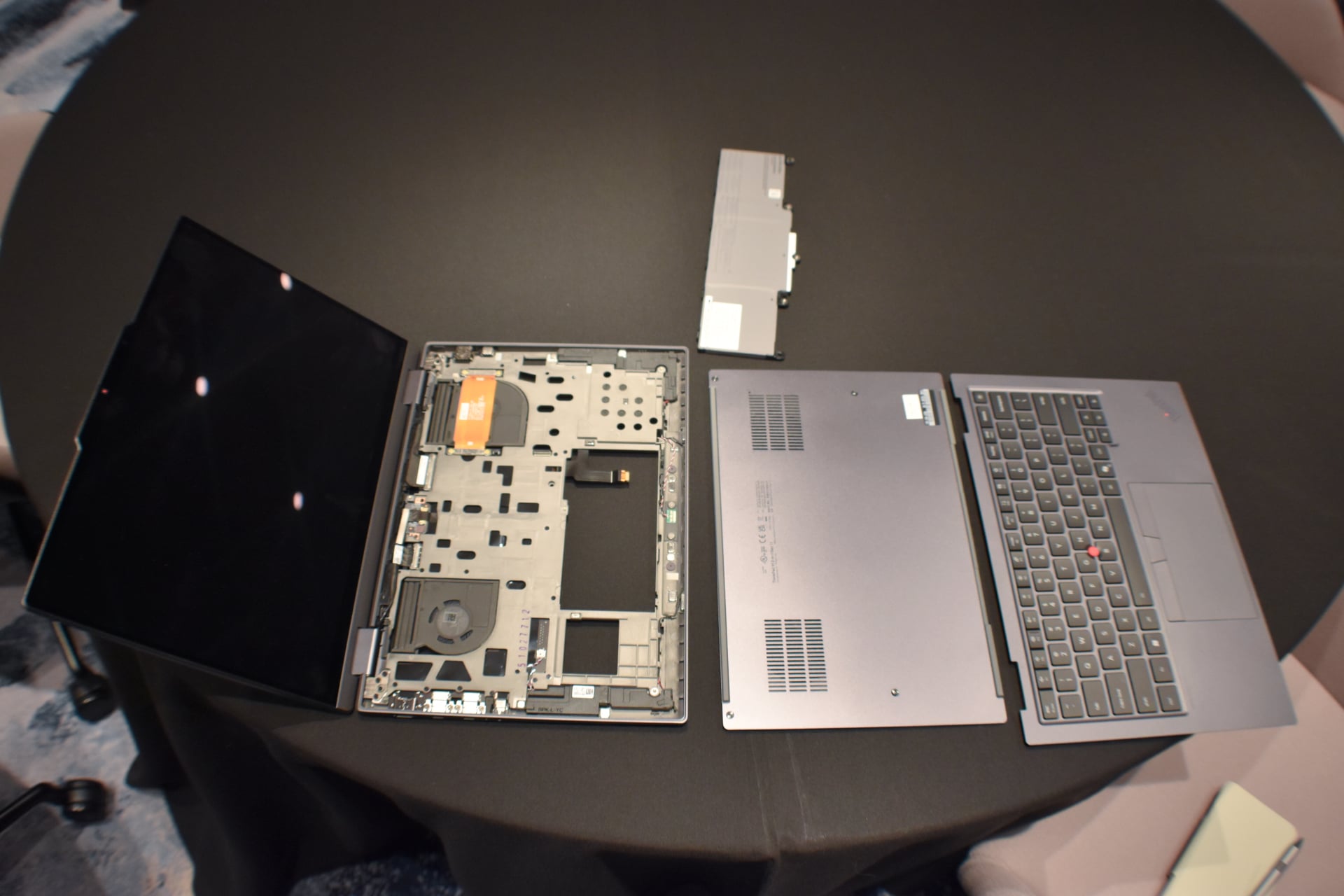
That’s not to say making more or all MacBooks more repairable can’t be done. Lenovo’s latest ThinkPads are easily some of the most repairable laptops available. iFixit granted the latest ThinkPad T14 Gen 7 and T16 Gen 5 a 10/10 score in repairability thanks to their easily removable keyboard, battery, and other components. Lenovo is getting more excited about swappable laptop parts with its recent concept devices. Meanwhile, Framework is still leading the pack in accessible, buildable, repairable PCs. The Framework Laptop 13 measures only 0.62 inches in height and allows users to replace every component down to the mainboard and accompanying SoC (system on a chip).
Really, the MacBook Neo is showing us more how Apple’s poor repairability was it leaning into its design-first ethos. The MacBook Air and MacBook Pro have maintained the same basic shell for the past half-decade. Judging by recent sustained performance issues on the top-end M5 Max MacBook Pro, Apple should be looking to refresh the design to facilitate its ever-more powerful chips. These next-gen laptops don’t have to sacrifice utility on the altar of aesthetics.
See MacBook Neo at Amazon
Read the full article here