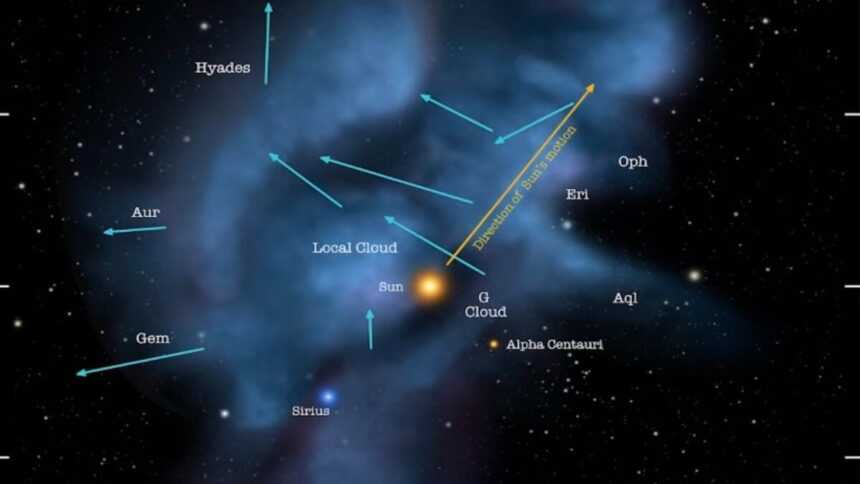
In the early 1990s, the Hubble Space Telescope picked up something odd in the local clouds that surround our solar system. An unusually large number of electrons had been ripped apart from the atoms found in the clouds of gas and dust, a process known as ionization. Now, researchers have traced the ionization of the local interstellar cloud to a close encounter between the Sun and two hot, fast, and massive stars.
In a new study published in The Astrophysical Journal, a group of researchers from the University of Colorado Boulder revealed that two stars raced past our host star 4.4 million years ago, coming as close as 30 light-years away from the Sun. At that distance, the two stars would have been visible from Earth.
In their wake, the stars emitted powerful radiation, which ionized the local clouds surrounding the solar system. The findings help solve a long-standing mystery in our corner of the universe and could also offer new insights into what makes Earth habitable.
Too close for comfort
The researchers behind the study set out to examine the forces that led to the ionization of the local interstellar clouds, simulating what Earth’s neighborhood may have looked like millions of years ago. This proved a difficult task, as the Sun and the solar system are traveling through the galaxy at a speed of 58,000 miles per hour (93,000 kilometers per hour).
“It’s kind of a jigsaw puzzle where all the different pieces are moving,” Michael Shull, an astrophysicist at CU Boulder and lead author of the new study, said in a statement. “The sun is moving. Stars are racing away from us. The clouds are drifting away.”
The team looked closely at two stars in particular: Epsilon Canis Majoris, also known as Adhara, and Beta Canis Majoris, or Mirzam. Both of the stars sit in the constellation Canis Major, and they’re both hot and massive. Epsilon and Beta Canis Majoris are 13 times more massive than the Sun and burn at about 38,000 and 45,000 degrees Fahrenheit (impressively hot compared to the Sun’s temperature of around 10,000 degrees Fahrenheit).
Today, the two stars lie about 400 light-years away from Earth. Based on the study’s simulations, however, the researchers believe Epsilon and Beta Canis Majoris charged past the Sun at a distance between 30 and 35 light-years. That’s around 175 trillion miles (281 trillion kilometers), but it’s extremely close in cosmic terms. Close enough to be visible from Earth.
“If you think back 4.4 million years, these two stars would have been anywhere from four to six times brighter than Sirius is today, far and away the brightest stars in the sky,” Shull said.
The study suggests that this close encounter contributed to the ionization of hydrogen and helium in the clouds surrounding the solar system, reshaping the Sun’s current interstellar environment. According to the researchers, simply being inside these clouds—which can shield the solar system from ionizing radiation—may be one subtle factor that helps keep Earth habitable today.
“The fact that the Sun is inside this set of clouds that can shield us from that ionizing radiation may be an important piece of what makes Earth habitable today,” Shull said.
Read the full article here