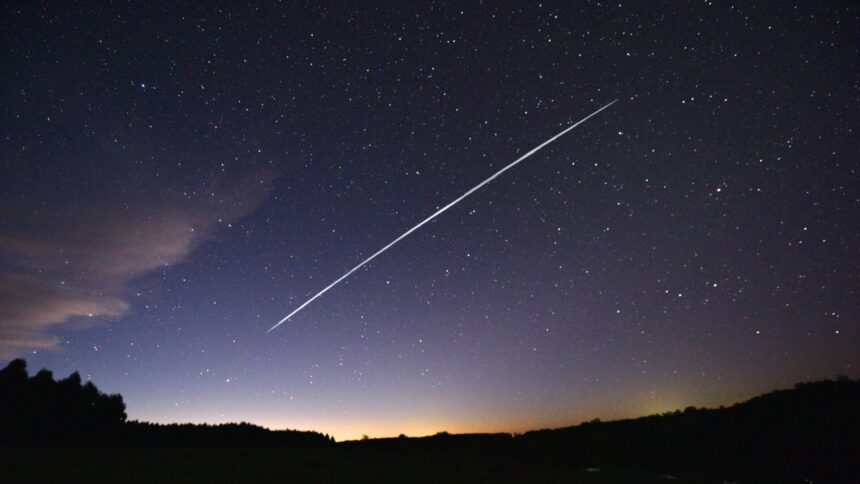
The western part of North America has been treated to an unofficial light show over the last week or so. People in California and Canada have spotted what look like meteorites falling from the sky, but it’s not a space rock that is burning up in the atmosphere—it’s just a sign someone is going to have a slightly slower internet connection. The fiery trails spotted in the sky belong to falling Starlink satellites, and a report from EarthSky suggests we could be seeing them a lot more frequently in the near future.
Currently, about one to two Starlink satellites are falling back to Earth every day from their place in the thermosphere. That’s according to retired Harvard astrophysicist Jonathan McDowell, the author of Jonathan’s Space Report, which keeps track of what is going up into orbit and what is coming down. McDowell maintains a graph that tracks the reentries of Starlink satellites over time, and the frequency of the satellites falling back to Earth is trending up.
In fact, McDowell told EarthSky that he expects the number of satellites burning up in the night’s sky to continue to climb, estimating that there will soon be as many as five per day. That is attributed in no small part to the growing number of satellites operating in Low Earth Orbit (LEO).
And it’s not just Starlink up there—though it’s certainly one of the most prolific satellite purveyors, with more than 8,500 currently in orbit, per McDowell’s detailed records. The astrophysicist told EarthSky that when you add in Amazon Kuiper and other satellite clusters from the US, there will soon be more than 30,000 LEO satellites in operation. That figure nearly doubles once you add in Chinese systems, which McDowell estimates will hit 20,000 satellites soon.
Those LEO satellites typically have a five-year replacement cycle. That means once we hit McDowell’s estimates for these large clusters, the expectation is that about five per day will “retire” from operation and fall from the sky as their lifespan comes to an end. There are conditions that may accelerate that, though. A recent study found that Starlink satellites have been reentering the atmosphere sooner than expected during periods of heightened solar activity. McDowell also warned of the potential for more satellites in the sky to lead to Kessler syndrome, which happens when the density of LEO objects gets so high that collisions become more common, and those collisions produce debris that is likely to cause even more collisions.
Most of those satellites will fall back to earth harmlessly, but it isn’t guaranteed that they all will—especially when their reentry is less controlled. The Federal Aviation Administration released a report warning that by 2035, it expects that every two years, a person will be injured or killed by falling debris. So keep your eyes on the sky, and maybe invest in a helmet.
Read the full article here