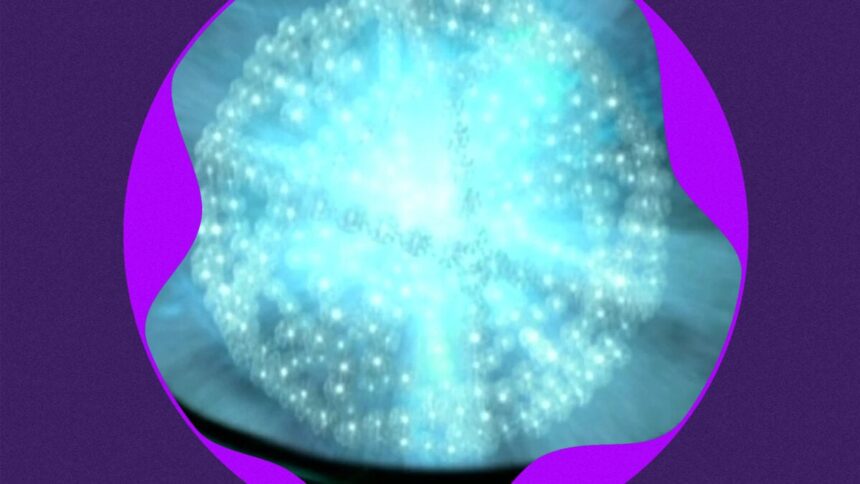
The Star Trek universe has faced many devastating threats—invading powers, wars, cataclysmic natural disasters—and come back from the brink time and time again. But all those conflicts and disasters pale in comparison to the potential of just one singular molecule.
Last week, Starfleet Academy set up its first season finale with the return of one of the rarest and most dangerous ideas that there’s ever been in Star Trek canon: a way to fundamentally obliterate intergalactic society as Trek has known it for a thousand years in an instant. That is, of course, the Omega molecule, an idea first brought up in Star Trek: Voyager as a hidden mystery kept under close wraps by Starfleet for years and, by the time of Starfleet Academy, synthesized and weaponized at the worst possible time to fall into the worst possible hands.
What Is the Omega Molecule?
An unstable particle long believed to be the most powerful substance in known existence, the Omega Molecule was long believed to only exist in theory. A singular molecule of Omega could contain as much energy as an entire warp core, and a handful of them chained could provide almost indefinite energy to an entire planetary civilization.
However, Omega’s issue—when it was actually discovered, rather than simply being consigned to theory and fable—was that it was also incredibly difficult to keep stable. Left unchecked, Omega’s vast energy destabilized with devastating effect, altering the fabric of space itself for light-years beyond the point of explosion. Omega’s violent expulsion of that energy essentially destroyed subspace itself, creating a wide enough rupture that made it impossible for a starship to create a stable warp field in its vicinity. Thus was the peril of Omega: if it could be contained, it could solve energy crises in almost perpetuity. If it couldn’t, it could destroy intergalactic society in an instant.
The History of the Omega Molecule
While the Borg became aware of the Omega molecule by the mid-22nd century—chasing the creation myths of various assimilated species until they successfully stabilized a singular molecule for just one trillionth of a nanosecond before it broke down and destroyed an entire Borg fleet—the Federation wouldn’t be able to prove the existence of Omega until over a century later.
By the late 23rd century, a physicist named Ketteract was researching the theoretical existence and creation of Omega in the Lantaru sector. Ketteract managed to create an Omega molecule, but as with the Borg’s own experiments in the past, it only existed for a fraction of a second: Omega detonated aboard Ketteract’s research station, killing him and the station’s entire staff instantaneously as well as rupturing subspace across the entire sector. Upon realizing the true nature of the damage Omega caused when rescue efforts were impacted by the inability to travel at warp speed in the sector, Starfleet mobilized to cover the accident up entirely as a naturally occurring phenomenon.
What followed was one of the most secretive orders in Starfleet Command, the Omega Directive, giving the molecule its Greek name to represent its nature as the perceived ultimate threat to the Federation’s existence. With much of the Federation led to believe that the Lantaru sector’s ruptures were natural events, shutting the region off from FTL space travel seemingly permanently, Starfleet issued the Omega Directive to only the most senior levels of command, restricting its knowledge to starship captains and other flag officers.
In the presence of a detected Omega molecule, the directive would cause a Starfleet vessel to be knocked out of warp speed and its engines and computer systems locked down—only accessible by the captain, who would personally verify the sensor data and contact Starfleet Command with their discovery. The directive then mandated that the captain destroy the detected Omega at any cost, even superseding the Prime Directive to do so.
Prior to the 32nd century, the last known Starfleet contact with Omega was by the USS Voyager during its displacement in the Delta Quadrant in 2374. The ship came across the remnants of a highly advanced, yet pre-warp civilization that had managed to effectively stabilize millions of Omega molecules in an attempt to solve their energy crises, only for an accident to destroy their facility and rupture subspace around the moon that had stored it. Utilizing prior Borg research leveraged by Seven of Nine, Voyager managed to contain and destroy the remaining Omega molecules and prevent further extensive damage to that region of subspace before continuing its journey home.
What the Omega Molecule Means for Starfleet Academy
Starfleet Academy revealed to us that by 3195, in secret, Starfleet had not only managed to successfully synthesize a form of Omega (dubbed Omega-47, suggesting at least 46 attempts to synthesize it beforehand) but had also effectively weaponized its destabilization, keeping it in storage alongside other weapon projects at a secret research starbase called J-19 Alpha. By that point, Starfleet was also apparently able to have done enough research to know that Omega’s subspace damage could last for millions of years at the very least, if not in perpetuity.
This, as we saw, made the theft of Omega-47 by the pirate faction known as the Venari Ral—and its deployment in a series of mines that effectively created a hard border in space for Federation members that could only be crossed on the threat of an Omega detonation—a crisis for the Federation, even outpacing the then-still-recent aftermath of the Burn.
The Burn had already given the galaxy a taste of what a warp-less intergalactic civilization could look like, and it had almost entirely eradicated the Federation from a point of almost universal reach across the known galaxy to operating broken across a handful of remaining member worlds. But the Burn was a different disaster, a resource crisis that had affected supplies of dilithium: there was no coming back from an Omega detonation, and one weaponized on an interstellar scale could threaten to completely end most known methods of faster-than-light travel virtually forever.
Want more io9 news? Check out when to expect the latest Marvel, Star Wars, and Star Trek releases, what’s next for the DC Universe on film and TV, and everything you need to know about the future of Doctor Who.
Read the full article here