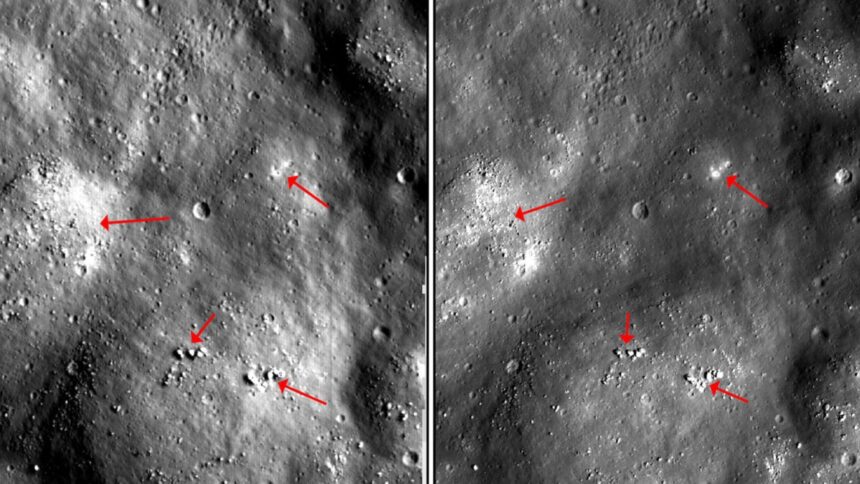
As NASA prepares to establish a sustainable base where astronauts can live and work on the Moon, recent images of the lunar surface may deal a blow to efforts to find the resources needed to make it happen.
Scientists have been collecting a growing body of evidence that there’s water on the Moon in the form of ice hidden in areas that never receive light from the Sun. To test that theory, a team of astronomers from the University of Hawaii looked at high-resolution images of the Moon’s permanently shadowed regions in hopes of finding water. The search, however, turned up empty, casting doubt on the abundance of water as a lunar resource.
The findings are detailed in a new study published in Science Advances.
Cold as ice
The Moon’s axis tilts by only 1.5 degrees relative to the ecliptic plane (Earth’s orbital plane around the Sun). As a result, the floors of craters near the lunar south pole never receive any direct sunlight. Any water that may have found its way to those permanently shadowed regions could stay there for long periods in the form of ice.
Several lunar missions, such as NASA’s Lunar Prospector and India’s Chandrayaan-1, have found evidence for signatures of water ice at the Moon’s poles. Since water is a primary resource for NASA’s plans to develop a sustainable presence on the Moon, finding sufficient amounts of it on the lunar surface has become crucial.
For the new study, the team of scientists relied on a hypersensitive optical camera called ShadowCam. NASA’s ShadowCam is on board the Korea Pathfinder Lunar Orbiter, which launched to the Moon in 2022.
To detect water ice, the researchers looked for two of its optical properties that would appear in images. Compared to lunar regolith, ice is more reflective at visible wavelengths. It’s also more strongly forward-scattering, meaning that it can be detected by pointing the camera in different directions and measuring how the surface brightness changes with each angle.
Nothing to see here
Unfortunately for the scientists hoping to see a glimpse of the water ice on the Moon, the images showed no signs of it in any of the permanently shadowed regions observed by the orbiter.
This doesn’t rule out the presence of water ice on the Moon altogether. The ice on the Moon is unlikely to be pure. Instead, it’s probably mixed with the lunar regolith at varying proportions that would affect how it appears in the images. For ShadowCam to be able to reliably detect the ice, it has to make up about 20% to 30% of the surface mixture.
The team behind the study notes that some previous measurements could be consistent with the presence of about 10% water ice levels, which wouldn’t have been detected by ShadowCam.
During upcoming attempts to search for water ice on the Moon, the team is hoping to push the detection threshold to as low as 1% ice in the surface mixture. There may still be some water on the Moon; it just might be a lot harder to find.
Read the full article here