
The $600 MacBook Neo is the best budget laptop we’ve tested here at Gizmodo. Despite its limited RAM and SSD storage, Apple’s new entry-level laptop is so good for the price that it’s already making PC makers panic. The largest names in PCs know they need to respond, but the lingering questions are how and when.
Speaking on Asus’ latest earnings call (translated from Chinese for investors) on Tuesday, Nick Wu, the company’s chief financial officer, said the MacBook Neo “is certainly a shock to the entire market.” Wu also added that “all PC vendors, including upstream vendors like Microsoft, Intel, and AMD” are taking the MacBook Neo “very seriously.”
See MacBook Neo at Amazon
PC makers will have to contend with memory prices
The Asus CFO said the MacBook Neo’s specs “had some limitations,” including the non-upgradable 8GB of unified memory and limited 256GB of base storage. But it’s not like Asus and other PC makers aren’t guilty of selling laptops with memory soldered to the board, too, which makes their machines equally as non-upgradeable in the future.
Packing more RAM into their budget laptops is one way to make the MacBook Neo look underpowered and insufficient. But while PC makers have mostly standardized around 16GB of RAM, the rising costs of memory may prevent them from doing so. Meanwhile, the increasing prices for laptops just to keep pace aren’t helping make budget PC laptops more attractive, either.
“We just need more time,” Wu said, addressing when PC makers might be able to respond to Apple’s budget-defining laptop.
The “unified memory” difference
As somebody who has actively used the MacBook Neo for the past week, there were few rare moments where I felt the limitations of 8GB of RAM coming to bite me. The laptop only buckled when I ran several intensive apps with a connected external display or benchmarked its rendering capabilities.
8GB on a spec sheet may seem like very little, but it’s not exactly a one-to-one comparison with a similar low-end PC laptop. The MacBook Neo uses “unified memory” instead of traditional RAM modules that are plugged into the motherboard. This means the memory is shared between the CPU and GPU components, leading to better efficiency. macOS also makes use of a feature called “swap memory,” which uses some of the SSD as virtual memory when the unified memory is full, so you technically have access to additional memory when you really need it. That’s why so many reviewers are finding 8GB of RAM more than able to handle a ton of apps.
The moment I realized I was going need to find a tougher test for the MacBook Neo😳 pic.twitter.com/QguwCp3BzQ
— Tyler Stalman (@stalman) March 10, 2026
Microsoft needs to fix Windows for low-cost laptops
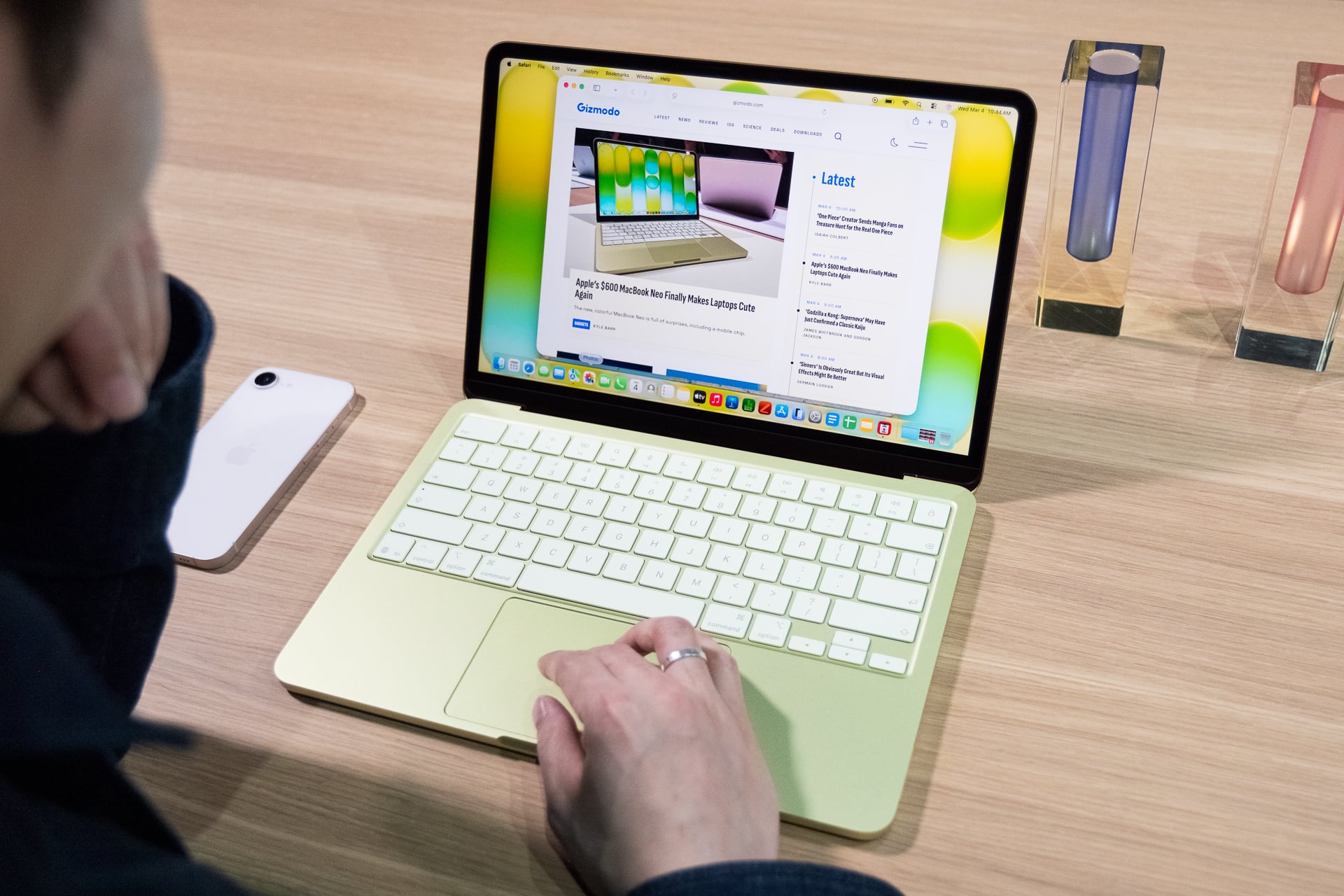
While the Asus exec implied that PC buyers may be looking for something more robust across their laptops—with better chips and more memory for more intensive tasks—it’s clear from reactions by both the media and consumers that there’s a demand for low-cost laptops that don’t feel cheap. Apple had to make a number of tradeoffs to bring the MacBook Neo’s price down. And still, it’s offering an all-aluminum chassis with a vibrant display, quality speakers, and enough performance for regular day-to-day tasks. There are few Windows laptops or Chromebooks that can claim the same at a similar price point.
Apple also has the advantage of chip design. The MacBook Neo uses an A18 Pro, a chip first built for the iPhone 16 Pro. And yet, in our tests, the A18 Pro still outperforms low-end Intel Core 5 CPUs and even Apple’s M1 MacBook Air from five years ago. Moreover, it’s the MacBook Neo’s overall build quality that should concern PC makers the most. While Apple owns the majority of its tech stack, down to its Wi-Fi and Bluetooth connectivity chip, PC makers still need to source most of their components from elsewhere. They also have to pay Microsoft for Windows 11 licenses, a cost that inevitably gets passed to the consumer.
Windows 11 has been increasingly problematic on lower-end PCs. New installs of Microsoft’s main operating system also install extra apps like 365 office apps, OneDrive, and Copilot. While most of these apps aren’t resource intensive, they take up precious storage space and inundate the system with pop-ups. Users have to manually keep programs like OneDrive from auto-running on startup through the Task Manager or apps like Microsoft’s own Autoruns.
Microsoft needs to step up and remediate Windows’ pain points. Earlier this year, company leadership promised to deemphasize Copilot AI and add in long-requested features like a movable taskbar. Sure, the panic is only just setting in, but it’s clear that Apple is going to enjoy an early lead with the MacBook Neo before any PC maker has time to catch up.
See MacBook Neo at Amazon
Read the full article here