The tech industry’s “VR is really going to happen” push comes around roughly once a decade. And while this generation’s devices—the Meta Quest, Apple Vision Pro, etc—are certainly the most technologically advanced yet, you might be surprised by the results that previous attempts at VR were able to achieve.
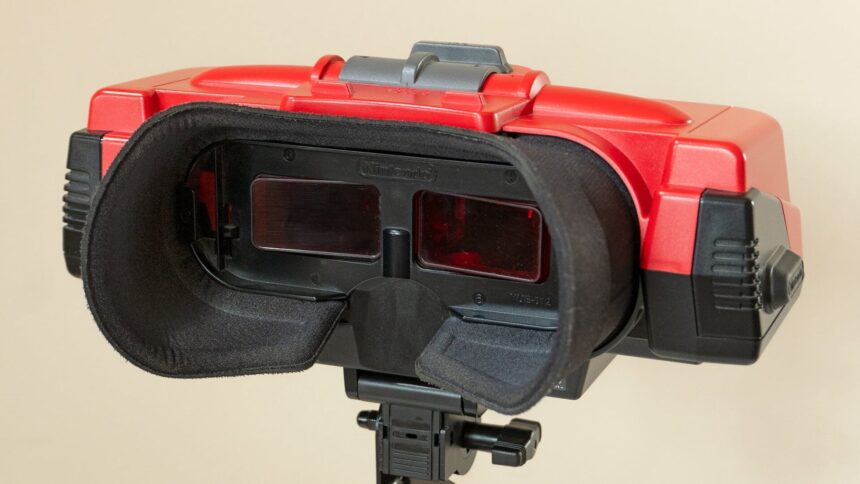
Take, for example, the Virtual Boy, a disastrous Nintendo console released in 1995. You might wonder how on earth 1995 technology managed to create any sort of illusion of VR. Well, in a fascinating video, Gavin Free—one half of YouTube veterans the Slo-Mo Guys—looks at how the Virtual Boy worked, and it turns out that the technology was genuinely ingenious.
If you’re only familiar with modern-era headsets, you might have trouble even recognizing the Virtual Boy as a VR device. For a start, it’s not a headset; instead, it’s a table-mounted device into which you peered in the same way that you might look into a kaleidoscope or a View-Master.
The difference between today’s approach to VR and that used in 1995 goes further than aesthetics and ergonomics, too. Instead of trying to render and display a full-blown 3D environment, which is a task that even today’s headsets find to be a struggle, the Virtual Boy did something extremely clever: it let the viewer’s eyes and brain do most of the work.
The magic starts with the Virtual Boy’s two displays—one for each eye—which had a resolution of 1 x 224. No, that wasn’t a typo—each display really is precisely one pixel wide. They’re also very small, only about 0.4 inches high, with two large lenses magnifying their output for the viewer to see. Each of the displays sits perpendicular to the front of the device; their output is redirected toward the viewer by two mirrors, each of which sits at an angle of about 45° to the display.
I say “about 45°” because the key point here is that the mirrors move. They move very fast, in fact, oscillating 50 times a second. As they move, it appears to the viewer that the column of pixels is panning back and forth across their field of vision. The effect is like watching an old cathode ray TV, where the image you see is created by an electron gun scanning back and forth rapidly as it fires a beam of electrons at the screen.
The use of two separate displays also allowed the Virtual Boy to create the illusion of a 3D image. It did so in a similar way to today’s headsets, which is by showing the image to each eye from a slightly different perspective.
There were limitations, of course. As the displays use only red LEDs, the image is monochrome, which no doubt saved on processing power. However, Free also points out that to display full color, the Virtual Boy would have required blue LEDs, which are actually a relatively recent technology. (The story of the blue LED is a fascinating subject in and of itself.)
Anyway, despite its ingenuity, the Virtual Boy was a commercial failure—reviewers complained about eye strain and dizziness, and it was discontinued only a year after its release, and only 22 titles were ever released for it. It seems the world wasn’t ready for VR in 1995, either.
Read the full article here