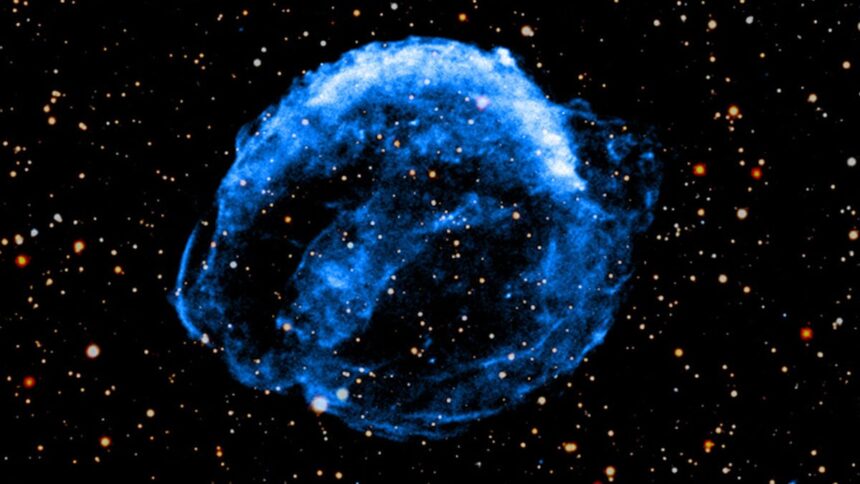
A mind-blowing video shows the remnant of an ancient cosmic explosion bleeding out into the universe, pushing against gas and other material, over the span of more than two decades.
NASA’s Chandra X-ray Observatory has captured 25 years’ worth of observations of Kepler’s supernova remnant, revealing the glowing debris field as it grows over time. Astronomers gathered X-ray data from 2000 to 2025 to create a stunning timelapse video, allowing them to visualize how supernovas develop over time and creep into their surrounding environments.
Ancient remains
In the video, the ring of debris expands through five datasets captured in 2000, 2004, 2006, 2014, and 2025. The debris field glows in X-ray light, appearing as a bright neon bubble that’s slowly expanding with time. As it grows, it crashes into material that’s already been tossed into deep space.
The remnant is located in the Milky Way galaxy, about 17,000 light-years from Earth, close enough for astronomers to observe its evolution in real time.
By observing the supernova remnant, researchers have determined that the debris is traveling at about 13.8 million miles per hour, or 2% of the speed of light, toward the bottom of the image. The expanding bubble is traveling at a slower rate at the top of the image, at about 4 million miles per hour, or 0.5% of the speed of light. The significant difference in speed may be due to denser gas at the top of the image, which slows the debris more than the thinner gas toward the bottom.
“The plot of Kepler’s story is just now beginning to unfold,” Jessye Gassel, a graduate student at George Mason University in Virginia, who led the research, said in a statement. “It’s remarkable that we can watch as these remains from this shattered star crash into material already thrown out into space.”
Death of a star
Kepler’s supernova remnant was once a white dwarf star that exploded after exceeding its critical mass. It may have been triggered by an interaction with a red giant star, which caused the white dwarf to gain too much mass, thereby resulting in a massive thermonuclear explosion.
German astronomer Johannes Kepler discovered the stellar explosion in 1604, and it remains the last supernova in the Milky Way visible to the naked eye. Kepler’s supernova remnant is classified as a type Ia supernova, which serves as a crucial measurement for cosmic distances and tracking the expansion rate of the universe.
“Supernova explosions and the elements they hurl into space are the lifeblood of new stars and planets,” Brian Williams, an astrophysicist at NASA’s Goddard Space Flight Center in Greenbelt, Maryland, and principal investigator of the new Chandra observations of Kepler, said in a statement. “Understanding exactly how they behave is crucial to knowing our cosmic history.”
Read the full article here