
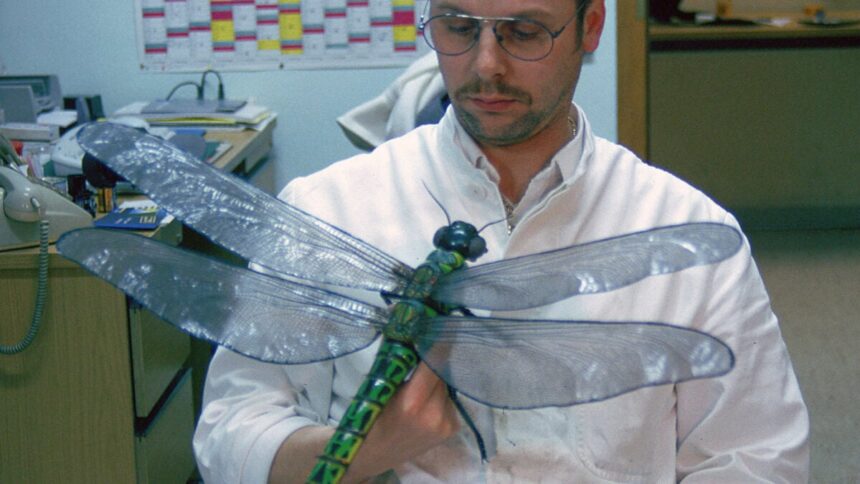
About 350 million years ago, dragonflies were roughly 27 inches (70 centimeters) wide. Scientific consensus is that high oxygen levels allowed these humongous fliers to exist, but a new study throws that idea into question.
In 1995, a Nature paper introduced a hypothesis that a period of high atmospheric oxygen was what allowed insects to grow so huge. That remained the consensus for a good 30 years, until—incidentally, also in Nature—an international team of researchers uncovered strong evidence that the flight muscles of insects are not constrained by atmospheric oxygen levels. The latest paper, published yesterday, potentially overturns this “textbook” theory on giant ancient insects—meaning that insect gigantism now returns to the basket of unsolved mysteries about ancient creatures.
If the new study is valid, there is “no physiological reason why insects the size of griffinflies could not fly in today’s atmosphere,” the researchers wrote in a column about the work for The Conversation. “And yet they don’t exist today.”
The giant bug-o-sphere
According to the new paper, it’s a “broadly accepted paradigm that oxygen enabled the evolution of complex life.” That led researchers to consider whether levels of oxygen in the atmosphere, which has changed throughout Earth’s history, would effectively “constrain” the evolution of body size for different species.
Throughout the 20th century, researchers discovered multiple fossils of giant insects with incomprehensibly wide wingspans. One of these was the griffinfly, which was later found to have lived in a time when Earth’s atmospheric oxygen levels were 9% higher than that today.
At the time, it made a lot of sense to assume that the two variables—the griffinfly’s size and higher oxygen levels—were connected, since the giant bugs “required these high external oxygen levels to power the rapid burn of energy during flight,” the team wrote in its column. Staying airborne requires that the flier defy gravity, so to speak, and the “rate of oxygen consumption increases roughly in proportion to the weight of the flier,” the researchers added.
Untapped flight potential
But the team wondered if insects could self-supply that oxygen demand, given how they have a unique biological, tree-like mechanism called the tracheal system. This structure delivers oxygen to insect flight muscles via a network of air-filled tubes called tracheoles, the development for which previous research confirmed was “heritable” and “highly plastic,” the paper noted.
The team arrived at this hypothesis during a separate investigation on the flight muscles of locusts, which revealed that tracheoles took up a measly 1% of the muscle fibers. The researchers then measured 44 species of flying insects across different sizes, taking 1,320 microscopic photos over five years.
Their results showed that this strangely low investment in tracheoles was quite common in flying insects. For context, a different organ with similar functions in birds and mammals occupies “about ten times the relative space,” Roger Seymour, the study’s senior author and a biologist at Adelaide University in Australia, said in a statement.
“This shows there is plenty of scope to increase the number and volume of tracheoles without weakening the muscle,” the team wrote in the column. “The conclusion is that the body size of flying insects has never been limited by the structure or function of their tracheal systems.”
Reopening a closed case?
If the findings are confirmed, this means that, theoretically speaking, there’s no reason that the griffinfly “could not survive in today’s atmosphere,” the team wrote. Given the physiological potential of flying insects, the ginormous flappers could simply compensate for lower atmospheric oxygen by growing more tracheoles.
But the team adds in the statement that the theory of oxygen constraining insect size isn’t “dead yet,” as it’s still possible that other physiological factors could be limited by oxygen levels. However, the findings strongly suggest researchers should “look elsewhere for why these giants existed,” according to the statement.
“The simpler reasons may be that larger animal species are more prone to extinction than smaller ones,” the team wrote. “300 million years ago, the griffinfly had no bird or mammal predators to watch out for.”
The griffinfly and its extra-large contemporaries may be long gone, but their legacy continues to uncover some fascinating insights into the versatility of insect biology.
Read the full article here