To fulfill its promise of reaching the Moon and Mars, SpaceX needs a really big rocket. Like, really big. The latest version of Starship is the largest and most powerful megarocket ever built, and it just hit a critical milestone.
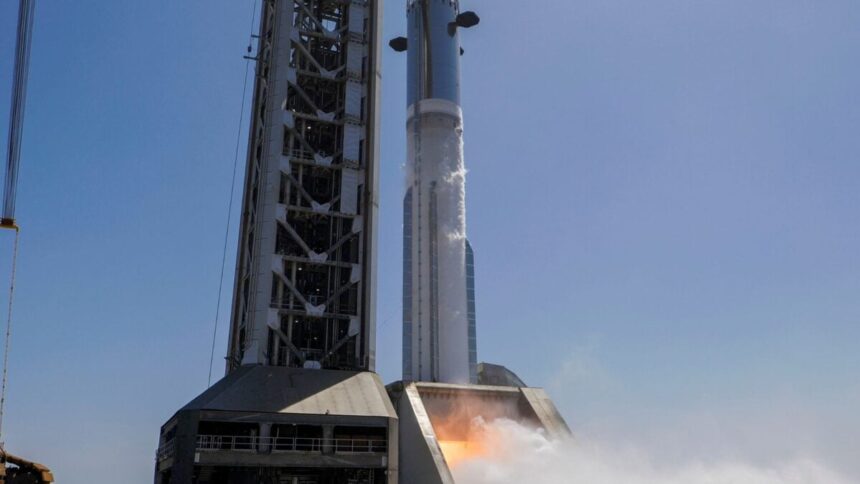
On Wednesday, SpaceX concluded the first static fire test of Starship Version 3. Engineers briefly fired Booster 19’s engines on Launch Pad 2 at the company’s Starbase launch site in South Texas. This was not only the first major test for Starship V3, but also the first time the rocket’s Raptor 3 engines have been fired together—and the first static test conducted on the newly constructed Pad 2.
A cryptic X post from SpaceX CEO Elon Musk previously suggested Starship V3 could embark on its first test flight—Flight 12—in early March. Clearly, that didn’t happen. On March 7, Musk amended his earlier statement, saying the megarocket will lift off for the first time in about four weeks. That pushed the launch to April, and if all further testing proceeds as planned, this seems feasible.
Gearing up to launch
Over several days of testing, engineers loaded cryogenic fuel and oxidizer into Booster 19 for the first time. During the static fire test, they successfully fired 10 of the booster’s Raptor engines but terminated the burn early due to an unspecified ground systems issue, according to SpaceX. The burn only lasted about one second, though the vehicle was safely detanked afterward, NASASpaceFlight reports.
Following the test, the booster rolled back to the Mega Bay 1 assembly facility. Over the next few weeks, engineers will inspect Booster 19 and install additional engines to prepare for a 33-engine static fire test, which will evaluate the booster’s propulsion system in its final configuration. In the meantime, the rocket’s upper stage—Ship 39—will likely undergo its own static fire test at Starbase’s Massey site.
Ship 39 recently passed a cryoproofing test, which evaluated the vehicle’s redesigned propellant system and structural strength. Engineers also performed “squeeze” tests to simulate the forces the rocket will experience when the chopstick arms of SpaceX’s Mechazilla launch tower catch it during descent.
Completing the static fire test is the last major milestone Ship 39 needs to complete before launch. Engineers will fire all six of the upper stage’s Raptor engines, and if the burn goes according to plan, Ship 39 will likely return to the Mega Bay for final inspections while Booster 19 completes its testing. Once both stages are good to go, stacking will commence for Flight 12.
A long road ahead
SpaceX has a lot riding on Starship V3, as this latest and greatest iteration will be the first to fly to the Moon and Mars. A modified version of the megarocket’s upper stage, called the Starship Human Landing System, could be the lander that returns NASA astronauts to the Moon for the Artemis 4 mission.
But the road from first launch to human-rating certification is arduous—especially when testing the biggest, most complex rocket in history. There are bound to be some explosive failures during Starship V3’s test flights. SpaceX’s ability to identify and fix issues quickly enough to stay on NASA’s tight Artemis schedule may be one of its greatest challenges yet.
Read the full article here