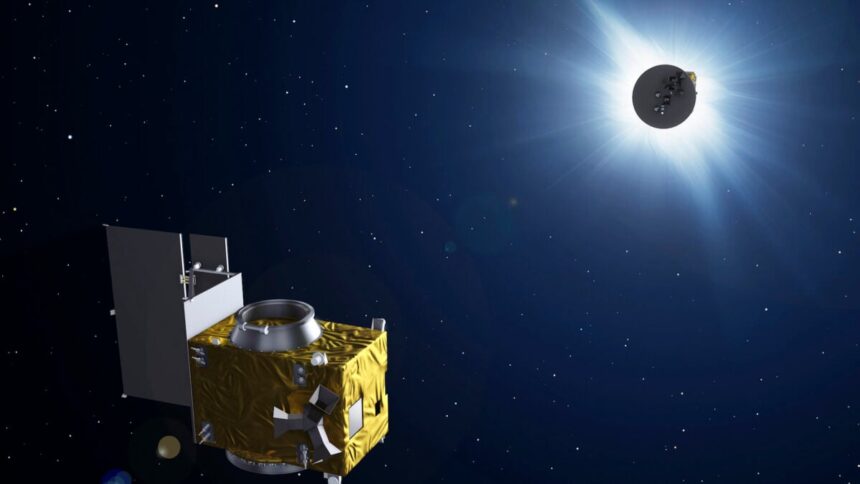
A pair of spacecraft has been flying in formation, creating an artificial solar eclipse to help scientists probe the elusive outermost part of the Sun’s atmosphere. For the past month, however, one of the spacecraft has been silent after suffering an in-flight anomaly, leaving its partner hanging. But now, the probe has finally phoned home and may be ready to resume operations soon.
The European Space Agency’s (ESA) Proba-3 mission recently reestablished connection with ground control. After a month of silence, the agency’s ground station in Villafranca, Spain, received telemetry data from the Proba-3 Coronagraph spacecraft.
“Hearing back from the Coronagraph is amazing news, and a great relief!” Damien Galano, Proba-3 mission manager, said in a statement. “When we got the call from the operators at Villafranca, the excitement in the team was palpable.”
It’s alive!
ESA’s Proba-3 satellites, the Occulter and the Coronagraph, launched in December 2024. Around six months later, the pair created the world’s first artificial total solar eclipse using their unique precision formation flying.
For the past month, the Coronagraph has been silently floating in space, exposed to the extreme cold of the harsh environment. After receiving a signal from the spacecraft, the team was able to gather initial data on its temperature, voltages, and health of onboard systems.
The spacecraft is currently in safe mode and stable, but mission teams are running health checks on Coronagraph to understand if any parts of it have been damaged, according to ESA.
“Since the issue was detected a month ago, the mission team, operators and our industry partners have been working tirelessly to get the spacecraft back,” Galano said in a statement. “But the hard work is not over yet—we need to carefully look at the data before we take any further steps.”
Coronagraph may need to warm up a bit before getting back into action. As it remains in safe mode, the spacecraft’s solar panel is facing the Sun to power the electronics on board and charge the battery with the remaining power.
A solar eclipse of the heart
The two satellites launched to an extremely elliptical orbit around Earth, flying at a distance of 492 feet (150 meters) from one another. The satellites have to maintain that distance with an accuracy down to a single millimeter in order to pull off the mission.
During the in-sync formation flying, the pair form one giant virtual telescope, with one casting a precisely controlled shadow on the other, blocking out the Sun’s light from view so that the other spacecraft, equipped with an optical instrument, can view the star’s corona.
The spacecraft take 19 hours and 36 minutes to complete one orbit around Earth, carrying out observations of the Sun’s corona during a six-hour window of each orbit. The corona, the outermost region of the Sun’s atmosphere, is a million times fainter than the star and extends millions of miles into space.
Observing the corona will help scientists resolve some of the biggest mysteries related to our host star, namely, how the outermost parts of its atmosphere are 200 times hotter than temperatures on the surface. The Sun’s corona also drives solar wind and coronal mass ejections, two main components that govern space weather.
Aside from the groundbreaking solar science, the spacecraft’s ability to create an artificial eclipse is an amazing technological feat within itself. Hopefully, the Coronagraph will be back to synchronized flying with its partner soon.
Read the full article here