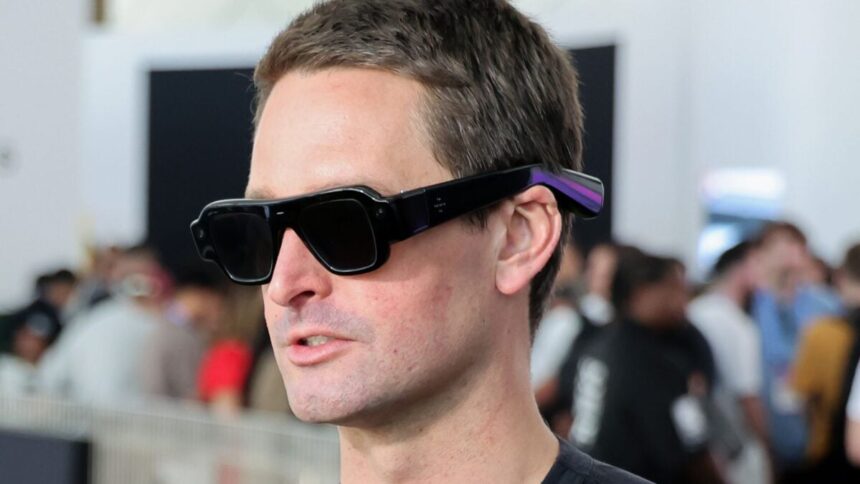
For most people, Snap’s Specs feel like a new phenomenon, but for Snap CEO Evan Spiegel, the launch of the company’s $2,200 AR glasses has been at least a decade in the making.
Back in 2016, Snap launched its first pair of glasses, the more verbosely named Spectacles, and despite sharing a similar nomenclature with Specs AR glasses, the original Snap glasses were a shell of what it’s launched now. The Spectacles of yore were akin to what Meta currently refers to as AI glasses: a pair of smart glasses with Bluetooth, Wi-Fi, and cameras, though lacking the AI part and the computer vision behind it.
Spectacles were more of a wearables experiment and a conduit for capturing media, or in Snap’s case, a pipeline to get you to use Snapchat. They were, and still are, an accessory over a true, dedicated face computer.
Fast forward to right about now, and the calculus has changed dramatically, and with that shift come some lofty new ambitions. Snap’s Specs aren’t really smart glasses. In fact, when I talked to Snap’s Head of Specs Studio, Ben Feuerstein, he was pretty adamant about the distinction.
“One of the big things with Specs that we want people to understand is that these are not smart glasses,” Feuerstein told me. “This is a computer built into a pair of augmented reality glasses.”
I tend to agree. The new Specs are ambitious. For one, they don’t rely on a separate device for computing (such as your phone), nor do they rely on a puck like Xreal and Google’s upcoming Aura glasses. This is a standalone machine. You put Specs on, and you’re on Snap’s platform. No iOS, Android, or any other tech giant’s software for Snap to barter with. No one but Snap to make or break the Specs experience.
Secondly, the Specs aren’t just a way of delivering Bluetooth audio and face-worn photo/video capture—they’re a headset shoved into a glasses-like form factor. Specs, as I had the chance to witness, can impose virtual stuff onto your environment in a similar fashion to Meta’s Quest headset. Sure, it can’t do VR, nor is it as performant or as sophisticated as an XR machine like a full-blown headset, but the ethos is there. Headsets, in many ways, are the more apt analog to Specs in 2026, not smart glasses.
The ambition of what Snap is doing with Specs can’t be overstated. While there are other hopefuls in the AR glasses space, like TCL’s RayNeo and lesser-known companies like Inmo, few companies have had the guts to actually launch a product like Specs into the world. Even Meta has only shown prototypes of its own AR glasses called Project Orion, and the roadmap for that piece of hardware is still firmly in the future—potentially as far off as 2030.

Snap is shooting for the wearable stars once again, and with that pioneering spirit come the same pitfalls, along with quite a few new ones.
For one, there’s the money. As high a price as $2,200 might seem for a pair of AR glasses, the cost of crafting these devices is likely much higher. In 2024, Meta said that Orion cost the company $10,000 per unit to make. While Snap hasn’t publicly disclosed how much Snap Specs cost to make, you can bet every non-AR dollar you have that they’re not going to be punching these things out like candy bars.
To help shoulder the cost of that production and Snap’s AR ambitions, it recently spun out Specs from its main business, Snapchat. Now Specs can raise money instead of solely relying on the Snapchat bank and its flow of advertising revenue.
Unlike Meta and its Reality Labs division, which has racked up $80 billion in operating losses since 2020, Snap doesn’t appear to be too keen on pushing the AR boulder up the hill entirely on its own. Maybe it’s not even capable of doing so. Either way, Snap is seeking outside help from investors, which is undoubtedly a force multiplier for expectations. And that’s a key word here—expectations.
As fun and ambitious as Specs are as a concept, there’s one aspect that makes the glasses a little less whimsical: the price tag. At $2,200, Specs are a serious investment, and if you’re going out and buying a pair, your expectations of what the glasses can do might match that cost. Hell, you might even be expecting perfection for that price, which is not something that AR glasses are currently known for.
In my initial testing, Snap’s Specs do feel like the most compelling AR glasses out there. My time with Specs was fairly brief, but the ease of use, the breadth of the ecosystem, and the size, weight, and functionality are all leaps and bounds better than similar gadgets like the RayNeo X3 Pro. But most people don’t have that context, and when they try on Specs, that experience will be their sole frame of reference.

Can Snap meet consumers’ expectations, however high, and create a quick, positive impression? I don’t know. What I do know is that it’s not going to be easy, and there’s a chance that Snap’s time to make that positive rapport with consumers is running out.
Snap has been in the AR game for a long time, and while its head is in the right space, it’s not sharing in the nascent success of companies like Meta, which has managed to sell millions of pairs of its smart glasses. However early to the race Snap has been, it’s actually looking at a major gap to close, and races, as we all know, don’t go on forever.
Snap has plenty of competition now. Despite being one of the first to market with a pair of AR glasses, Meta is already looking in the same direction, and devices like Xreal’s Aura glasses, which are powered by Google and its Android XR platform, suggest that Google could be, too. It’s one thing for Snap to outflex RayNeo in the AR glasses space, but it’s another to eclipse companies of that scale.
The clock is ticking. After my demo, I think Snap has genuine value to offer people in a growing niche of AR hardware, but it’s not my interest that Snap should be worried about; it’s the droves of people out there who think disappearing pictures and videos are still the only thing that Snap has to offer.
Read the full article here