For obvious reasons, tracking space weather events from long ago is extremely difficult—unless we’re talking about extremely powerful, out-of-the-ordinary occurrences. But for understanding broader weather patterns, these rarities aren’t the most ideal markers. So, scientists tried turning to an unexpected source for help: poetry.
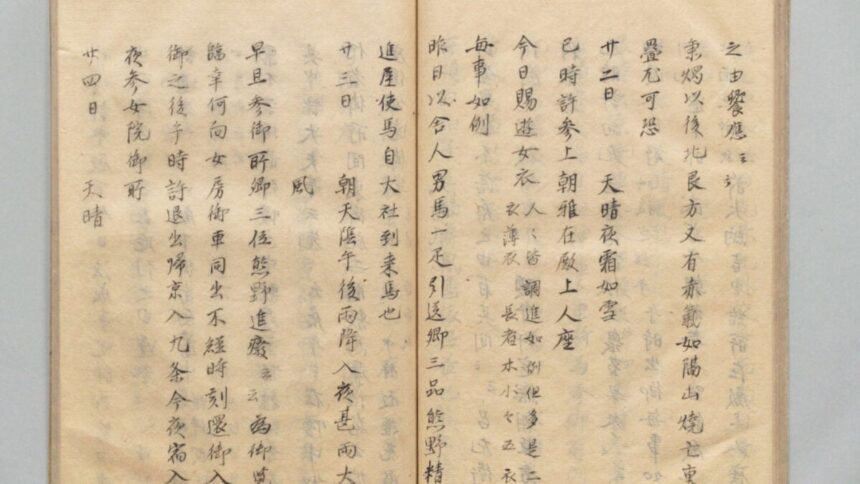
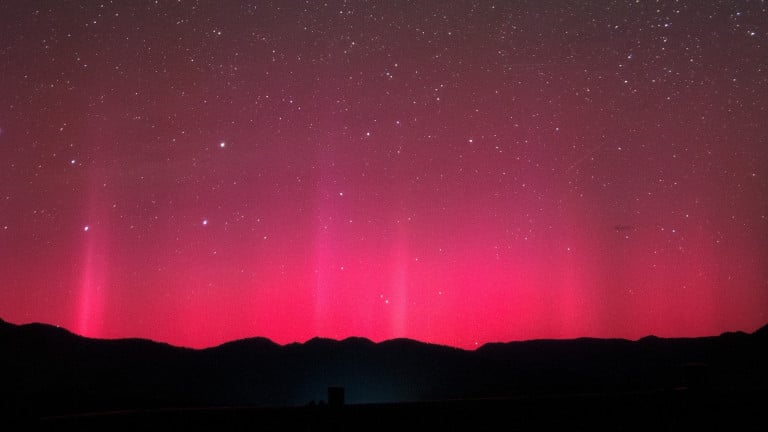
In the winter of 1204, Fujiwara no Teika, a renowned Japanese poet, wrote about “red lights in the northern sky over Kyoto” over three nights. Researchers at the Okinawa Institute of Science and Technology (OIST) in Japan decided to perform ultra-precise carbon dating of buried trees from that period. Their analysis, published today in the Proceedings of the Japan Academy, Series B, revealed a peak in solar activity between 1200 and 1205 CE, demonstrating the potential of historical literature in the study of space weather patterns from long ago.
“The high-precision data not only allowed us to accurately date sub-extreme solar proton events, but it also let us clearly reconstruct the solar cycles of the period,” Hiroko Miyahara, the study’s lead author and a physicist at OIST, said in a statement.
Easier said than done
Technically speaking, existing tools are quite capable of characterizing carbon-14 spikes in tree rings, which represent solid physical evidence of powerful solar events. The team behind the new findings took a step further, spending 10 years to perfect a method to collect ultra-precise measurements of carbon-14 content in organic material.
But an (arguably) bigger issue was deciding on which period of historical time—over 10,000 years—would give them the best bang for their buck. It didn’t help that the method, as capable as it was, took a lot of time and effort to execute. What’s more, the team wanted to study weaker occurrences of solar proton events (SPEs), during which high-energy particles slam Earth at up to 90% of the speed of light. While these “sub-extreme” SPEs aren’t as damaging, they still happen more often and potentially pose risks to space missions, the researchers explained.
History saves the present
And so, the researchers turned to historical records. In addition to Teika, the team found Chinese and French documents from around the same time noting similar observations. Ancient astronomical records from Korea and China also described sunspots and red auroral activity with consistent frequency between 1193 and 1258 CE. This indicated that East Asian scholars noticed increased solar activity in this time, according to the paper.
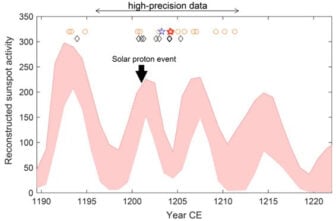
Based on this preliminary analysis, the team gathered carbon-14 data from asunaro trees buried in northern Japan. SPEs tend to trigger a ripple of high-energy particles propagating throughout Earth’s atmosphere, and some particles collide with atmospheric gases, creating carbon-14 compounds, which get incorporated into CO2 and absorbed by trees during photosynthesis. As expected, the team confirmed an “abrupt jump” in carbon-14 content, which they dated to sometime between 1200 and 1201 CE.
While that timeframe doesn’t exactly match Teika’s observation of auroras, one Chinese record does explicitly refer to a red, low-latitude aurora precisely in that year, the team explained in the paper. But Teika’s writings are still consistent with the overall increase in solar activity around this time.
The medieval solar cycle
The wholesale review and comparison of historical records allowed the researchers to reconstruct the solar cycles between 1190 and 1220. Fascinatingly, the analysis suggested that solar cycles in the 13th century lasted between seven and eight years, as opposed to the 11 we know today.
The work “helps to build the picture of past solar activity far back beyond the measured and observational record,” Charlotte Pearson, a dendrochronologist at the University of Arizona who wasn’t involved in the study, told Scientific American. “What is especially cool about it is that you get two records for the price of one—you get solar events and solar cycles in year-to-year detail.”
“Integrated approaches like these are necessary to accurately reconstruct past solar activity, helping us better understand the characteristics of extreme space weather,” Miyahara said. “For example, while the SPE we found occurred near the peak of the solar cycle, some of the prolonged low-latitude aurora recorded in the literature seems to fall near the minimum of our reconstructed solar cycle. This is unexpected, and we’re excited to look further into what solar conditions could cause this.”
Read the full article here