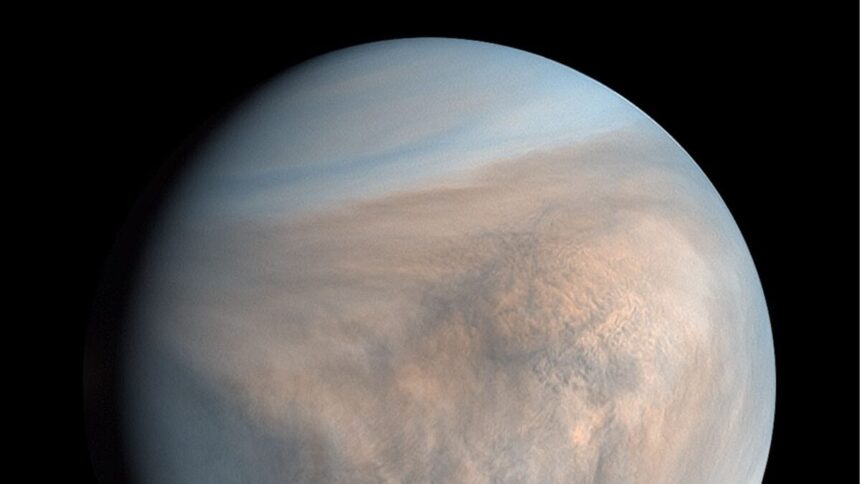
Acid clouds: This is not just a genre of house music someone ten years older than you, or younger than you, will claim exists. Swirling above the hellish surface of Earth’s nearest neighbor Venus, a surface where the average temperature could melt lead and even some aluminum alloys, layers of “superrotating” sulfuric acid clouds roil with the energy generated by the planet’s runaway greenhouse gas effect.
The prospect that extraterrestrial microbes might somehow be able to call this caustic storm of an atmosphere home has galvanized scientists from NASA and elsewhere across the world—but now researchers at MIT have demonstrated a powerful confirmation of this possibility in the lab. Chemists and planetary scientists at the university have subjected peptides, molecules that can act as biochemical signaling mechanisms in organic life, to extreme concentrations of sulfuric acid, 98% by weight. MIT’s team confirmed that at least three of these peptides can retain a well-defined and stable structure under these harsh conditions for weeks on end.
“If peptides find their way to that cloud layer of concentrated sulfuric acid, they will stay and be stably preserved in that cloud of droplets,” MIT chemist Mei Hong, a senior author on the new study, said in a statement.
“And once these macromolecules have a defined three-dimensional structure, they can potentially have a function.”
The interplanetary Venus-cloud acid test
Part of what’s so intriguing about this experiment is that NASA researchers have already found evidence that peptides—which can serve as building blocks for proteins—do form in space, with one example present inside the ancient Murchison meteorite. Careening space rocks like Murchison have crash landed into planets across our solar system for billions of years, likely seeding the early Earth and its neighbors with some of the key organic molecules needed to foster life.
Previously, MIT planetary scientist Sara Seager and her collaborators confirmed in the lab that smaller, biologically significant molecules, including lipids, amino acids, and nucleic acids, like those found in DNA, could withstand similarly acidic conditions. Seager’s team began working with Hong’s lab to rerun these tests against peptides due to Hong’s expertise in advanced nuclear magnetic resonance (NMR) spectroscopy for the study of biological macromolecules.
“NMR spectroscopy is ideally suited for studying peptides in concentrated sulfuric acid, because site-specific measurements […] are unaffected by the solvent,” as the team explained in its new study, published this month in the Proceedings of the National Academy of Sciences.
Three peptides, HHQ, HHQ13, and K7, proved to be surprisingly at home in sulfuric acid. In fact, molecules of the acid appeared to act as scaffolding for the creation of so-called “omega loop” shapes similar to the geometry of some proteins: a compelling indicator (arguably) that promising biochemistry could be wafting around the acid clouds of Venus.
Life as we don’t know it
Hong suspects that a lack of water, which plays a key role reacting with sulfuric acid to dissolve peptides, most likely explains these compounds’ stability and fascinating 3D shapes under Venus-like conditions.
“Without water, an acid that you would consider a harsh solvent suddenly is not as menacing as one might think,” Hong opined. (Perhaps needless to say, any life that evolved coasting through Venus’s toxic vapors would operate via some truly alien biochemical processes.)
Seager, who has now left MIT for a post at the University of Toronto, said these experiments should be seen as a sign that astrobiologists and other space scientists ought to widen the aperture on what celestial bodies might contain life.
“We really don’t know the full extent of what planet archetypes are out there,” Seager said in a statement. “We’re seeking exoplanets that might be a true Earth twin, but what if they’re all Venuses? Our findings definitely open up a whole range of possibilities.”
Read the full article here