Scientists may have just made a breakthrough in the field of in vitro fertilization (IVF)—one that could sidestep a well-known pitfall for some women who undergo the procedure.
In a preliminary study released this month, a team claims to have reversed a defect that becomes more common as women age. The defect causes eggs to have an abnormal number of chromosomes and is a leading cause of IVF failure among older women. The results, if further validated, could extend how long IVF remains a viable option for families, the researchers say.
“What is really beautiful is that we identified a single protein that, with age, goes down, returned it to young levels and it has a big effect,” Melina Schuh, a director at the Max Planck Institute for Multidisciplinary Sciences in Göttingen, told the Guardian last week.
A common flaw
A viable embryo must contain 46 chromosomes, with 23 provided by each of the sperm and egg cells. But for these cells to have 23 chromosomes, they first have to divide into cells that lose half the number typically found in a human cell, through a process known as meiosis.
A certain percentage of human eggs will undoubtedly have the wrong number of chromosomes when they divide, a condition called aneuploidy. But this phenomenon becomes much more common in women as they get older, and it’s a major reason why IVF is much less likely to work with eggs taken from women over 40.
Age-related aneuploidy is primarily caused by the improperly timed separation of identical chromosome pairs during meiosis. Schuh and her team’s previous work has suggested that a specific protein, Shugoshin 1 (SGO1), is important to preventing this error. What’s more, they’ve shown that levels of it tend to drop off in older eggs.
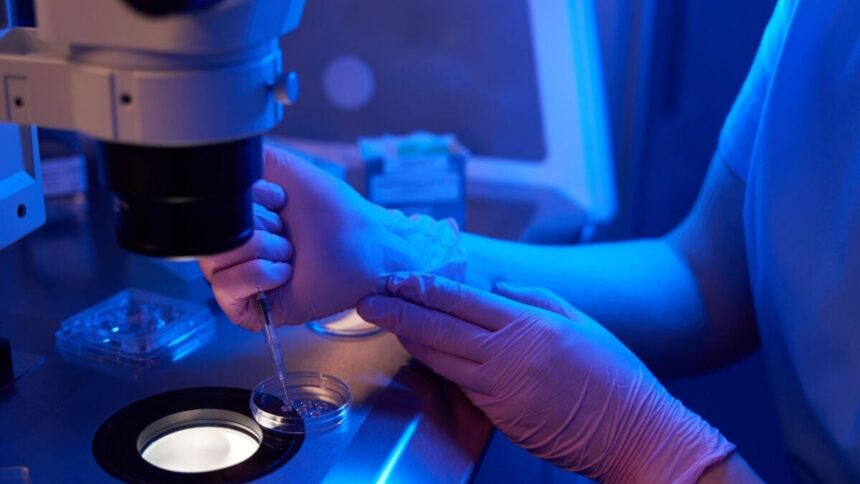
In this new study, they delivered microinjections of Shugoshin 1 to mice and human eggs (the latter were donated by patients at a fertility clinic). In both groups, adding the protein appeared to increase levels inside the eggs and reduce the risk of improper separation. More than half of the human eggs without treatment showed this flaw, for instance, compared to only 29% of eggs given added Shugoshin 1.
“These findings establish SGO1 supplementation as a potential strategy to preserve chromatid cohesion in aging oocytes,” the researchers wrote in their paper, released last week on the preprint server bioRxiv.
What happens now?
This research is still in its early stages. The researchers are planning to present it at the British Fertility Conference in Edinburgh later this week, but it has yet to undergo peer review, a vital part of the scientific process.
The team will also have to generate evidence that adding Shugoshin 1 can improve actual fertility outcomes and that it can be done safely and reliably. And they’re careful to note that such a treatment still wouldn’t make IVF a possibility for women who have entered menopause.
But IVF is becoming more common among older women, and this research, assuming it passes muster, could certainly make these procedures much less of a gamble for this group.
“This is really important work because we need approaches that work for older eggs because that’s the point at which most women appear,” Güneş Taylor, a fertility researcher at the University of Edinburgh not affiliated with the study, told the Guardian.
Schuh and her colleagues have founded the company Ovo Labs in hopes of further developing and commercializing their technique.
Read the full article here