By using this site, you agree to the Privacy Policy and Terms of Use.
Accept
Tech Consumer JournalTech Consumer JournalTech Consumer Journal
  • News
  • Phones
  • Tablets
  • Wearable
  • Home Tech
  • Streaming
  • More Articles
Reading: Scientists Planted Telecom Cables to Find ‘Thunderquakes.’ Here’s What Happened
Share
Sign In
Notification Show More
Font ResizerAa
Tech Consumer JournalTech Consumer Journal
Font ResizerAa
  • News
  • Phones
  • Tablets
  • Wearable
  • Home Tech
  • Streaming
  • More Articles
Search
  • News
  • Phones
  • Tablets
  • Wearable
  • Home Tech
  • Streaming
  • More Articles
Have an existing account? Sign In
Follow US
  • Contact
  • Blog
  • Complaint
  • Advertise
© 2022 Foxiz News Network. Ruby Design Company. All Rights Reserved.
Tech Consumer Journal > News > Scientists Planted Telecom Cables to Find ‘Thunderquakes.’ Here’s What Happened
News

Scientists Planted Telecom Cables to Find ‘Thunderquakes.’ Here’s What Happened

News Room
Last updated: August 22, 2026 5:32 am
News Room
Share
SHARE

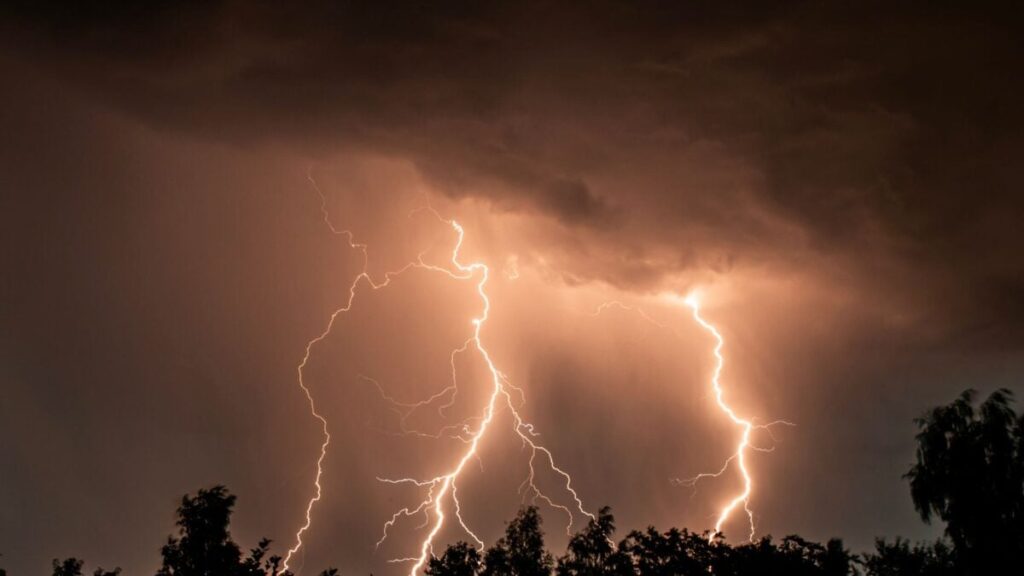
When lightning strikes the ground, the impact creates small vibrations that propagate through the ground. These “thunderquakes” were believed to be too small to be useful to scientists; if anything, they might even be noise blocking out more tangible signals.

Enter high-quality fiber-optic cables. Researchers at Pennsylvania State University buried telecom cables under their campus, connecting the network to the kinds of acoustic sensors used in seismology. Remarkably, the sensors recovered information on the tiny changes caused by 458 thunderquakes over two years. In a paper published today in Science Advances, the team explained that it successfully used the dataset to create detailed images of the geological structures below Penn State, up to around 328 feet (100 meters) underground.

“In other words, a storm in the sky can help us see underground,” Tieyuan Zhu, the study’s co-author and a geophysicist, told Gizmodo. “We are turning what seismologists traditionally consider environmental noise into a useful scientific signal.”

Shallow vibrations

According to the paper, seismology has tended to focus on “sources within the solid Earth,” like earthquakes that literally shake up geological structures tens of miles below the surface. On the other hand, it’s reasonable to assume that things in Earth’s “fluid spheres,” like atmospheric phenomena, would “inject energy into the ground and generate measurable seismic motion,” the paper explained.

However, this hasn’t been studied too extensively, the team said. What’s more, thunderquakes are “far too weak to cause damage, and people generally cannot feel them,” Zhu explained to Gizmodo. But they’re also ideal candidates for studying the uppermost part of Earth’s surface, owing to their high-frequency energy, he added.

The team had found earlier that normal telecommunications fibers were sensitive enough to pick up thunderquakes. Zhu said this naturally raised the following question: “Could we move beyond simply detecting thunderquakes and actually use them to image the subsurface?”

Noise to signal

For the latest study, the team used a technique called distributed acoustic sensing, which sends out laser pulses through optical fibers and measures how changes in ground motion affect the fiber. This effectively allows a single cable to “act like thousands of closely spaced seismic sensors,” Zhu explained to Gizmodo. To ensure reliability, the team also separately collected geological and geophysical data to compare readings with the thunderquake data.

Schematic illustration of thunder-to-seismic wavefield modeling and observations. A lightning source generates propagating ground vibrations that are represented by the modeled wavefield (right), while the corresponding measured seismic data are shown as a channel-by-time record (left). © Zhu et al., 2026

“Because seismic-wave speed depends on the properties of the material through which the waves travel, these measurements allowed us to estimate the shallow subsurface structure,” Zhu said. “Thunderstorms happen frequently, but their seismic energy has largely been ignored. Our study shows that this energy can become a renewable and essentially free source for probing the ground.”

Above and beyond

Zhu told Gizmodo that the team’s next step is to test the same method in other locations and geological environments. For instance, differences in the physical features of either the storm or the environment could influence the quality and depth of the final image. On a more fundamental level, Zhu hopes to better understand the electromagnetic forces at play for the seismic energy associated with lightning.

In the paper, the team also noted that the same method could feasibly help explore subsurfaces on other planets and moons. Saturn’s Titan, for example, has been known to experience thunder. Thunderquakes won’t replace conventional seismic surveys, Zhu told Gizmodo, but they certainly “offer an additional, naturally recurring source of information—especially in places where earthquakes are infrequent or where conventional surveys are difficult or expensive.”

“The broader message is that the ground is continually responding to activity in the atmosphere and at the surface,” he concluded. “Signals that once looked like noise may contain valuable information about the hidden world beneath our feet.”

Read the full article here

You Might Also Like

How ‘Strange New Worlds’ Made Sure the Puppet Episode Still Felt Like ‘Star Trek’

Proposed Oura Lawsuit Highlights Wearables’ Health Limitations

The New ‘Insidious’ Director Got Very Nervous When He Watched ‘Backrooms’

This Plant Summons Parasitic Wasps to Kill Its Enemies

This ‘Little Planet’ Is a Surreal Record of How We’ve Changed Nature—and It’s a Science Photo Contest Winner

Share This Article
Facebook Twitter Copy Link Print
Previous Article The New ‘Insidious’ Director Got Very Nervous When He Watched ‘Backrooms’
Next Article Proposed Oura Lawsuit Highlights Wearables’ Health Limitations
Leave a comment

Leave a Reply Cancel reply

Your email address will not be published. Required fields are marked *

Stay Connected

248.1kLike
69.1kFollow
134kPin
54.3kFollow

Latest News

NASA Study Warns It’s Easier Than Expected for Astronauts to Contaminate the Moon
News
No One Does Live-Action Adaptations Quite Like Takashi Miike
News
U.S. Government Lab Reportedly Probing Chinese Lidar Security Risks on Behalf of Private Industry
News
‘The Odyssey’ Comes Home in November
News
The ‘Dungeon Crawler Carl’ TV Show Just Got a New Overlord
News
This Might Be Your Last Chance to Own Patrick Stewart’s Professor X
News
DC’s Jimmy Olsen TV Show Has Its Official Title, Cast, and More
News
Thousands of Goal Zero Power Stations Recalled for Catching Fire (But There’s a Fix)
News

You Might also Like

News

TCL’s Jedi-Like Smart Lock Is Now Even Better

News Room News Room 5 Min Read
News

Tesla Is Pulling the Plug on Its Solar Roof Tiles

News Room News Room 4 Min Read
News

Scientists Recreate the Melting ‘Diamond Rain’ of Neptune and Uranus. It May Help Fusion Power

News Room News Room 5 Min Read
Tech Consumer JournalTech Consumer Journal
Follow US
2024 © Prices.com LLC. All Rights Reserved.
  • Privacy Policy
  • Terms of use
  • For Advertisers
  • Contact
Welcome Back!

Sign in to your account

Username or Email Address
Password

Lost your password?