

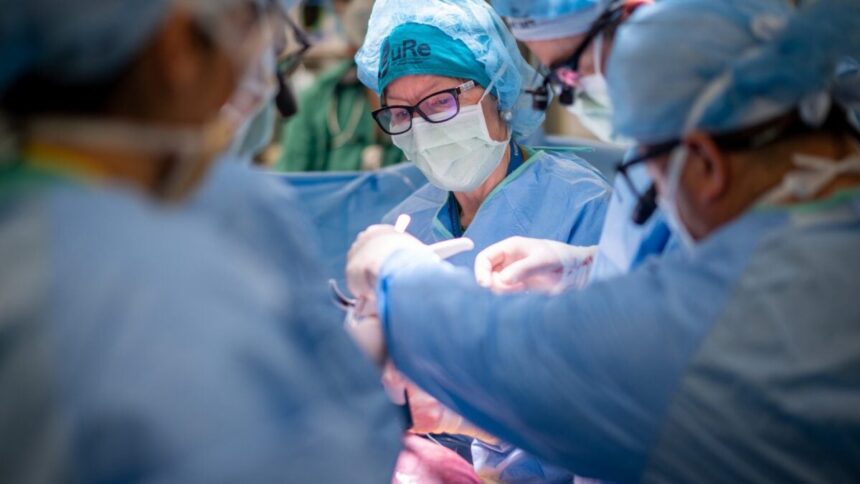
Stem cell therapy could represent a new frontier in the treatment of certain birth defects. Preliminary research published today suggests that donor stem cells received in the womb can help children born with spina bifida.
Scientists at the University of California, Davis, conducted the world’s first in-utero trial of stem cell therapy for spina bifida. They found that the treatment, used alongside prenatal surgery, could be safely deployed, with no lingering adverse events seen in any of the babies once born. What’s more, the stem cells may have improved the surgery’s effectiveness, and consequently, the children’s quality of life.
“Putting stem cells into a growing fetus was a total unknown. We are excited to report great safety,” said lead study author Diane Farmer, chair of the UC Davis Department of Surgery, in a statement from the university.
New hope for a debilitating condition
Spina bifida is a type of neural tube defect, meaning that a fetus’ developing spine and spinal cord don’t fully form and close as usual. It can vary in severity, depending on how much of the spine is exposed, but it’s often a debilitating condition that leads to lifelong cognitive, bladder, and mobility issues.
Traditionally, spina bifida has been treated with surgery that tries to close up exposed spinal tissue soon after birth. In more recent years, prenatal fetal surgery has become the standard of care, with improved outcomes. But many children still experience serious health problems even with prenatal surgery, including not being able to walk independently.
Stem cells have garnered lots of scientific attention for their potential to boost the body’s regenerative healing beyond its natural limits. And that’s led the UC Davis researchers and others to wonder if they could help make prenatal surgery for spina bifida all the better. Earlier animal studies appeared to support their idea, resulting in this current study, the phase I CuRe trial.
The trial involved six pregnant women who had fetuses diagnosed with spina bifida between 2021 and 2022. All the fetuses were given standard spinal repair surgery. Before the surgery was completed, however, the researchers applied a patch of stem cells—derived from donor placentas—onto the fetuses’ exposed spinal tissue.
Phase I trials are primarily intended to demonstrate the safety of an experimental treatment, and this one appeared to be a clear success. There were no signs of complications that could plausibly be related to the stem cell therapy, such as the growth of tumors. The surgeries also went off without a hitch, with no infections and complete wound healing in all the fetuses.
Though it’s still too early to know for sure, the stem cells may have also helped improve surgical outcomes. MRI scans showed that the newborns all experienced a reversal of their hindbrain herniation, a sign of the surgery working as hoped. And none of the children needed a shunt for hydrocephalus (fluid buildup in the brain) before leaving the hospital, an otherwise common complication of spina bifida.
The team’s findings were published Friday in the Lancet.
What comes next?
These results are still very early. It will take more time and research to know whether the stem cell therapy has actually improved the long-term health of these children, let alone whether it can consistently do the same for others with spina bifida.
There’s certainly reason to be hopeful about this treatment, not just for spina bifida, but also for other conditions that first develop in a growing fetus. “It paves the way for new treatment options for children with birth defects. The future is exciting for cell and gene therapy before birth,” said Farmer.
The researchers will be tracking the long-term outcomes of the original six children. And they’ve already begun to move ahead with a larger Phase I/IIa trial of 35 children.
Read the full article here