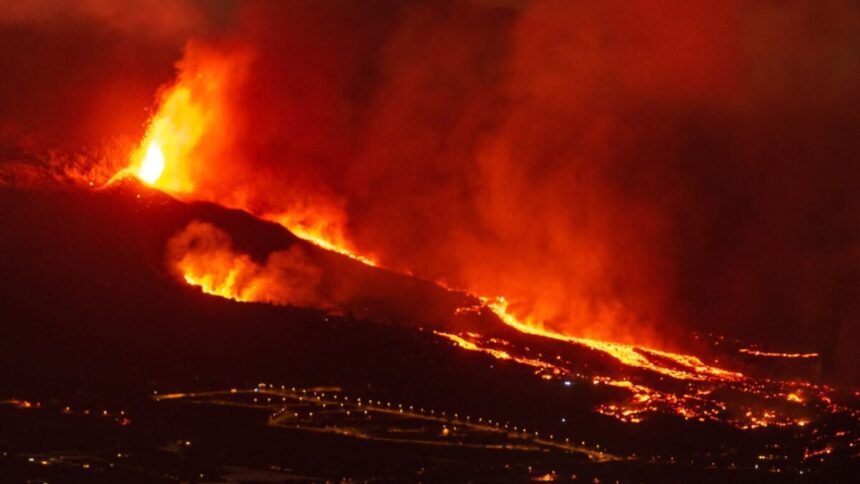
Rivers of lava rose to an average height of nearly 20 feet (6 meters) and cut through the landscape at an estimated 984 feet (300 m) per hour when the Tajogaite volcano blew on the island of La Palma in 2021. This historic, 85-day smoldering eruption on one of Spain’s Canary Islands plagued residents long enough and hard enough for at least one local politician to consider dropping a bomb to divert its heaping lava flow.
But, if there’s a silver lining to Tajogaite’s months of destruction, it’s this: Geologists and other Earth science researchers have now managed to use cooled rock from the cone of this volcano to recreate its molten magma in the lab. And the team’s high-temperature experiment has uncovered an entirely new governing principle that could help scientists predict what makes certain volcanic events likely to be more powerful than others.
The degree of “superheating” acting on magma, the researchers say, might soon play as powerful a role forecasting future volcanic activity as the more traditional factors scientists currently rely upon, gas content, pressure, and the geologic chemistry of the magma itself.
“Until now, we did not fully understand the dynamics of crystal growth for magmas that received an injection of superheat just before ascent,” volcanologist Barbara Bonechi, the study’s lead author, explained in a statement.
Magma at superheated temperatures, Bonechi and her colleagues argue, exhibits “a first-order control on magma viscosity” preventing bits of molten rock from crystallizing into any solid grit that might otherwise slow its flow amid the molten rock’s heated ascent to Earth’s surface.
Volcanic histories
Bonechi’s team selected a portion of cooled tephrite from the cone of Tajogaite on La Palma because this igneous rock’s crystalline mineral texture and composition were relatively easy to interpret. It had been “extensively characterised in previous studies” since the 2021 blast, as researchers scrambled to explain how a series of earthquakes jumpstarted the island’s long dormant volcano. Plus, using these rock samples as the starting point for their human-made magma allowed them to draw a “direct link between experimental observations and natural magmatic conditions” as witnessed on La Palma.
The volcano’s 2021 tephrite was melted back into magma in an internally heated pressure vessel whose outer walls—while opaque to the naked eye—were transparent to X-rays.
“[With] synchrotron X-ray microtomography we can actually observe these processes ‘in situ,’” Bonechi noted.
This real-time data on their homebrew magma showed that a slippery superheated state impacted its interaction with other influential factors like gaseous pockets, changing pressures, and ultimately the volcanic event’s “eruptive style,” they wrote.
“The history of crystal and bubble growth can dramatically control how a magma erupts,” Bonechi said.
Magma superheated to 2,309 degrees Fahrenheit (1,265 degrees Celsius) took longer to cool down, with rocky mineral crystals only beginning to form at 1,963 degrees F (1,073 degrees C). And greater superheating appeared to further push the formation of mineral crystals down to even lower temperatures, with magma heated to 2,489 degrees F (1,365 degrees C) only starting to form crystals when it cooled to 1,936 degrees F (1,058 degrees C).
Lava alert
Margherita Polacci, Bonechi’s coauthor and her volcanology colleague at the University of Manchester, hopes their research will find its way into future “volcanic hazard assessment” models.
“This work suggests that pre-eruptive thermal history and crystallisation kinetics may also play an important role in controlling magma ascent and eruptive behaviour,” Polacci said in a statement.
The team’s work, published Monday in Nature Communications, already makes one rule of thumb pretty clear: Deeper-sourced molten magma, heated up below Earth’s crust somewhere closer to its core, is more likely to be superheated and erupt with a faster flow, if given the chance.
“If magma ascends directly from the mantle or a deep reservoir, it is likely to experience significant superheating immediately before eruption,” the researchers wrote. “[Even] modest variations in magma storage conditions … can lead to substantial changes.”
Read the full article here