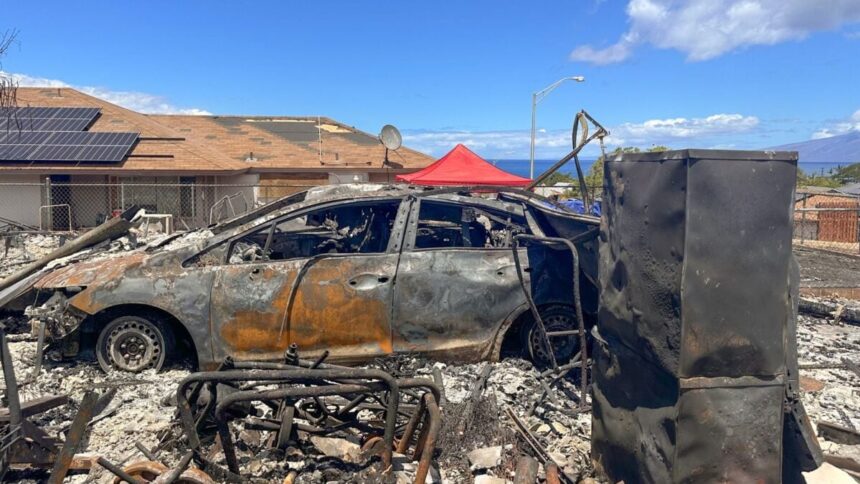
In August 2023, a series of devastating wildfires broke out on the Hawaiian island of Maui, destroying more than 2,200 structures and causing about $5.5 billion in damages. In Lahaina, the hardest-hit community, more than 100 people were killed. Maui still bears scars from this catastrophe, and new research suggests toxic metal exposure remained a threat to public health for months after the blazes were extinguished.
The new study, published today in the journal Proceedings of the National Academy of Sciences, tested the urine of 1,400 adults six to 18 months after the fires. The researchers found substantially elevated concentrations of several metals in participants’ urine samples, including antimony, manganese, barium, and arsenic. They also linked greater amounts of metal accumulation in the body to abnormal lung function.
“My biggest takeaway is not to assume the health consequences of a disaster end when the smoke disappears,” co-author Ruben Juarez, co-director of the Maui Wildfire Exposure Study and an endowed professor of health economics at the University of Hawaii at Mānoa, told Gizmodo. “Short-term air monitoring is essential, but after a major community-burning wildfire it may not tell us the whole story.”
The dangers of airborne metals
When a fire burns through structures and vehicles, the extreme heat turns metals into microscopic particles that waft into the air as a component of smoke. Wildland fires can also create airborne metals by superheating minerals in soils, but smoke from wildland-urban interface fires like the Maui disaster typically contains higher metal concentrations.
The team behind the Maui Wildfire Exposure Study (MauiWES) is working to understand the long-term public health impacts of this disaster. By measuring urine concentrations of 24 different metals, the researchers found evidence to suggest Maui residents were exposed to certain metals long after the fires.
To be clear, “finding elevated metals six to 18 months after the wildfire does not necessarily mean the same metals have simply remained in the body since the day of the fire,” co-author Alika Maunakea, MauiWES co-director and professor at the UH Mānoa John A. Burns School of Medicine, told Gizmodo. “Different metals behave very differently in the body. What our results suggest is that there may have been continued or intermittent exposure during recovery.”
The researchers suspect that ash, contaminated soil, settled dust, and resuspended particles may be culprits of this long-term exposure.
For several metals, participants exhibited concentrations that were significantly higher than baselines based on U.S. biomonitoring data, including antimony at 40 times, manganese at 3.8 times, barium at 2.3 times, and arsenic at 2.2 times national reference values. Statistical analysis showed that higher combined metal exposure was associated with several measures of abnormal lung function, with arsenic, cadmium, copper, and antimony among the metals with the strongest links to those measures.
The findings come with caveats. First, the researchers note that their study did not establish that individuals met the clinical threshold for metal poisoning. “We are saying the levels were unusually elevated, and the higher overall metal burden was associated with poorer lung function,” Juarez clarified.
Second, the study did not completely isolate the 2023 wildfires from other potential sources of metal exposure. The researchers compared communities across Maui, looked at geographic patterns, compared observed metal concentrations to national reference data, and examined whether the metals they found overlapped with contaminants identified in ash and environmental samples studied after the fires. But without biological samples taken from participants before the fires, they can’t definitively say that every elevated metal resulted from this event.
“Hawaii also has natural geological sources and a history of agricultural and industrial land use,” Juarez said. “Our hypothesis is that a disaster like this can both create new contamination and remobilize contamination that was already in the landscape.”
The growing threat of urban wildfire
The threat of wildland-urban interface fire, and thus the threat of airborne metal exposure, is rising. That’s because climate change is fueling larger and more severe fires while development expands infrastructure into the wildland-urban interface. Wildland-urban interface fires produce more complex emissions than fires that burn only vegetation, making them more hazardous.
“This is becoming a national issue,” Juarez warned. It is particularly prevalent in the western U.S., where recent events like the Los Angeles wildfires of January 2025 have underscored the growing threat that wildfire poses to densely populated cities.
“That is why Maui has relevance far beyond Hawaii,” Maunakea said. “We need to understand the health consequences of fires that burn the built environment, because more communities are facing that kind of disaster. The problem is not only more fire. It is fire increasingly intersecting with where people live.”
Read the full article here