

By using this site, you agree to the Privacy Policy and Terms of Use.
Accept
Tech Consumer JournalTech Consumer JournalTech Consumer Journal
  • News
  • Phones
  • Tablets
  • Wearable
  • Home Tech
  • Streaming
Reading: Scientists Discover Time Crystals You Can Hold—and They Levitate
Share
Sign In
Notification Show More
Font ResizerAa
Tech Consumer JournalTech Consumer Journal
Font ResizerAa
  • News
  • Phones
  • Tablets
  • Wearable
  • Home Tech
  • Streaming
Search
  • News
  • Phones
  • Tablets
  • Wearable
  • Home Tech
  • Streaming
Have an existing account? Sign In
Follow US
  • Contact
  • Blog
  • Complaint
  • Advertise
© 2022 Foxiz News Network. Ruby Design Company. All Rights Reserved.
Tech Consumer Journal > News > Scientists Discover Time Crystals You Can Hold—and They Levitate
News

Scientists Discover Time Crystals You Can Hold—and They Levitate

News Room
Last updated: February 13, 2026 11:31 am
News Room
Share
SHARE

Last year, physicists created a time crystal—atomic arrangements repeating motion patterns—visible to the naked eye. But the latest research on this quantum eccentricity might represent more than a few steps forward.

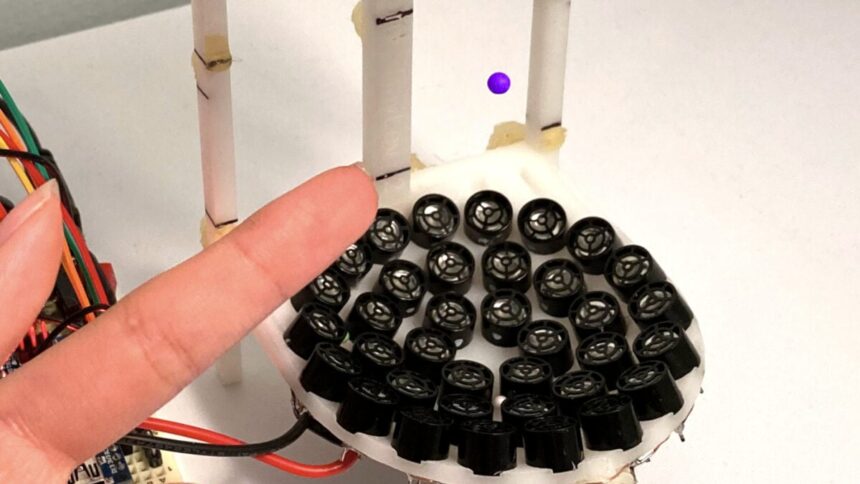
This time crystal, described in a recent Physical Review Letters paper, is big enough to be held in your hand, and it levitates. Discovered by a team of physicists at New York University (NYU), the new type of time crystal consists of styrofoam-like beads that levitate on a cushion of sound while exchanging sound waves.

If that wasn’t strange enough, the time crystal does this by violating Newtonian physics—and the team believes that gives the new crystal both academic and practical significance.

“This was a discovery in the truest sense,” David G. Grier, the study’s senior author and a physicist at NYU, told Gizmodo. “Perhaps the most remarkable thing is that such rich and interesting behavior emerges from such a simple system.”

What are time crystals?

In 2012, Nobel laureate Frank Wilczek pitched an idea for an impossible crystal breaking the rules of symmetry in physics. Typically, solid crystals maintain a continuous lattice of their respective components. Time crystals, however, do the exact opposite, with the individual atoms inside them changing positions over time in a relatively defined pattern.

In the past decade or so, physicists have managed to find varying versions of Wilczek’s vision. But these instances mostly featured short-term, microscopic time crystals with little practical implications. It was only last year that one team at the University of Colorado Boulder proposed a time crystal design that we can actually see.

Styrofoam finds a new quirk

The setup of the new time crystal system. A bead (purple) is suspended in mid-air by sound waves emanating from (black) circular speakers arranged in a six-inch-tall 3D-printed frame. Credit: NYU Center for Soft Matter Research

The newly discovered time crystal may represent huge advances in the practical relevance of time crystals. For one, the bead in the experiment is expanded polystyrene—the same material used for packing styrofoam.

The team turned this common material into a time crystal by suspending styrofoam beads in sound waves. By itself, the bead floats motionlessly, but things begin to change once multiple beads levitate together.

In this system, each bead scatters its own share of sound waves. That contributes to an overall system of “unbalanced interactions” that essentially allows the particles to harvest and supply energy from the sound waves, Grier explained. “The key point is that time crystals select their own frequency without being told what to do by any external force.”

The simplest of them all?

What’s more, these interactions aren’t bound to Newton’s third law of motion, which dictates that two bodies exerting force on each other must exert the same amount of force in opposite directions.

“Think of two ferries of different sizes approaching a dock,” Mia Morrell, the study’s lead author and a graduate student at NYU, said in a university statement. “Each one makes water waves that push the other one around—but to different degrees, depending on their size.”

Time Crystals Nyu Stop Motion
A stop-motion image that shows pairs of millimeter-scale beads forming a time crystal over approximately one-third of a second in time. The colors represent the beads interacting at different stages during this period. Credit: NYU Center for Soft Matter Research

According to Grier, the sheer simplicity of this time crystal setup potentially makes it the “hydrogen atom” for this phenomenon—highlighting its potential across other contexts, such as “the neural pacemakers in our hearts to cyclic trends in financial markets.”

“We’re hoping that studying a minimal model will provide access to the deepest insights into the spontaneous emergence of clocks in more general and more complex manifestations,” he added.

Read the full article here

You Might Also Like

This Retro ‘Wonder Man’ Trailer Is So Fun, We Wish It Was a Real Movie

Sony Says ‘KPop Demon Hunters’ Was a Hit Specifically Because It Was on Netflix

Israel Accuses Two Polymarket Bettors of Trading on Classified Military Operations

Trump Just Blew American Climate Policy to Smithereens

Mutated Rats Reign in This Ooey-Gooey Clip From ‘Cold Storage’ (Exclusive)

Share This Article
Facebook Twitter Copy Link Print
Previous Article Israel Accuses Two Polymarket Bettors of Trading on Classified Military Operations
Next Article Sony Says ‘KPop Demon Hunters’ Was a Hit Specifically Because It Was on Netflix
Leave a comment

Leave a Reply Cancel reply

Your email address will not be published. Required fields are marked *

Stay Connected

248.1kLike
69.1kFollow
134kPin
54.3kFollow

Latest News

‘Starfleet Academy’ Decides Everyone Needs a Harsh Lesson
News
‘The Last Sacrifice’ Explores the (Maybe?) Occult Crime That Inspired ‘The Wicker Man’
News
Researchers Jailbreak ChatGPT to Find Out Which State Has the Laziest People
News
Waymo Announces Its Next Generation of Robotaxis
News
‘Scarlet’ Is a Ravishing Vision Undercut by a Glib ‘Hamlet’ Reimagining
News
NASA Puts 21-Year-Old Spacecraft on Pause to Keep It From Crashing Into Earth
News
Your First Look at Hasbro’s ‘Mandalorian and Grogu’ Figures Is Here (Exclusive)
News
Saturn’s Rings Came From a Two-Moon Collision About 100 Million Years Ago, Study Says
News

You Might also Like

News

OpenAI President Defends Trump Donations, Refuses to Comment on ICE

News Room News Room 5 Min Read
News

This Tiny Comet Pulled Off a First-of-Its-Kind Spin Flip

News Room News Room 5 Min Read
News

After Two Years, the Apple Vision Pro Finally Has a YouTube App

News Room News Room 4 Min Read
Tech Consumer JournalTech Consumer Journal
Follow US
2024 © Prices.com LLC. All Rights Reserved.
  • Privacy Policy
  • Terms of use
  • For Advertisers
  • Contact
Welcome Back!

Sign in to your account

Username or Email Address
Password

Lost your password?