

People with allergies can suffer long after the offending organism has been removed. Researchers, however, are now envisioning a future with portable devices that can clear a room of airborne allergens using ultraviolet (UV) light.
In new research published in the journal ACS ES&T Air, researchers have found a way to change the structure of allergy-causing airborne proteins with UV light. This approach reveals a better alternative to months of cleaning carpets and cats, and in extreme cases, it could even save lives.
“We have found that we can use a passive, generally safe ultraviolet light treatment to quickly inactivate airborne allergens,” Tess Eidem, a microbiologist at the University of Colorado Boulder and a co-author of the study, said in a university statement. “We believe this could be another tool for helping people fight allergens in their home, schools or other places where allergens accumulate indoors.”
You’re not allergic to cats
If you’re allergic to things like cats, dogs, mold, or plants, you’re probably not allergic to those organisms per se, but to a protein they emit. Cats, for example, emit a protein in their saliva called Fel d1 that, when they lick themselves, becomes airborne in tiny flakes of dead skin. When we breathe in allergens like these particles, our immune system creates antibodies that lock onto the protein’s special 3D structure, triggering an allergic reaction.
That’s why you might still sneeze when you shake out a carpet, even though a cat hasn’t walked on it for months. The proteins are still there, and they can’t be killed like microbes because they aren’t alive. Diminishing allergens via typical methods such as using a filter, vacuuming, and washing walls and pets is helpful but difficult to keep up in the long term.
As such, Eidem and her colleagues investigated an alternative method: instead of trying to get rid of allergy-causing proteins, they changed their structure to make them unfamiliar to the immune system. The team likens it to unfolding an origami animal. “If your immune system is used to a swan and you unfold the protein so it no longer looks like a swan, you won’t mount an allergic response,” Eidem explained.
Less intense lights
Cue UV light. Ultraviolet light is already used to eliminate airborne pathogens and to disinfect equipment in institutions such as hospitals and airports. But the bandwidth is usually so strong—a 254-nanometer wavelength—that people have to don equipment to protect their eyes and skin to use them.
As such, the team tested the less-intense 222-nanometer-wavelength lights, which are deemed to be safe for populated rooms because they don’t penetrate deep into cells. Eidem, however, admits that there are some risks, such as the production of ozone, which can be harmful if inhaled. As such, human exposure should still be restricted.
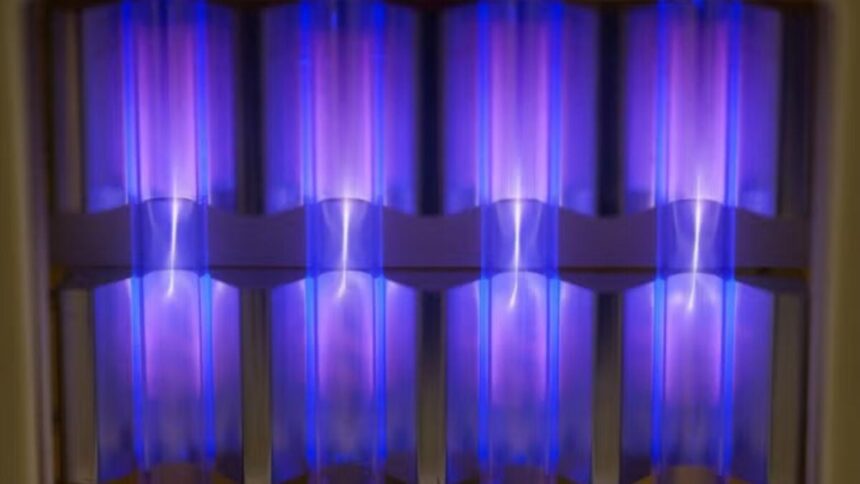
Eidem and her colleagues released tiny allergens from mites, pet dander, mold, and pollen into a chamber and turned on four lunchbox-sized UV222 lamps on the ceiling and floor. They tested the air in 10-minute intervals and found that immunorecognition of treated samples was reduced. In other words, antibodies did not identify many of the proteins and bind to them.
“Aeroallergens were quantified using an antibody-based immunoassay, which relies on intact protein conformation for antibody-allergen recognition, binding, and quantification,” the researchers explained in the paper.
After half an hour, airborne allergen levels saw an average drop of 20 to 25%, depending on the type of allergen, how long the light was on, and what the allergen was floating in, such as dust or droplets. In one situation, 40 minutes of UV light exposure saw Fel d1 diminish by 61% compared to untreated, allergen-filled air.
“Those are pretty rapid reductions when you compare them to months and months of cleaning, ripping up carpet, and bathing your cat,” said Eidem.
Personal applications
While UV222 lights are already available to consumers, they are mostly for industrial applications, so Eidem hopes to see the day when people could have access to portable UV222 lights to use for more personal activities, such as visiting that one friend with three cats. On a more serious note, UV222 lights might even be lifesaving.
“Asthma attacks kill about 10 people every day in the United States, and they are often triggered by airborne allergies,” Eidem concluded. “Trying to develop new ways to prevent that exposure is really important.”
Read the full article here