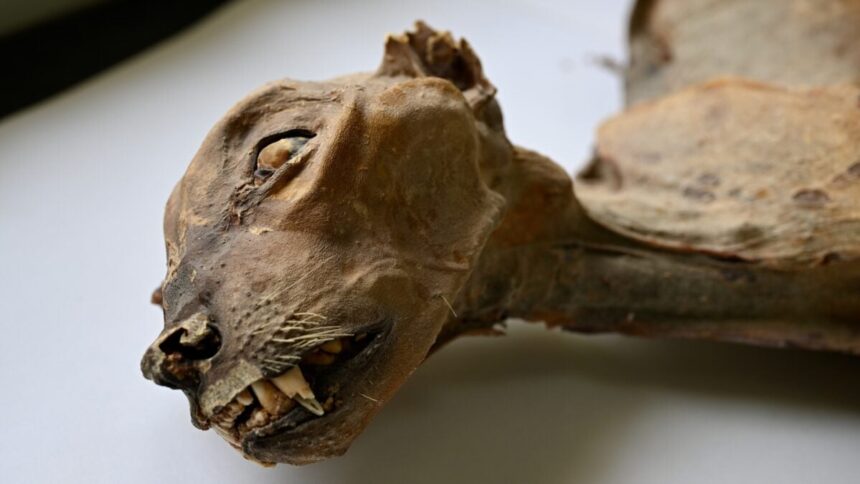
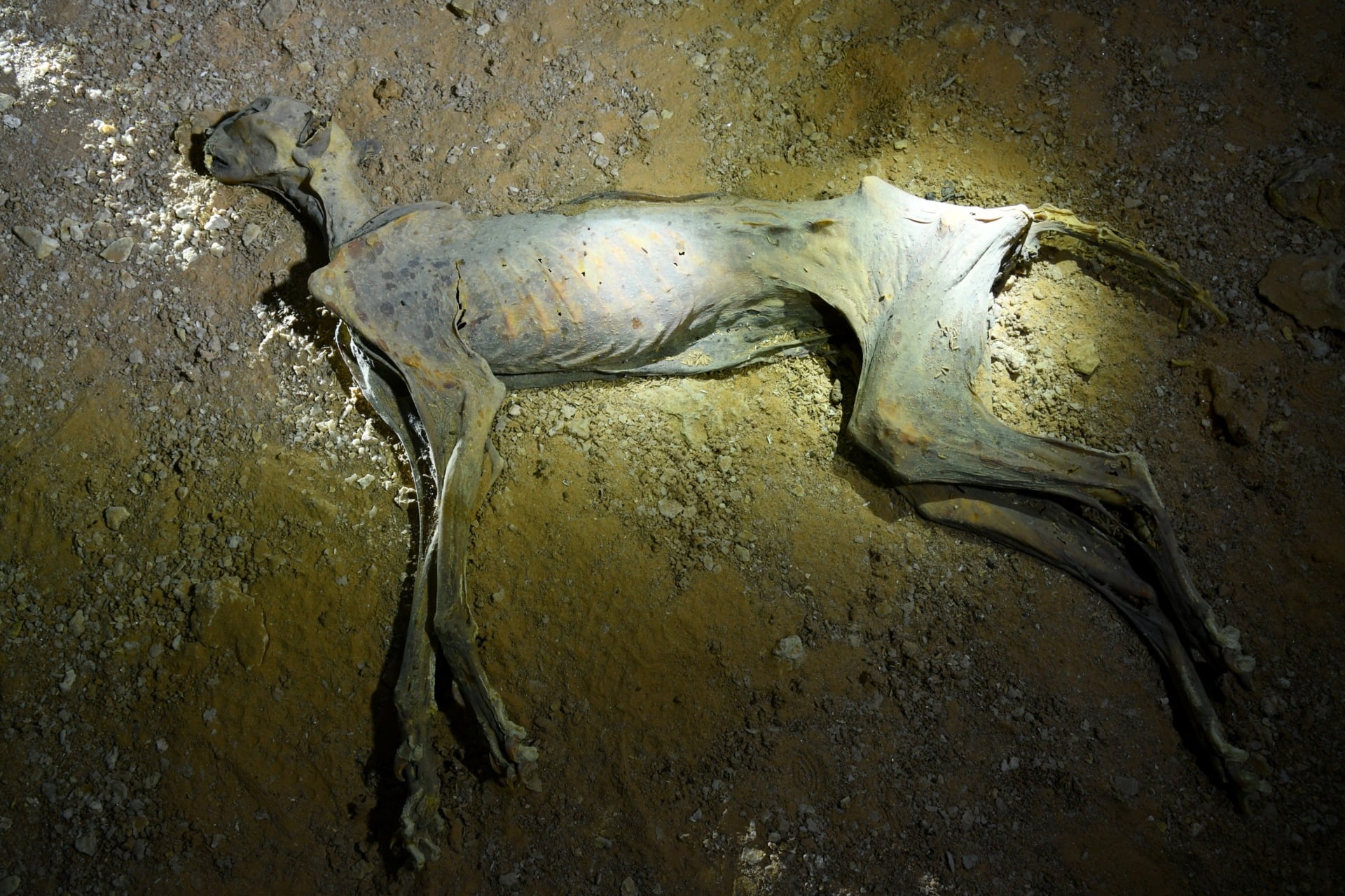
Deep inside the Lauga cave network in northern Saudi Arabia, scientists stumbled upon the exquisitely preserved remains of cheetahs that date back hundreds, and even thousands, of years. The once-iconic animal of the Arabian Peninsula has been locally extinct for over 50 years, but the rare discovery could help reintroduce cheetahs into the region.
A team of researchers from the National Center for Wildlife in Saudi Arabia were exploring the caves near the city of Arar when they found seven mummified cheetahs, which date from approximately 130 to 1,870 years ago. They also found the skeletal remains of 54 cheetahs, the oldest of which dates back to around 4,000 years ago.
By examining the ancient remains of the big cats, the researchers discovered that the cheetahs were closely related to the Northwest African cheetahs. The subspecies is still alive today in the Sahara and the Sahel, although it is critically endangered. The findings, published today in the Communications Earth & Environment journal, offer a new glimpse of hope to bring back the extinct animal to the Arabian Peninsula.
Wild cats
For thousands of years, cheetahs were a familiar presence across Asia, but their population has dramatically decreased by 98%. The big cats are thought to have gone extinct in the Arabian Peninsula by the 1970s due in large part to big-game hunting, habitat loss, and decline of prey species.
The team behind the discovery, made in 2022 and 2023, was able to extract complete genome sequences from three of the seven mummified cheetahs. Although it’s not clear how the cheetahs ended up in the caves, the dry climate kept their remains beautifully preserved, while the cool and dark environment was conducive to preserving their DNA. This marks the first time this type of genetic material extraction has been done on naturally mummified big cats, according to the study.
The genome sequencing revealed that while the most recent specimen is related to the Asiatic cheetah, the two oldest specimens were more similar to the Northwest African cheetah. The discovery that cheetahs in Saudi Arabia are closely related to the Northwest African cheetah, and not just the Asiatic cheetah, could be helpful in ongoing efforts to reintroduce the animal to the wild.
New hope
The Asiatic cheetah was once thought to have been the only subspecies to have lived in modern-day Saudi Arabia. Today, there is a small population of Asiatic cheetahs found in Iran, but the possibility of reintroducing the critically endangered animal to the Arabian Peninsula has been under debate.
There are roughly 400 Northwest African cheetahs in the wild today in remote desert and Sahara habitats, while some are being bred in captivity. Although one of the rarest big cat subspecies, the critically endangered animal could serve in efforts to reintroduce cheetahs to Saudi Arabia given their similarity to the cheetahs that once inhabited the region long ago.
The researchers behind the discovery say that an increased available genetic pool makes efforts to reintroduce cheetahs to the wild more feasible. The study also suggests that ancient DNA records from similar specimens could be used to reintroduce other extinct species to the wild.
Read the full article here