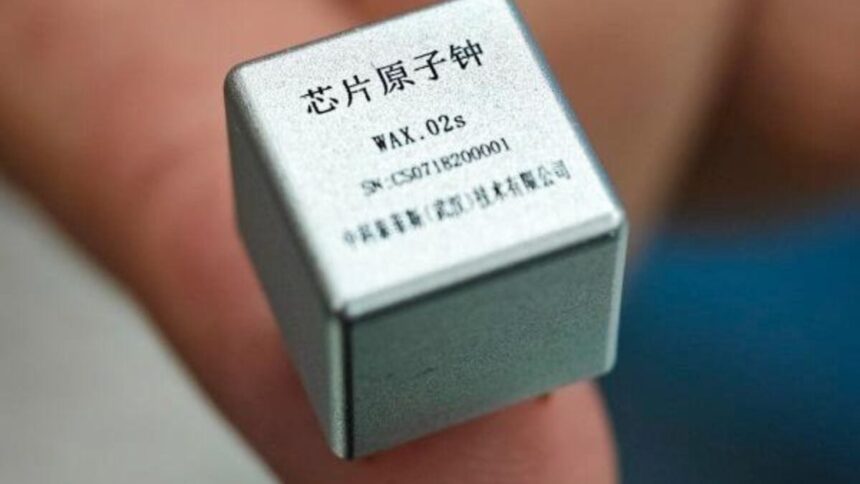
This tiny cube fits on the tip of your finger and also just so happens to be one of the most accurate clocks ever invented.
The Wuhan University scientists who created the device claim it’s the world’s smallest chip-scale atomic clock (CSAC) measuring just 0.14 cubic inch (2.3 cubic centimeters). That’s over seven times smaller than the leading U.S. model. According to the university, the clock is remarkably precise, losing just one second every 30,000 years.
Now that China is mass-producing these freakishly accurate gizmos, the tech could soon find its way into defense systems. The clock’s compact size will allow for easier integration into drones, missiles, and underwater navigation systems, significantly enhancing their precision-timing capabilities.
The next generation of timekeeping
Unlike the clock hanging on your wall, atomic clocks run on the steady vibrations of atoms—the minuscule building blocks of matter. These atoms act as perfect, unvarying pendulums, allowing atomic clocks to achieve a level of precision that traditional timekeeping technologies cannot.
Timing is everything in modern warfare. Military operations rely on highly precise alignment between troops, vehicles, weapons, and satellites. Even a nanosecond delay can mean the difference between success and catastrophic failure when it comes to coordinating airstrikes. Atomic clocks, therefore, play a crucial role in defense, measuring time down to tiny fractions of a second with unmatched accuracy.
Chip-scale atomic clocks are particularly useful for military applications because they can easily fit inside drones, missiles, and satellites without adding significant bulk or power demand. The smaller the better.
“Even if traditional atomic clocks are [miniaturized], the minimum volume limit is still several hundred cubic [centimeters] and the minimum power consumption is at least several watts,” professor Jiehua Chen of Wuhan University’s Satellite Navigation and Positioning Technology Research Centre, whose research team developed this chip-scale atomic clock, told the South China Morning Post.
His team’s design achieves a high level of precision in a teeny-tiny package using a quantum optical phenomenon called coherent population trapping, the SCMP reports. This approach eliminates the need for the bulky, power-hungry microwave cavity used in traditional atomic clocks.
Scaling production poses challenges
The team reportedly believes its device could transform drone warfare, underwater navigation, and battlefield communications.
“We have achieved mass production of chip-scale atomic clocks, successfully applying them to time [synchronization] systems such as micro-PNT [positioning, navigation and timing], underwater BeiDou [China’s equivalent of GPS], low-orbit satellites, and drone swarms,” Chen told the SCMP.
But there are still barriers to scaling up production, such as high costs and manufacturing demands (specifically the need for specialized lasers). Members of Chen’s team founded a company backed by the state-owned pharmaceutical company Yangtze River Industry Group to produce the clocks at scale, SCMP reports.
If costs decline enough to allow these itty-bitty clocks to expand into broader military applications, they could redefine precision timing in defense technology. It appears a new era of ultra-compact, super-accurate timekeeping is just beginning.
Read the full article here