Pigeons have historically served as messengers for humans, but a Russian startup claims to take this to a new level—effectively “hacking” pigeon brains to turn them into biological drones.
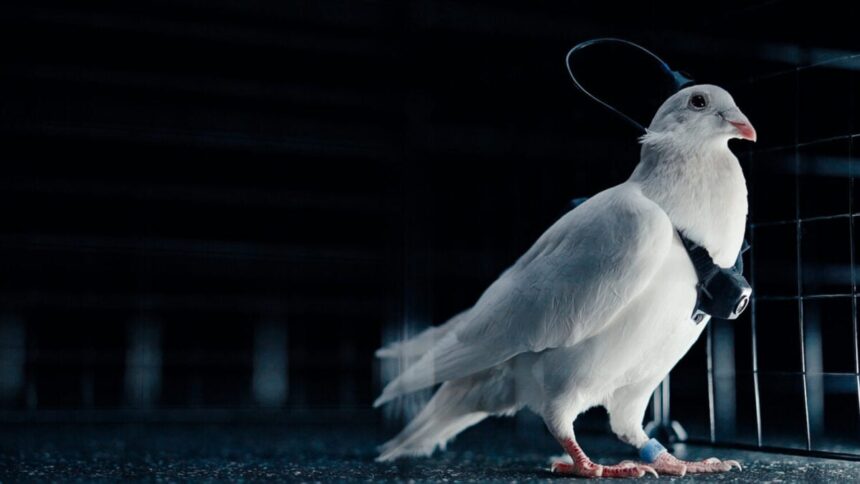
In a recent statement, Russian startup Neiry announced it had completed test flights of pigeons fitted with neural implants developed by the company. According to Neiry, the interface delivers “mild stimulation” to parts of the pigeon’s brain, prompting it to prefer certain flight paths—similar to how standard drones follow pre-loaded flight tasks—while the bird “otherwise behaves naturally.”
During the test flights, the pigeons carried a small controller, solar panels, and a camera for users, which allowed the company to assess the effectiveness of the so-called “bio-drones” in collecting data.
The drone is alive
To turn the pigeons into living drones, company technicians insert tiny electrodes through the birds’ skulls, then connect the electrodes to a stimulator mounted on the pigeons’ heads. The pigeons can be deployed almost immediately after surgery, which the company claims poses a low risk to the birds’ survivability.
Pigeons, as naturally skilled fliers, may outperform mechanical drones in navigating complex terrains, accessing small spaces, and withstanding harsh weather. What’s more, the birds can fly up to 300 miles (483 kilometers) a day without needing to charge batteries, the company explained.
This makes the “bio-drones” efficient vessels for surveillance, inspecting infrastructure or the environment, and supporting search-and-rescue operations, Neiry CEO Alexander Panov told Bloomberg.
Are the cyborg pigeons safe?
Neiry noted in its statement that, when not engaged in test flights, the birds continued their normal routines and received care from company operators. The company also claims to consult in-house bioethicists for their experiments.
However, Neiry has yet to provide independent reviews from third-party sources, leading some experts to question the ethical implications of their technology.
“Any time we’re using neural implants to try to control and puppeteer any species, it feels icky,” Nita Farahany, a bioethicist at Duke University, told Bloomberg. There are clear ethical concerns when the purpose is to “subjugate [animals] and deploy them as if they’re products rather than living creatures,” she added.
Neiry has also firmly insisted that PJN-1 is strictly restricted to civilian use. In a statement to The Telegraph, a spokesperson for Neiry said it makes “every effort to ensure that our bio-drones are used exclusively for civilian purposes, with no concealed or secondary use.”
As for the involvement of Russian government-related investors, the Neiry spokesperson added that “government support is a common and widely accepted worldwide practice: in all major countries, breakthrough technologies are supported by the state.”
Just the start?
All that said, the company seems intent on proceeding with the project, confirming the technology is ready for practical use in “utilities, logistics, agriculture, and emergency response” in its press release.
Panov in particular anticipates that, in the near future, the technology could be applied to various species for specialized tasks. But should the firm pivot to international sales, it’ll likely be subjected to serious reckoning from stakeholders—and only time will tell how or whether the company plans to address such concerns.
Read the full article here