
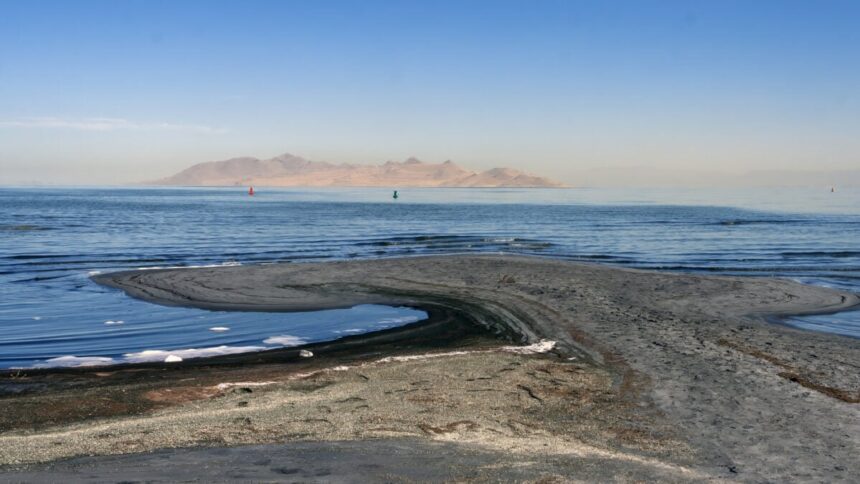
Scientists knew of only two groups of animals that call the intense salt water of Utah’s Great Salt Lake home—until recently.
A team of researchers has confirmed the existence of at least one previously unknown nematode in the exceptionally salty lake. Meet Diplolaimelloides woaabi—wo’aabi being an Indigenous word for “worm”—a little guy that seems to be endemic to the body of water.
Nematodes, also known as roundworms, are incredibly widespread and abundant unsegmented worms. They make up around 80% of animals in land-based soils and around 90% of those on the ocean floor. There are over 250,000 known nematode species. It might not come as a surprise that nematodes can live in the Great Salt Lake; nematodes exist in other extreme environments, such as polar ice and deep-sea hydrothermal vents.
Nematodes in the salty lake
In 2022, the University of Utah’s Julie Jung led field expeditions that found nematodes in Great Salt Lake’s microbialites (microbe-built mounds on the lake bottom). Their finding marked the first time that researchers had ever conclusively recorded nematodes there, with roundworms joining the previously known animal groups brine shrimp and brine flies.
“We thought that this was probably a new species of nematode from the beginning, but it took three years of additional work to taxonomically confirm that suspicion,” Jung, a co-author of a study published in November of last year, explained in a University of Utah statement. What’s more, there could be another undocumented nematode species within the samples, as suggested by genetic evidence.
The team is now faced with an interesting question. Namely, how did these tiny nematodes get here? Besides the newly identified D. woaabi, researchers know of only one member of Diplolaimelloides that exists beyond coastal regions, and it exists in eastern Mongolia. The Great Salt Lake is around 800 miles (1,287 kilometers) from the closest ocean and approximately 4,200 feet (1,280 meters) above sea level.
Michael Werner, lead author of the study and a biology professor at the University of Utah, said there are two “kind of crazy” hypothesized scenarios. One is that these nematodes may have been here for millions of years. The Cretaceous period (145 to 66 million years ago) saw a significant portion of modern-day Utah on the shore of a giant sea in North America.
“So we were on the beach here. This area was part of that seaway, and streams and rivers that drained into that beach would be great habitat for these kinds of organisms,” explained Byron Adams, co-author and a nematologist at Brigham Young University. “With the Colorado Plateau lifting up, you formed a great basin, and these animals were trapped here. That’s something that we have to test out and do more science on, but that’s my go-to. The null hypothesis is that they’re here because they’ve always kind of been here.”
An even crazier theory
The theory has at least one significant obstacle, however. Northern Utah wasn’t consistently salty.
“If the nematode has been endemic since 100 million years ago, it has survived through these dramatic shifts in salinity at least once, probably a few times,” Werner explained, highlighting a significant obstacle to the theory. The other “crazier” scenario, according to him, is that nematodes in saltwater lakes in South America may have hitched a ride on the feathers of birds that then flew them north. “Maybe the birds are transporting small invertebrates, including nematodes, across huge distances,” Werner continued. “Kind of hard to believe, but it seems like it has to be one of those two.”
The mysteries, however, don’t end there. The researchers found that their lake samples consisted of significantly more female nematodes than male, a trend that doesn’t extend to when the team cultures the worms back at the lab. There, it’s 50-50. According to Werner, there must be something separate going on in the lake compared to the lab.
Nematodes play significant roles in numerous habitats. Even though the precise seat in the food web of the ringworms in question remains unclear, the fact that they’re in the super salty lake indicates this is yet another environment where they carry out significant tasks.
What’s more, nematodes can be bioindicators, meaning that shifts in their populations or spread can reflect environmental changes. As such, D. woaabi could prove to be helpful in keeping an eye on the Great Salt Lake as human activity adds more and more stress to the habitat.
“When you only have a handful of species that can persist in environments like that, and they’re really sensitive to change, those serve as really good sentinel taxa,” Adams explained. “They tell you how healthy is your ecosystem.”
It remains to be seen what further research will reveal about these creatures, which seem to survive just on microbialites.
Read the full article here