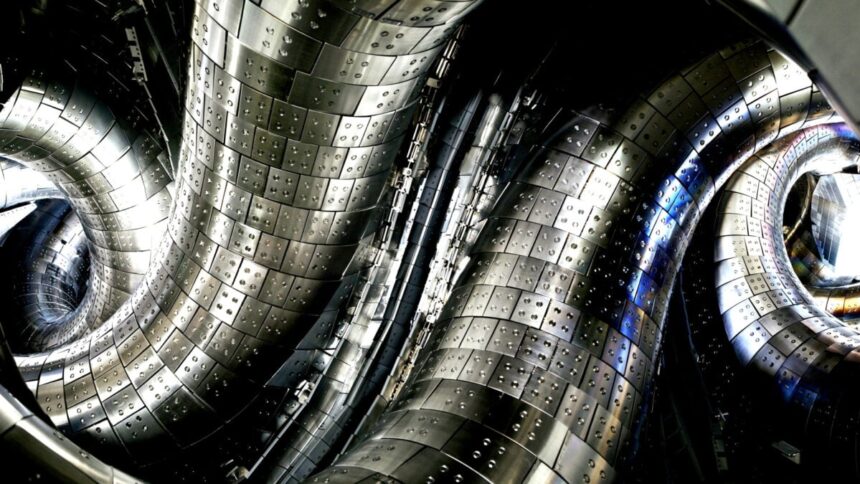
The interiors of fusion reactors can get seriously chaotic. But for obvious reasons—like extreme temperatures and pressures—researchers aren’t typically able to peek directly inside a reactor. Some physicists have found workarounds, and when they do, the results appear to contradict conventional theory on what scientists think should be happening inside.
During fusion experiments, the reactor heats up the plasma inside to more than a hundred million degrees. If all works out, that generates enough heat and pressure to coax two lightweight particles to merge, releasing a huge load of energy. In this process, the plasma naturally develops turbulence, or fluctuating waves.
For the first time, researchers at the National Institute for Fusion Science (NIFS) in Japan have captured plasma turbulence in detail, revealing two unexpected roles the phenomenon plays in fusion experiments. Specifically, turbulence acts as both a carrier and a mediator of heat, according to a recent Communications Physics paper on the findings.
Watch out for turbulence
Just as in-flight turbulence—irregular disruptions in the airflow—results in a bumpy plane ride, plasma turbulence transports heat and particles outward in jagged patterns. If left uncontrolled, this could lead to a sizable loss of energy that could have been allocated toward fusion reactions. That’s bad for efficiency.
On the other hand, there was already a mismatch between theoretical predictions and experimental results on plasma turbulence. According to theory, heat and turbulence should gradually spread from the center of a reactor to the edges. Experiments, however, sometimes showed turbulence propagating much faster, the researchers explained in a statement.
Two hats, one plasma
For the experiment, the researchers used NIFS’s large helical plasma experimental device to investigate how heat and turbulence responded to short and long heating patterns. Then, they made detailed measurements of shifts in temperature, turbulence, heat propagation, and other metrics.
To their surprise, some parts of the turbulence, which the researchers dubbed the “mediator,” rapidly connected different regions of the plasma. This occurred in less than 0.0001 seconds following the initial heating, the paper noted.
Following the “mediator,” the “carrier” turbulence subsequently transported the heat throughout the plasma, evening out the temperature distribution of the whole structure. The “mediators” grew stronger and spread heat faster with shorter initial heating times.
“So, inside the plasma, turbulence plays two roles as ‘mediator’ and ‘carrier’ to transfer a partial change to the overall structure almost instantaneously,” the researchers said.
The team is now investigating how and whether this “mediator” role could be intentionally controlled to create slower but more efficient plasma reactors. But this “distant-yet-instantaneous” reaction could also represent the physics behind other natural phenomena that show turbulence, such as oceans, atmospheric conditions, and more.
Related article: Nuclear Fusion Took Big Leaps in 2025. Here’s What Mattered Most
Read the full article here