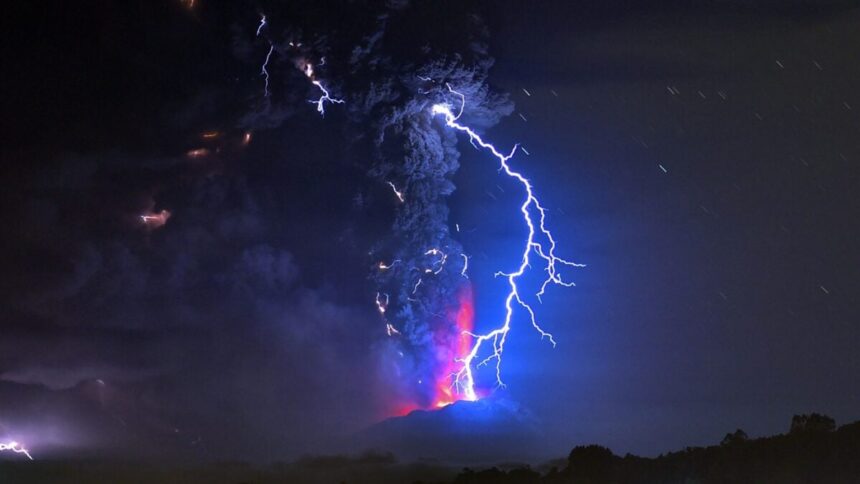
Volcanic lightning looks surreal: an arc of light rises from the volcanic crater, stretching out into the murky skies. Although scientists knew what caused such frightening yet beautiful phenomena, some of the smaller details remained unexplained—until now.
In a recent Nature paper, physicists attribute a molecular “film” of carbon to phenomena like volcanic lightning. Theoretically speaking, volcanic ash—a gassy lump of colliding silicon dioxide particles—shouldn’t experience triboelectric effects, or the exchange of electrical charge, since they’re all the same type of particle. But in nature, they do charge up in the same way that hair sticks to a balloon after vigorous rubbing. According to the new study, a carbon-rich “cocktail of molecular and atomic species” in the atmosphere drives this same-species electrification.
Tracking a volcanic flash
Triboelectric effects represent just one of several known causes of volcanic lightning, which Oregon State University says has been witnessed and studied for over 200 years. For instance, in 2016 researchers discovered that ice plays a role in some instances of volcanic lightning. This mechanism mirrors that of normal thunderclouds in that the interactions between high-living ice crystals and the ash clouds generate electrification.
That ice-based mechanism could appear in tandem with triboelectric effects, according to National Geographic. In the earliest stages of a volcanic eruption, the watery part of magma quickly vaporizes and becomes charged as it meets the air. These excited particles scatter into the air, eventually colliding and generating triboelectric effects. When the ash plume rises high enough to freeze, that makes lightning rates “skyrocket,” explained National Geographic.
Carbon never dies
For the study, the researchers sought to reproduce the molecular processes at play inside volcanic eruptions. They created a small sound chamber, using sound waves to suspend small spheres of silicon dioxide onto a plate made of the same material. Then they bounced the spheres off the plate and measured whether it became electrified.
They repeated the same experiment while slightly adjusting each run to account for factors such as height or humidity. The team also tried washing up the particle and letting it sit for some time, then checking to see how much carbon material the particle had collected just by existing in some non-vacuum environment.
“We saw that this effect [of the carbon-based molecules] overcomes everything else,” Galien Grosjean, the study’s lead author and a physicist at the Autonomous University of Barcelona in Spain, told New Scientist.
“The authors’ findings show that triboelectric charging is fundamentally an interfacial phenomenon, shaped by chemical as well as mechanical factors,” Simone Ciampi, a researcher at Curtin University in Australia who wasn’t involved in the new study, wrote in an accompanying News & Views.
Back from volcanoes to labs
The challenge of any study on extreme phenomena is that it’s nearly impossible to directly investigate the system. That is, the team isn’t likely going to be flying inside a volcanic ash cloud to check its work. Still, the study offers a fascinating perspective into unexpected things at play for a force as commonly seen as friction. For one, it could complicate the work of material scientists, whose experiments often require pristine surfaces to deter the influence of unwanted forces.
“People know surfaces have a lot of crap on them,” Daniel Lacks, a chemical engineer at Case Western Reserve University, told New Scientist. “But I’ve never seen that come up in triboelectric charging.”
On the other hand, the findings could inform how researchers control and model triboelectric charging to their liking, Ciampi said. In that case, that would mean advances in “technologies such as laser printing, mineral processing, and industrial exhaust treatment.”
Read the full article here