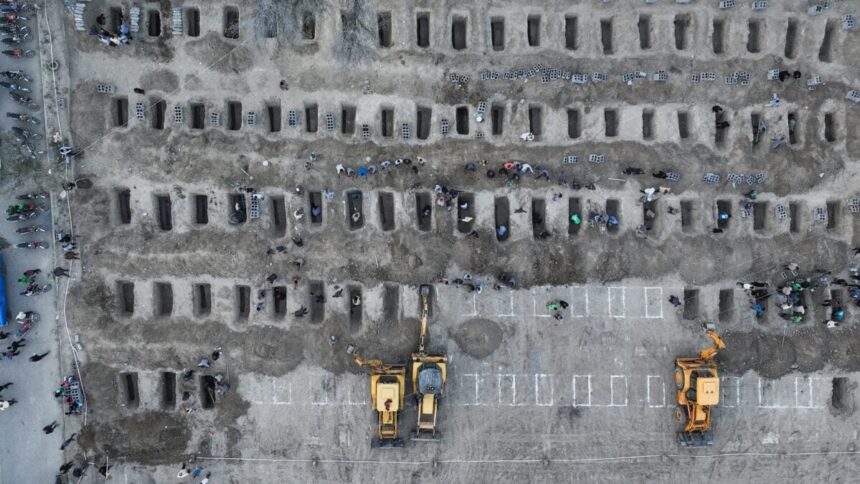
An investigation by the U.S. military into America’s missile strike on an Iranian school will likely blame outdated targeting information, according to a new report from the New York Times. The attack killed at least 175 people, most of them children, and President Donald Trump has previously tried to blame Iran for hitting the school.
On Feb. 28, the first day of the war, the U.S. launched a Tomahawk missile at Shajarah Tayyebeh elementary school in Minab, Iran, while allegedly trying to hit targets at a nearby Iranian military base. The preliminary findings of the investigation by the U.S. have found that the school used to be part of the base, though reports differ about when the building was converted into a school.
NBC News reports that the school building was segmented from the base, run by the Islamic Revolutionary Guards Navy, roughly 15 years ago. The New York Times notes that a fence was erected between the base and the school sometime between 2013 and 2016. Washington Post open source investigations reporter Evan Hill notes on X that colorful murals at the school were visible from Google Earth at least eight years ago, calling into question how anyone with access to satellite imagery may have mistaken the school for a legitimate military target.
The Defense Intelligence Agency labeled the school as a target and passed that information to U.S. Central Command, according to the Times. Investigators “do not yet fully understand” how the bad information was transmitted, and investigators are reportedly looking at how the National Geospatial-Intelligence Agency, which examines satellite images for the military and intelligence community, may have been involved.
After the strike on the school, there was widespread speculation that AI might be to blame for the bad targeting information. Anonymous officials told the Times that AI was “unlikely” to be the cause of the strike, suggesting instead it was probably human error.
Anthropic’s AI model Claude is used by the U.S. military, though the U.S. has now labeled the company as a “supply chain risk.” The Pentagon has never before designated a U.S. company as a supply chain risk, and Anthropic has now filed suit, but the Pentagon is still using Claude as it’s phased out over the next six months.
Hegseth ordered the designation of Anthropic as a supply chain risk because the AI company refused to drop guardrails that prohibit Claude from being used for mass domestic surveillance and for fully autonomous weapons. The Pentagon’s designation has caused other companies that do business with the U.S. government to reconsider their contracts with Anthropic, and some have characterized the Trump regime’s moves as attempted corporate murder of an American AI company.
Trump has tried to blame Iran for the missile strike on the school, though even Hegseth refused to back up the president recently during a talk with reporters on Air Force One. “We think it was done by Iran. They’re very inaccurate, as you know, with their munitions. They have no accuracy whatsoever. It was done by Iran,” Trump said March 7.
Hegseth merely said it was under investigation and insisted that the U.S. does not target civilians. But the Defense Secretary has frequently belittled adherence to “stupid” rules of engagement and denounced so-called “woke” policies.
Anthropic plans to open a permanent office in Washington D.C., according to a new report from Axios, and there’s still hope in some circles for a resolution to the conflict with the Pentagon. But it’s hard to see a scenario where Trump and his cronies would ease up the pressure unless Anthropic pledged to allow mass domestic surveillance and the use of autonomous weapons.
More than 1,800 people have died since the start of the war in Iran, according to the New York Times, including 7 U.S. service members. But the number that U.S. commentators are most fixated on is oil prices, as that seems like the most likely thing that will potentially pressure Trump to end the war.
The current national average for a gallon of gas is $3.57, according to AAA, up significantly from $2.98 just before the war started. The International Energy Agency said Wednesday that member countries would release 400 million barrels of oil from their emergency reserves, the largest ever. But it remains to be seen whether that will put a dent in prices at the pump.
Read the full article here