The Sun has been a powerful source of energy fueling the solar system for billions of years, but our host star may have had rough beginnings. A new study suggests the Sun migrated away from the center of the Milky Way, settling into a more comfortable place in the galaxy that allowed life on Earth to thrive.
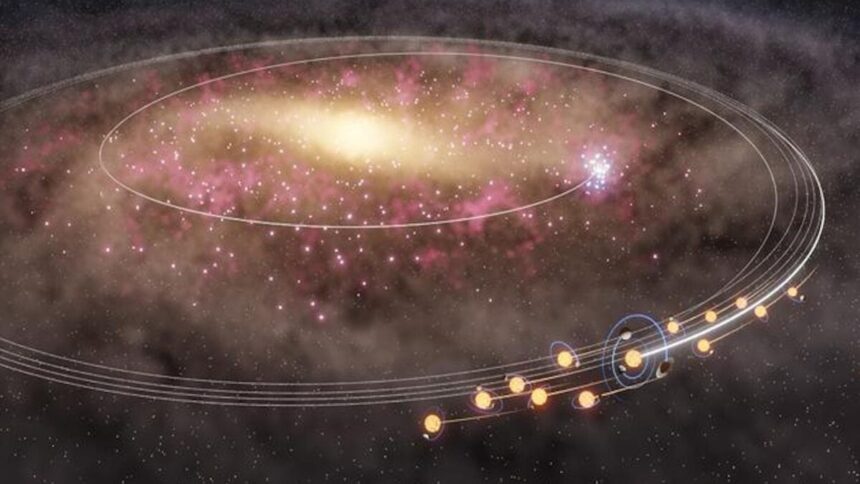
A team of researchers from Tokyo, Japan, created a catalog of thousands of stellar twins—stars born around the same time as the Sun that share similar characteristics to our host star. By examining the large group of Sun-like stars, they uncovered evidence that our host star joined a mass migration to leave the core of the Milky Way 4 to 6 billion years ago. The findings are detailed in two studies published in the journal Astronomy & Astrophysics.
Migration event
When the Sun was born 4.6 billion years ago, the star was located more than 10,000 light-years closer to the center of the Milky Way from its current position. Scientists know this based on the Sun’s composition of elements heavier than hydrogen and helium, which is more consistent with the metals found within the inner regions of the galaxy.
The missing piece of the puzzle, however, was how the Sun managed to get past the Milky Way’s central bar—a dense region that cuts across the galaxy and serves as a barrier to moving stars.
To better understand the Sun’s history, the lead authors behind the new studies, Daisuke Taniguchi from Tokyo Metropolitan University and Takuji Tsujimoto from the National Astronomical Observatory of Japan, used data taken by the European Space Agency’s Gaia mission. By sifting through observations of nearly two million stars, they found 6,594 that were similar to the Sun.
The researchers analyzed the sizes, temperatures, and composition of the solar twins to estimate their ages and noticed a broad peak for stars around 4 to 6 billion years old (including the Sun). The discovery that the Sun, along with its twins, are of similar ages and positioned around the same distance from the center of the Milky Way suggests that the stars were part of a mass migration event.
Send location
The Sun is currently located about 26,000 to 28,000 light-years from the center of the Milky Way. The crowded central region of the galaxy is far less hospitable to life, littered with tightly packed stars and violent cosmic events, and much closer to the supermassive black hole Sagittarius A*.
If the Sun had stayed near its birthplace, it’s unlikely that life would have been able to emerge and thrive on Earth. Thankfully, our host star settled into a quieter part of the galactic neighborhood where organisms could develop and evolve.
The new findings suggest that when the central bar of stars and gas formed in the Milky Way, this process accelerated stellar birth and shoved a number of stars into different parts of the galaxy. While the central bar was previously considered a barrier to the relocation of the Sun, the study proposes that the bar took on its final form after the group of stars had migrated.
Finding the Sun’s stellar twins could help scientists reconstruct how the solar system evolved—and how the conditions for life on Earth first emerged.
Read the full article here