By using this site, you agree to the Privacy Policy and Terms of Use.
Accept
Tech Consumer JournalTech Consumer JournalTech Consumer Journal
  • News
  • Phones
  • Tablets
  • Wearable
  • Home Tech
  • Streaming
Reading: Our Solar System Is Moving Faster Than It’s Supposed To, Study Suggests
Share
Sign In
Notification Show More
Font ResizerAa
Tech Consumer JournalTech Consumer Journal
Font ResizerAa
  • News
  • Phones
  • Tablets
  • Wearable
  • Home Tech
  • Streaming
Search
  • News
  • Phones
  • Tablets
  • Wearable
  • Home Tech
  • Streaming
Have an existing account? Sign In
Follow US
  • Contact
  • Blog
  • Complaint
  • Advertise
© 2022 Foxiz News Network. Ruby Design Company. All Rights Reserved.
Tech Consumer Journal > News > Our Solar System Is Moving Faster Than It’s Supposed To, Study Suggests
News

Our Solar System Is Moving Faster Than It’s Supposed To, Study Suggests

News Room
Last updated: November 25, 2025 2:52 pm
News Room
Share
SHARE

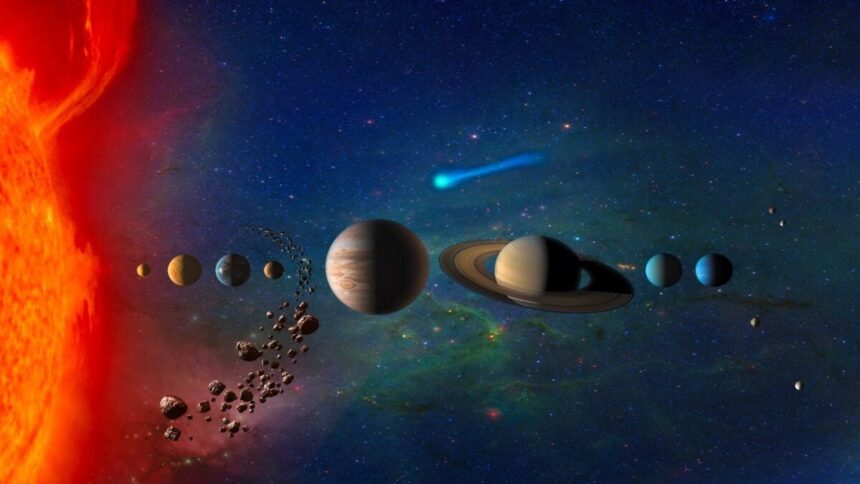
It may not feel like it, but everything in the universe is in constant motion. Our Sun, with all its planets, orbits the center of the Milky Way, flying through the cosmos at around 450,000 miles per hour (720,000 kilometers per hour), completing one full orbit in about 230 million years, according to NASA.

Astronomers measure the speed at which the solar system is hurtling through space by mapping surrounding galaxies and observing how light from other objects is shifted. New measurements, however, put the existing models to the test and found that the solar system may in fact be much speedier than previously believed.

A team of researchers used extremely sensitive instruments to detect a subtle headwind created by the motion of the solar system and found that our host star and neighboring planets are moving more than three times faster than current models predict. The study, published in Physical Review Letters, challenges the standard model of cosmology and our understanding of how the universe evolved since the Big Bang.

Speeding through

The scientists behind the recent study turned to radio galaxies to hone in on the speed at which the solar system travels. Radio galaxies are an excellent source of radio waves, emitting as much as one trillion solar luminosities of radiation with long wavelengths.

The team analyzed the distribution of radio galaxies using the LOFAR (Low Frequency Array) telescope, a radio telescope network that stretches across Europe, combined with data from two additional radio observatories. As the solar system moves through the cosmos, it creates a subtle headwind whereby more radio galaxies appear in the direction in which it’s traveling.

The researchers also applied a new statistical method that accounts for the fact that many radio galaxies consist of multiple components, producing a more accurate analysis of the solar system’s speed.

Combining the data revealed that the distribution of radio galaxies is 3.7 times stronger than what the standard model currently predicts.

“If our solar system is indeed moving this fast, we need to question fundamental assumptions about the large-scale structure of the universe,” Dominik Schwarz, cosmologist at Bielefeld University and co-author of the study, said in a statement. “Alternatively, the distribution of radio galaxies itself may be less uniform than we have believed. In either case, our current models are being put to the test.”

Either way, we’re zipping around the galaxy at a rapid clip, even if a firm grasp on why, or what it means for the universe, remains out of reach.

Read the full article here

You Might Also Like

I Tracked My Urine to Find Out if It’s the Next Wellness Tracker

A Smart Home Camera for Almost Nobody

Trump’s National Bitcoin Reserve Is Still in the Works. Some States Have Already Taken Action on Theirs

Sony and Netflix Will Keep Being Streaming Buddies

Terrifying Photo from the Minneapolis ICE Protests Will Have You Shopping for Leicas

Share This Article
Facebook Twitter Copy Link Print
Previous Article Gizmodo Senior Writer James Pero’s 8 Favorite Tech Gifts of 2025
Next Article Is Google The New Leader of the AI Race?
Leave a comment

Leave a Reply Cancel reply

Your email address will not be published. Required fields are marked *

Stay Connected

248.1kLike
69.1kFollow
134kPin
54.3kFollow

Latest News

The Gathering’ and Secret Lair
News
Report Shows Massive Increase in Iranian Bitcoin Adoption Amid Nationwide Unrest
News
The Wacky Musk-OpenAI Legal War Now Involves a Fittingly Insane Amount of Money
News
We Finally Know Real Things About the Next J.J. Abrams Movie
News
Netflix Will Keep Warner Bros. Movies in Theaters for 45 Days
News
The New ‘Exorcist’ and ‘Paranormal Activity’ Will Haunt Your 2027
News
The Atari Hotel in Las Vegas Isn’t Happening Anymore
News
A Good Vacuum That Tries to Do Too Much
News

You Might also Like

News

Should I Invest in SpaceX?

News Room News Room 10 Min Read
News

Scientists Discover 2000-Year-Old Mummified Cheetah in an Unexpected Place

News Room News Room 4 Min Read
News

Lucasfilm Tried to Make an Animated ‘Indiana Jones’ Show

News Room News Room 5 Min Read
Tech Consumer JournalTech Consumer Journal
Follow US
2024 © Prices.com LLC. All Rights Reserved.
  • Privacy Policy
  • Terms of use
  • For Advertisers
  • Contact
Welcome Back!

Sign in to your account

Username or Email Address
Password

Lost your password?