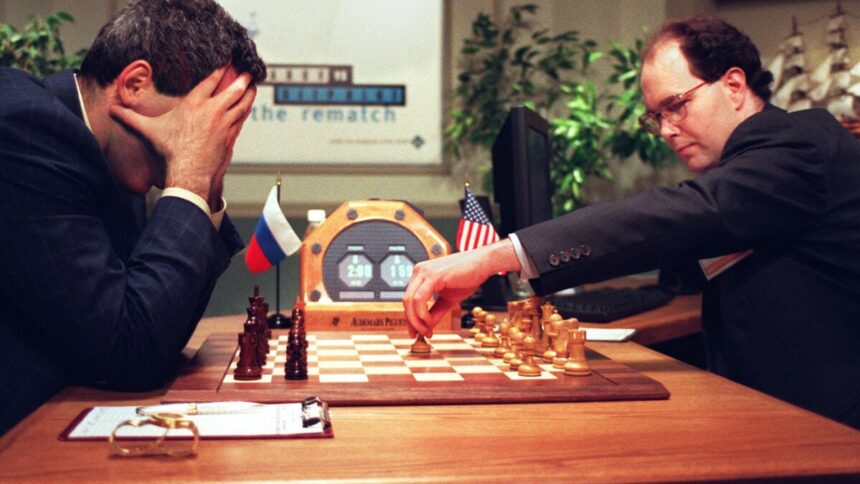
Humans have a long track record of being humbled by AI.
Chess was celebrated once upon a time as a uniquely human activity, a game far too complex for any machine to master. The 1997 defeat of Garry Kasparov by IBM’s Deep Blue forever dispelled us of that idea. Less than twenty years later, DeepMind’s AlphaGo beat Lee Sedol in Go, an ancient game many orders of magnitude more complicated than chess. But surely, people continued to think, computers will never be able to compose poetry or become so fluent in human speech that we sometimes mistake them for conscious beings. Wrong, and wrong again.
Now, mathematics—that field that’s so often held up as the pinnacle of the human intellect—has become the latest domino to fall.
That’s at least the view of Tristan Buckmaster, the NYU math professor who earlier this week found himself at the center of a fierce controversy involving OpenAI, a math problem that had vexed his field for ninety years, and perhaps even the very future of scientific inquiry. In an interview with the Australian Broadcasting Corporation (ABC), Buckmaster lamented that AI had become so capable at reasoning through complex math problems that the role of human mathematicians has been forever transformed and diminished. A Rubicon has been crossed, in Buckmaster’s eyes, and his field now faces an uncertain future as AI companies compete with one another to solve long-standing problems to which human mathematicians once devoted years of painstaking effort.
“I think it’s pointless,” Buckmaster told the ABC. “Like, I think the game is up.” Unsettling words from a well-respected professor, if you’re an undergraduate studying mathematics.
A quick recap
The OpenAI controversy erupted on Tuesday, when the company announced in a blog post that it had solved the Navier-Stokes existence and smoothness problem, one of the “Millennium Problems” that are widely regarded as the most difficult unresolved mysteries in mathematics, each of which comes with a $1 million prize for the first correct solution. Prior to publishing its result, OpenAI reached out to Buckmaster, who was rumoured to have achieved a breakthrough on another problem related to Navier-Stokes, in collaboration with another mathematician named Levent Alpöge.
The two had used multiple AI systems over the course of their work, including OpenAI’s Codex. (The mathematical prowess of the LLMs had deeply impressed Buckmaster: “This is a Deep Blue-Kasparov moment,” he wrote in a statement the night before OpenAI published its Navier-Stokes solution.) After learning about OpenAI’s approach to solving Navier-Stokes, Buckmaster grew suspicious that his and Alpöge’s Codex logs had been used by the company. According to Buckmaster, OpenAI offered two options for sharing credit for the Navier-Stokes solution, one of which involved him publishing his results along with the company’s—but removing Alpöge’s name. Alpöge works for Anthropic, but his collaboration with Buckmaster was solely as an independent researcher. Buckmaster refused both offers.
The episode has caused widespread outrage throughout Buckmaster’s profession. In an open letter published Wednesday, a group of current and former CalTech mathematicians wrote that “[AI] companies appear guided by an unhealthy instinct to claim certain results before competitors at all costs, regardless of the collateral damage to mathematical understanding.”
An OpenAI spokesperson told ABC that the company “can say categorically that it is impossible for Dr. Buckmaster’s Codex prompts over the last two months to have influenced the system in any way, including training.” Buckmaster previously said that he asked the company about whether his and Alpöge’s work could’ve conceivably been used during model training, and that he didn’t receive an answer. Earlier this week, OpenAI told reporters that it could not rule out that Buckmaster and Alpöge’s use of Codex helped improve its models.
Neither OpenAI nor Buckmaster immediately replied to Gizmodo’s requests for comment.
Reality check
It’s entirely possible that Buckmaster is getting a little ahead of his skis by claiming “the game is up” for mathematicians.
He’s had a presumably stressful week, even without all the talk of an impending AI-triggered apocalypse, and so his gloomy outlook is understandable. It’s also worth bearing in mind that humanity’s inability to accurately forecast the future cuts both ways: sometimes we’re overly optimistic that we’ll never be bested by machines, other times we’re the opposite. Throughout history, the rise of transformative new technologies has again and again caused some trepidation among the academic establishment, and sometimes those fears are overblown. The changes being wrought by AI—not just in mathematics but in virtually every other field—are arguably happening much quicker than any previous technological revolution. So again, some anxiety is perfectly natural.
But another lesson from recent history is that even when machines beat us in something, whether it’s chess or Go, people don’t just give up on it. They keep playing just for fun. Even if AI in the future is formulating new mathematical proofs quicker than we can ever hope to keep up with, it’s unlikely that humans, with all our limitless curiosity, will simply stop tinkering with math or teaching it to our kids.
That’s assuming, of course, we all survive the AI boom.
Read the full article here