
Intel’s new chips built for 2026’s revised slate of gaming laptops promise a marginal boost in game performance. The new CPUs shouldn’t be the only reason you buy a desktop replacement laptop this year. If you do shell out for a beastly gaming laptop, expect to spend even more than you would have in 2025 for slightly improved specs.
The Intel Core Ultra 9 290HX Plus replaces last year’s flagship Core Ultra 9 285HX, which stood as Team Blue’s top-performing laptop chip. It’s still running on the Arrow Lake microarchitecture, and it even features the same 24 cores in total, with eight performance cores and 16 efficiency cores, as the 285HX. The two chips claim the same 5.5GHz top frequency. The main difference between the old and new is an improved die-to-die frequency, which can speed up on-chip data transfer and marginally increase performance in demanding apps.
That means the performance increase between last year’s Core Ultra 9 285HX and the new Core Ultra 9 290HX Plus will be less or more dramatic depending on the game. According to Intel, Red Dead Redemption 2 running at 1080p on high settings only nets 2% better frame rates. Cyberpunk 2077 receives a 10% boost, while Borderlands 3 tops out at 24% better performance. These tests were conducted on an MSI Titan 18 HX with an RTX 5090 mobile GPU. That laptop already costs more than $5,000 for higher-end specs. An upgraded version may be priced even higher thanks to the upgraded chip and the ballooning price of memory.
Alongside the top-end CPU, Intel is also promoting a new Core Ultra 7 270HX Plus. It’s a midrange, 20-core chip that promises better performance than current Arrow Lake chips like the Core Ultra 7 265HX. This promised boost to frame rates or creativity app performance isn’t going to be nearly as consequential as Intel’s Arrow Lake update for desktops. The Intel Core Ultra 270K Plus series increased the number of efficiency cores and pushed the boost clock frequency compared to past-gen chips like the Intel Core Ultra 9 285K. In other words, laptops with “Intel Inside” may not feel like the dramatic upgrade some PC gamers may demand.
Laptop makers are juggling costs with new chips and screens
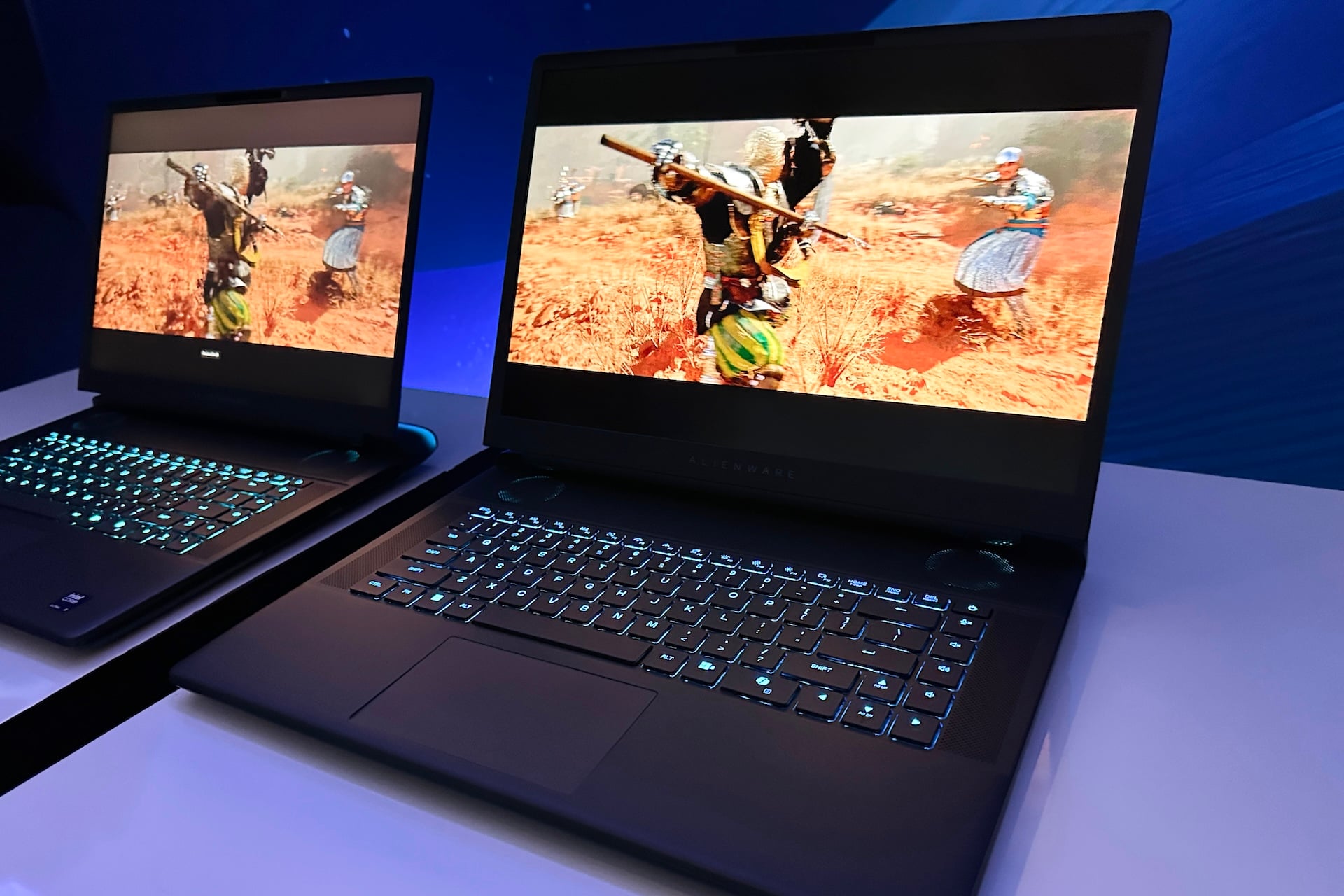
Some of the major OEMs (original equipment manufacturers) are finally putting a street date on the laptops we first saw at CES 2026. That includes Alienware, which is ready to launch a new version of its Alienware 16 Area-51 and 18 Area-51. Last year’s models felt great and offered fast in-game performance. They were brought down by lackluster LCD displays. The new models have OLED screens with an added coating that hopefully reduces reflections and glare. Gizmodo has seen 16- and 18-inch models in person, and they could prove to be our favorite gaming laptops of both 2025 and 2026 thanks to their clacky mechanical keyboards.
The 16-inch Area-51 starts at $3,150 for a version with an Intel Core Ultra 9 275HX and Nvidia GeForce RTX 5080 laptop GPU. That model comes with an LCD screen and is functionally equivalent to last year’s model. For an OLED panel, you have to spend a whopping $4,900 for a 16-inch Area-51 with an RTX 5090 GPU and Core Ultra 9 290HX Plus CPU. The refreshed 2026 Area-51 is set to ship starting in April.

Other OEMs are updating their gaming laptops for 2026 and the new Intel Core Ultra 200 HX Plus lineup. Acer is trying to push a Predator Helios Neo 16S AI with a 240Hz OLED screen. That laptop measures just under 0.75 inches tall when closed up and still manages to pack in the Core Ultra 9 290HX Plus and up to an Nvidia RTX 5080 mobile GPU. Acer’s refreshed laptops should be available in July. We still don’t know how much it will cost.
Asus is bringing back last year’s Strix G16 and G18 models along with an upgraded 300Hz refresh rate on the IPS LCD model, a higher spec than the 240Hz from the previous generation. The 18-incher can sport a mini LED display with a peak of 1,600 nits of brightness. And you can bet your bottom dollar both sports the new Core Ultra 9 290HX.
Asus told Gizmodo the Strix G16 will cost between $3,500 and $3,900. A G18 will demand between $2,800 and $3,300. We still don’t know when we can even buy one. Asus also plans to reveal a new version of last year’s ROG Strix Scar 18 sometime within Q2 of this year. Just don’t expect any of these laptops to be cheaper than before.
This post was updated 3/17/26 at 5:03 p.m. to include updated pricing information from Asus.
Read the full article here