

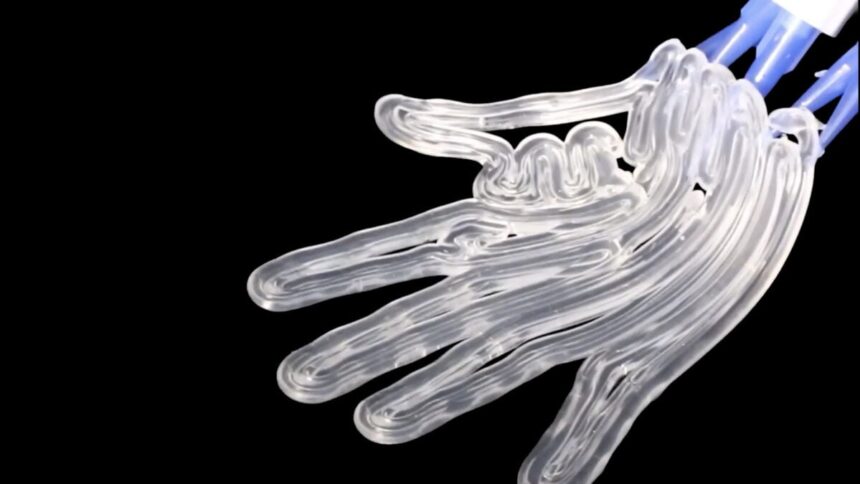
While 2026 has been an objectively terrible year for humans thus far, it’s turning out—for better or worse—to be a banner year for robots. (Robots that are not Tesla’s Optimus thingamajig, anyway.) And it’s worth thinking about exactly how remarkable it is that the new humanoid robots are able to replicate the smooth, fluid, organic movements of humans and other animals, because the majority of robots do not move like this.
Take, for example, the robot arms used in factories and CNC machines: they glide effortlessly from point to point, moving with both speed and exquisite precision, but no one would ever mistake one of these arms for that of a living being. If anything, the movements are too perfect. This is at least partly due to the way these machines are designed and built: they use the same ideas, components, and principles that have characterised everything from the water wheel to the combustion engine.
But that’s not how living creatures work. While the overwhelming majority of macroscopic living beings contain some sort of “hard” parts—bones or exoskeletons—our movements are driven by muscles and ligaments that are relatively soft and elastic.
The use of similar materials in robotics is the fundamental idea behind the field of soft robotics, which explores the construction of robots out of materials like rubber and soft plastics, instead of hard, rigid metals. Many of the familiar mechanisms used in machines—hinges, gears, etc—are unsuitable in soft robotics: after all, there’s no point in making a robot from rubber if its movement is controlled by a hard metal exoskeleton.
So how do these robots move? Well, one variety of actuator that’s often used is a sort of artificial muscle. These structures are formed of a soft substance that contains internal pneumatic channels. Inflating or deflating these channels pulls or pushes on the surrounding material, causing the part to deform. This creates motion that can be used to move the part itself and/or other attached components.
In the past, the muscles were generally manufactured via mold-casting. The need to create the embedded pneumatic channels has mostly meant casting each piece in two parts, each in a different mold—one with the channels embedded into it, and one without. (An example of such a process can be seen in this video.)
However, in a recent paper published in the journal Advanced Materials, a team at Harvard University describes a new method for manufacturing these structures. Instead of being cast in a mold, the muscles are 3D printed, and the technique used—which goes by the catchy name “rotational multimaterial 3D printing”—creates the entire structure in a single pass. This is achieved by printing the channels in a soft gel, over which the “tissue” is layered. Once the whole structure is complete, the gel is drained from the channels, leaving them hollow and ready to be pumped full of air.
This makes for obvious improvements in both speed and efficiency: there’s no need to create bespoke molds for every part, and no need to print multiple components and then fit them together. This promises to make the use of artificial muscle structures cheaper and more commercially viable. And that probably means that more creepy crawling six-fingered robot hands and disconcertingly dextrous kung-fu deathbots are just around the corner.
Read the full article here