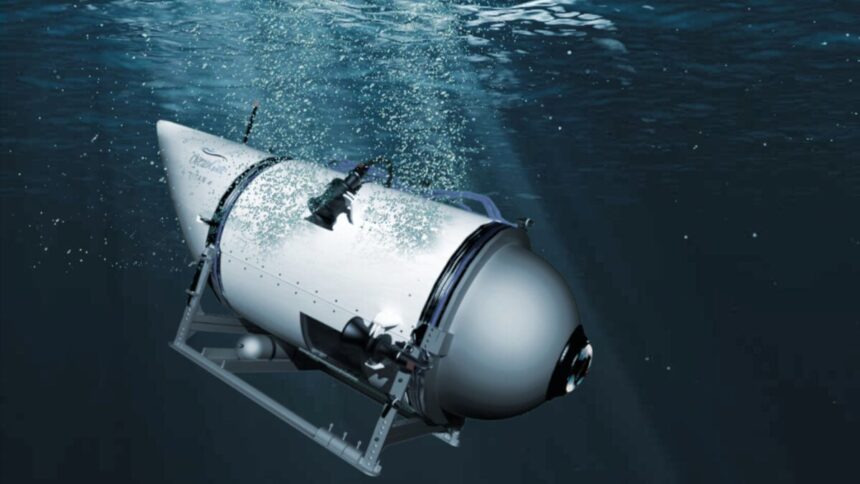
Aerospace engineers capably deploy lightweight, super-tough carbon fiber to build stealth fighters and commercial aircraft. F1 racers, like McLaren and Ferrari, use the composite material, too. So, how did OceanGate—the startup behind 2023’s disastrous Titan submersible implosion—manage to go so wrong with its own carbon fiber hull?
Researchers in Australia appear to have dredged up a new clue while stress-testing the infamously durable material’s performance for flight applications: Moisture absorption, they found, is the single most critical factor to how carbon fiber materials degrade over time.
Mechanical and aerospace engineers with the Royal Melbourne Institute of Technology (RMIT) and Monash University began their study by investigating how various carbon fiber designs would degrade when weatherized. While their results don’t address the case of the Titan sub directly, what they found not only surprised them but also raises important questions about the prudence of constructing deep-sea submersibles out of this material again in the near future.
“What we found is that it’s not the exact aging temperature or humidity that matters most,” study coauthor Katherine Grigoriou, an aerospace composites researcher at Monash, said in a statement, “it’s how much moisture the material ultimately absorbs.”
“This means that if we understand how moisture builds up inside a composite structure,” Grigoriou elaborated, “we can much more reliably predict how it will perform over many years in service.”
Critically waterlogged
Grigoriou and her colleagues focused their attention on how the orientation of carbon fibers, woven together, interacts with “hygrothermal conditioning” (aging via hot and humid atmospheric exposures) and impacts aerospace-grade carbon-fiber materials.
They subjected three weaves—pure 90-degree angle weaves, 45-degree angle weaves, and a mixture of those two—to conditioning under 140 degrees Fahrenheit (60 degrees Celsius) and 176 degrees Fahrenheit (80 degrees Celsius) and under both 90% and 100% relative humidity.
Their analysis of the “microstructural damage,” examined via x-ray computed tomography and scanning electron microscopy, found that the mixed composites containing both 90-degree angle and 45-degree angle weaves fared best at resisting the water absorption degradation. (The purely 45-degree angle weaves, apparently, fared the worst.)
But, to their surprise, the temperature and humidity all these carbon fibers were exposed to had little impact on this process. The severity of these structural defects, as they reported in the journal Composites Part A: Applied Science and Manufacturing this month, was “governed solely by the final moisture content—not by the conditioning temperature or humidity.”
According to Grigoriou, the findings have changed how engineers should think about simulating the lifetime stability of these materials via these heat and humidity stress tests in the lab. The moisture content in the material has to be “properly understood and controlled,” she said.
Substandard undersea design
Back in 2023, as investigators with the U.S. Coast Guard and the National Transportation Safety Board scrambled to determine both the causes and culpability for the fatal high-pressure implosion of the Titan sub, some academics were already talking about this waterlogging issue.
Arun Bansil, a physicist at Northeastern University’s campus in Boston, told a campus publication that the “degrading effects of water absorption on the epoxy binding the carbon fibers in the composite” were worth paying attention to in “assessing the failure of Titan.”
That said, the basic idea of using carbon fiber in a sub may one day work, Bansil speculated. A more cautious team than OceanGate’s, under less domineering leadership, “will eventually develop carbon-fiber-based materials for deep-sea applications,” he said, “along with testing protocols for safe operation.”
In truth, NTSB investigators found serious safety lapses across OceanGate’s entire Titan project, ultimately describing the sub’s implosion, which killed all five passengers, as a “preventable tragedy.”
Like the tragedy of Icarus in Greek mythology—the story of an ancient serial entrepreneur who flew too close to the Sun on wax wings—it now looks like one of those lapses was as much a case of bad materials science as it was simple hubris.
Read the full article here