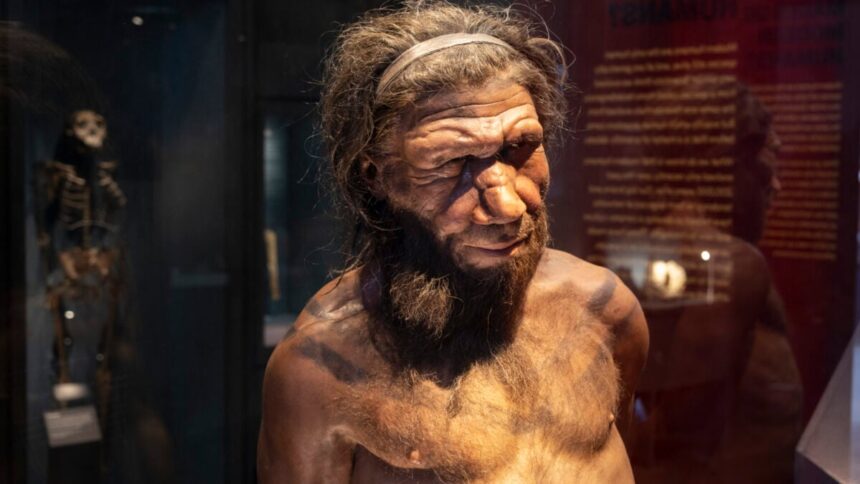
Around 2% of modern humans carry Neanderthal DNA, meaning we know early humans got super intimate with our now-extinct relatives. According to new research, when Neanderthals and humans did hit it off, it seems they favored a particular sex combination over another.
In a paper published today in Science, evolutionary geneticists at the University of Pennsylvania report an excess of modern human ancestry on the Neanderthals’ X chromosome compared to other parts of their genome. That excess was probably due to sex-based mating, specifically between human women and Neanderthal men, according to the new study.
“The most likely explanation for this sex bias is mate preference,” study co-lead author Daniel Harris told Gizmodo. “[E]ither Neanderthal men preferred human women, human women preferred Neanderthal men, or a combination of both.”
A genetic desert
In 2023, the researchers were involved in another study that identified which sections of the Neanderthal genome came from modern humans. During their analysis, they found large sections of the modern human genome with zero traces of Neanderthal ancestry, designated “Neanderthal deserts.” (For context, modern humans aren’t descended from Neanderthals, although fossil and genetic evidence strongly suggests we share a common ancestor.)
The new research builds on this finding and other prior work that found a prevalence of so-called Neanderthal deserts on the human X chromosome. The team wondered if there were identifiable patterns on Neanderthal X chromosomes that could explain some unanswered questions.
For instance, did these Neanderthal deserts come simply from smaller Neanderthal populations? If not, were there some inherent genetic incompatibilities between Neanderthals and humans?
“Explicitly, this observation about the X chromosome has engendered considerable speculation over the past 10 years,” study co-lead author Alex Platt explained to Gizmodo. “We felt that the approach we had been developing could offer some novel insights to break this tie.”
Breaking the tie
For the latest study, Harris, Platt, and senior author Sarah Tishkoff performed a statistical analysis of Neanderthal genomes. They considered several hypotheses for the lack of Neanderthal X chromosomes in modern human populations and how each scenario would influence Neanderthal genetics.
Surprisingly, they found a 62% relative excess of modern human ancestry on Neanderthal X chromosomes compared to the rest of Neanderthal autosomes, which are chromosomes that are not sex chromosomes.
Further investigations supported a “sex-biased mate preference in human-Neanderthal mating patterns,” Harris said, adding that the bias was so prominent that “this bias likely needed to persist for more than just one generation.”
The Pleistocene dating scene
It’ll be interesting to see how other geneticists respond to this paper. And indeed, the authors themselves were careful to not overstate their findings, presenting several notes of caution. For example, the conclusions were based on genetic patterns and modeling, as opposed to direct evidence of how Neanderthals and modern humans actually chose partners. Also, Harris and his colleagues had to work with very few Neanderthal genomes (even if high quality), and none from the exact time after Neanderthals and modern humans interbred.
That said, the scientists make the case that a pattern exists and that this mating bias stuck around for a very long time. “The bias that we inferred seems to have remained consistent across [mating] events separated by 200,000 years,” the scientists wrote in the study, adding that the “potential for preferences in mate choice to persist across time and space have been documented in both human and animal studies.”
The researchers, however, aren’t yet sure what motivated this mate preference. It’s possible, for example, that mate choice had little to do with it, and that migration and demographic pressures were the underlying, or contributing, factors. But the data presented in the paper could serve as the underpinning for future collaborations with anthropologists and evolutionary psychologists, Harris mused.
“Studying Neanderthals and ancient humans allows us to learn about the evolutionary history of our species,” said Harris. “It allows us to ask questions like, ‘What makes us human?’”
More broadly, Platt added, the findings indicate that intimate relationships for modern human ancestors weren’t solely dependent on survival of the fittest, so to speak, but “can also stem from cultural and social interactions.”
Read the full article here