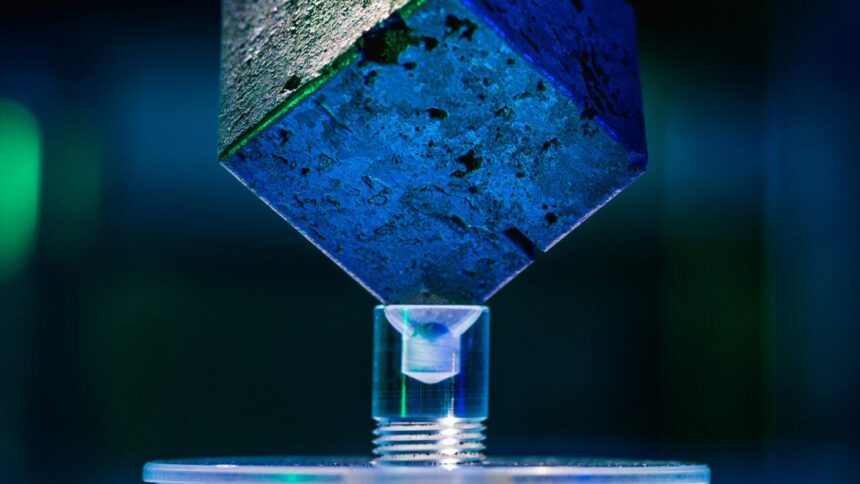
According to historians, the Manhattan Project began as a response to Nazi Germany’s perceived lead in nuclear technology. While their reactor never really took off, scholars are divided as to how close they got—and the answer may be that they weren’t at all close to criticality, a new study argues.
In what they call “nuclear archaeology,” researchers conducted a literature review of historical documents on Uranprojekt—Nazi Germany’s nuclear program—and then devised a model to reproduce realistic measurements of its progress. Specifically, the team focused on B8, Nazi Germany’s final, large-scale uranium experiment in 1945. Two years after the war, project designer Werner Heisenberg claimed that the reactor would have worked with a little more uranium. However, the latest assessment, published today in PNAS Nexus, rejects this estimate, claiming that Nazi Germany couldn’t have built either a heavy water or a graphite reactor.
“Our new nuclear analysis reveals that the B8 required roughly 2 times the uranium and 2.3 times the heavy water to reach criticality, far exceeding Heisenberg’s estimates,” the team, which includes physicists Patrick J. Park and Timothy W. Koeth from Columbia University and the University of Maryland, respectively, wrote in the paper. Those figures are compared with what B8 actually used.
This means the Nazis were far short of the heavy water needed to sustain a nuclear chain reaction. To put it into perspective, B8 would have needed about twice the heavy water that Norsk Hydro—the plant in Nazi-occupied Norway that supplied Germany’s program—produced during the entire war, according to the study.
Taking a backseat
That’s right—the Heisenberg who oversaw Nazi Germany’s uranium project was the same Heisenberg who revolutionized modern quantum physics. (If you’re curious to learn more, I recommend David Cassidy’s Beyond Uncertainty.) Heisenberg joined Germany’s nuclear efforts in 1939, a year after the discovery of nuclear fission. He led a total of eight large-scale experiments exploring the feasibility of generating energy from uranium.
According to the paper, military setbacks drove the Germans to deprioritize nuclear research, and after the war their nuclear materials “disappeared into American or Soviet intelligence collections or onto the black market.” That “left a window” for former collaborators like Heisenberg to make technical claims about Uranprojekt that couldn’t be independently verified, the team explained. Notably, Heisenberg argued in a Nature paper from 1947 that B8 in particular would have succeeded had his team secured “a relatively small amount of uranium.”
Setting aside his politics, Heisenberg is undoubtedly among the most brilliant physicists of his time. Given his renown, his claims have led to a division in modern scholars’ discourse on the failure of Nazi Germany’s nuclear program, according to the study. What’s more, the discourse has focused mostly on historical documents and not a technical reassessment of what appears scientifically feasible, the researchers added—hence, the new analysis.
Coming up short
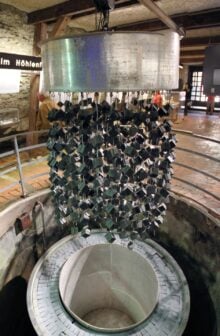
For the study, the team conducted forensics and document-based archaeology of B8’s uranium, heavy water, and graphites. Although primary German sources omitted chemical specifications, the researchers were still able to arrive at a fair estimate based on techniques used by previous investigations on postwar nuclear facilities. The team then constructed three different simulation models to recreate B8’s physical conditions. It also referenced data from contemporary projects like the Manhattan Project’s Chicago Pile 3, a heavy water-moderated, natural uranium reactor similar to B8.
Overall, the latest analysis indicated that Heisenberg “significantly underestimated” what he needed to achieve criticality. At minimum, B8 would have needed 1.9 to 2.7 times more uranium and 2.1 to 2.4 times more heavy water, according to the paper. In addition, Germany’s graphite supply, as an alternative to heavy water, contained too many impurities to sustain a reactor. Heisenberg may have been an exceptionally intelligent physicist, but even he would have struggled to overcome this reality.
“Several counterfactuals may seem feasible if one only sets total demand against total supply [in theory], but to practically achieve them in wartime conditions would require nearly omniscient foresight and coordination,” the researchers noted in the study.
Read the full article here