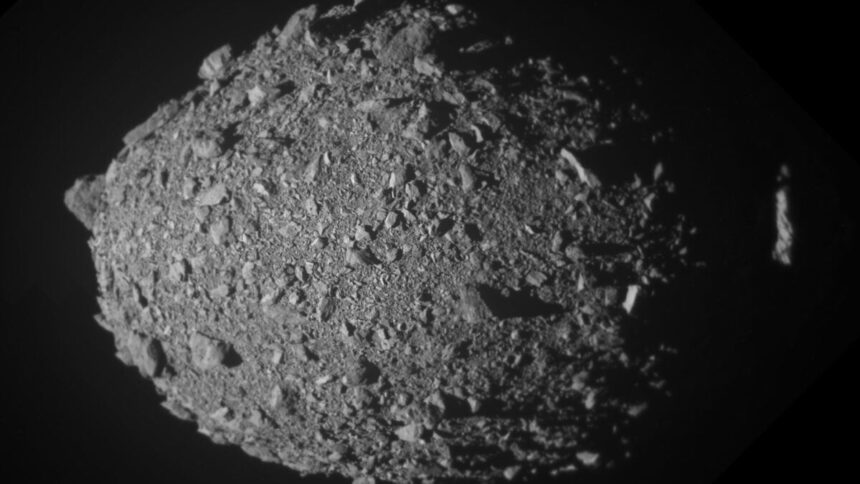
In September 2022, NASA’s DART spacecraft rammed into the asteroid moonlet Dimorphos at nearly 15,000 miles per hour (24,000 kilometers per hour). The mission aimed to test whether NASA could one day use this technique to save Earth from an oncoming asteroid, and a new analysis suggests it could work.
Before we dive into the findings, a bit of context. Dimorphos is part of a binary asteroid system, meaning it orbits a much larger asteroid called Didymos. This system poses no threat to Earth, but it did serve as the perfect natural laboratory for NASA to test its kinetic impactor planetary defense technique. After the DART impact, researchers determined that the mission altered Dimorphos’s orbit around Didymos, proving that humanity can deliberately change a celestial object’s trajectory.
But from a planetary defense perspective, this only matters if humanity can alter an asteroid’s orbit around the Sun, and this new study confirmed that DART did exactly that. Incredibly, the impact didn’t just change Dimorphos’ orbit around Didymos—it also slightly altered the pair’s path around the Sun. The findings, published Friday in the journal Science Advances, make the strongest case for the kinetic impactor technique yet.
“With this paper, we have shown for the first time that an asteroid has been put on a different orbit by human interaction,” co-author Steven Chesley, a senior research scientist at NASA’s Jet Propulsion Laboratory, told Gizmodo. “So it works, and we know how to do it in the real world.”
Tiny change, big deal
To figure out how DART affected Dimorphos’s solar orbit, Chesley and his colleagues primarily analyzed 5,955 ground-based radar measurements of the asteroid’s position and 22 measurements of stellar occultation events, which occur when a celestial body passes in front of a star. Astronomers can then measure the temporary blocking of the star’s light and calculate the object’s trajectory with remarkable precision.
Those occultation measurements came from a cadre of mostly “amateur” astronomers working across the globe—though Chesley said the term undersells their dedication and expertise. “The accuracy of these observations is really kind of mind-boggling,” he said. This allowed his team to identify a tiny change in the velocity of Dimorphos’s solar orbit after the DART impact, finding that it slowed by 11.7 micrometers per second, or approximately 1.7 inches per hour.
While the change is minute, it still had the power to alter the solar orbit of the entire binary system over time. The size of the system’s orbit shrank by about 1,200 feet (360 meters), meaning that its 2.1-year trip around the Sun shortened by roughly 0.15 seconds.
“That’s a tiny change, and that’s because the system is so much more massive than the satellite itself,” Chesley explained. In a real planetary defense scenario, this probably wouldn’t do much good, but the study still marks a significant step forward in our planetary defense capabilities by demonstrating the kinetic impactor technique can alter an object’s solar orbit.
Questions remain
Still, much remains unknown about the impact of the DART mission, and answering these questions is critical to validating the kinetic impactor technique. For one thing, Chesley’s previous research suggests that DART significantly changed the shape of Dimorphos, but it will require a detailed survey to determine exactly what the asteroid looks like now.
That’s where the European Space Agency’s Hera mission comes in. This spacecraft is currently en route to the Dimorphos-Didymos system, and when it arrives in November, it will map the entire surface of Dimorphos—and most of Didymos—at high resolution. This, coupled with a highly precise measurement of Dimorphos’s mass, will allow researchers like Chesley to constrain the change to the system’s orbit, reducing the uncertainty that underlies his team’s calculations.
Until then, the cadre of astronomers that contributed occultation data to this study will continue doing their thing, Chesley said. More occultation measurements will similarly enhance the precision of orbital change calculations.
So while there’s still much work to be done before NASA can definitely say the kinetic impactor technique is viable for planetary defense, scientists are now closer than ever. With Hera on the way to conduct its groundbreaking survey, researchers are poised to turn this proof-of-concept into a fully tested strategy for asteroid deflection.
Read the full article here