
By using this site, you agree to the Privacy Policy and Terms of Use.
Accept
Tech Consumer JournalTech Consumer JournalTech Consumer Journal
  • News
  • Phones
  • Tablets
  • Wearable
  • Home Tech
  • Streaming
  • More Articles
Reading: NASA Is Launching a $4 Billion Space Telescope on Sunday. Here’s Why You Should Care
Share
Sign In
Notification Show More
Font ResizerAa
Tech Consumer JournalTech Consumer Journal
Font ResizerAa
  • News
  • Phones
  • Tablets
  • Wearable
  • Home Tech
  • Streaming
  • More Articles
Search
  • News
  • Phones
  • Tablets
  • Wearable
  • Home Tech
  • Streaming
  • More Articles
Have an existing account? Sign In
Follow US
  • Contact
  • Blog
  • Complaint
  • Advertise
© 2022 Foxiz News Network. Ruby Design Company. All Rights Reserved.
Tech Consumer Journal > News > NASA Is Launching a $4 Billion Space Telescope on Sunday. Here’s Why You Should Care
News

NASA Is Launching a $4 Billion Space Telescope on Sunday. Here’s Why You Should Care

News Room
Last updated: August 27, 2026 8:38 am
News Room
Share
SHARE

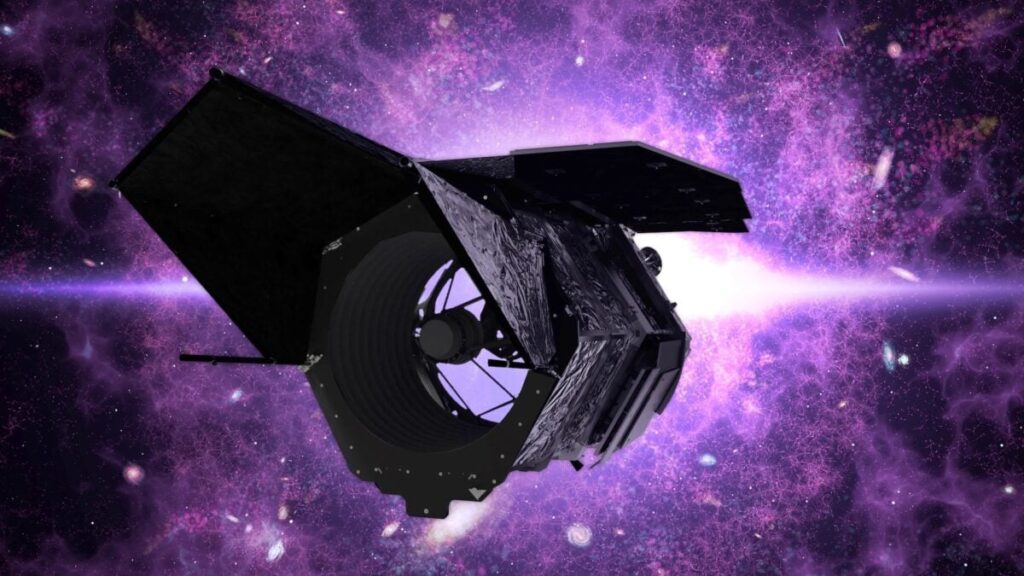
A revolutionary space telescope is ready to join the ranks of Hubble and Webb, capturing panoramic views of the cosmos to survey millions of galaxies, measure the expansion rate of the universe, and hunt down hundreds of alien worlds.

NASA’s Nancy Grace Roman Space Telescope is set for liftoff on Sunday at 7:26 a.m. ET aboard a SpaceX Falcon Heavy rocket from the Kennedy Space Center in Florida. The launch will be streamed live on NASA’s website, as well as the agency’s YouTube channel. You can also tune in through the feed below.

The $4 billion observatory is equipped with sharp infrared vision, combined with a field of view at least 100 times larger than the Hubble space telescope, according to NASA. Roman is tasked with solving some of the greatest mysteries of the universe: dark matter and dark energy. By surveying massive areas of the sky, the telescope will be able to track how galaxies are distributed throughout the universe and map the invisible dark matter.

Wide-eyed telescope

NASA refers to Roman as Hubble’s wide-eyed cousin. While it has the same sensitivity as Hubble’s cameras, a single Roman image will hold the equivalent detail of 100 pictures from Hubble.

The part of the sky Roman can cover compared to that of the Hubble Space Telescope. Credit: L. Hustak (STScI)

The new observatory has two main instruments: the Wide Field Instrument (WFI) and a Coronagraph Instrument. The 300-megapixel WFI is designed to take extremely sharp images across a huge field and measure very sensitive spectroscopic data.

Like the Webb Space Telescope, Roman captures the universe in infrared light. Webb has a much larger mirror and can look extremely deep into the universe, while Roman can see vast areas of the sky simultaneously.

What is Roman going to do?

Following its launch, the Roman telescope will travel to the second Sun-Earth Lagrange point, or L2, about one million miles (1.5 million kilometers) from Earth. From its high perch, the telescope will have an unobstructed view of the sky while maintaining a relatively stable orientation.

Once it’s up there, Roman has three major scientific missions: investigate dark matter, measure how the universe expands over time, and look for planets beyond our solar system.

Dark matter is the invisible glue that holds the universe together. While it makes up most of the matter found in galaxies and galaxy clusters, scientists are still not quite sure what it is. Since dark matter is invisible, it is nearly impossible to observe. It does, however, take up space and hold mass, so we can see how it interacts with and influences ordinary matter.

Roman will observe how galaxies cluster and how matter bends light through a phenomenon called weak gravitational ​lensing. The telescope will be used to scan about 12% of the sky high above our galactic plane to look for the lensing effect in millions of distant galaxies. By measuring tiny distortions across those galaxies, Roman may be able to map how dark matter is distributed throughout the universe.

Another mystery that scientists are hoping to resolve using the Roman telescope is the expansion rate of the universe. The universe is expanding at an accelerating rate, and dark energy may be the main culprit speeding it up.

To help gather clues about this mysterious force, Roman will look for supernovae in distant galaxies. The stellar explosions can provide insight into how fast the universe is expanding because they peak at predictable brightness, helping astronomers measure cosmic distances.

Roman will also map how galaxies cluster together in time and space, revealing the potential effects of dark energy. By observing millions of galaxies, the telescope can reveal how the universe evolved over time.

Scientists are also hoping to use the telescope to find an enormous number of worlds beyond our own. Rather than looking at individual nearby stars, Roman will monitor 100 million stars for hundreds of days. The telescope is expected to find about 2,500 exoplanets using a process known as microlensing, using a foreground star to act as a lens.

Its planet-hunting skills are sensitive enough to find planets smaller than Mars and will reveal planets orbiting their host stars at distances ranging from closer than Venus to beyond Pluto, according to NASA. The telescope’s coronagraph is designed to directly image exoplanets by blocking out a star’s light, allowing astronomers to observe much fainter planets.

The Roman space telescope is designed to create an enormous amount of data to help scientists understand how the universe has changed and evolved over cosmic history, providing clues to some of the most vexxing unknowns in astrophysics.

Read the full article here

You Might Also Like

Americans Can Now Add Metal to Their Food From the Comfort of Their Own Grill

Samara Weaving to Fight Killer Wasp Outbreak in ‘Hivemind’

Is Anti-AI Fashion This Season’s Hottest New Look?

Plaud’s First Wireless Earbuds Crank AI Productivity to Max Volume

Samsung’s Galaxy S26 FE Strips the S26+ Down to Its Basics

Share This Article
Facebook Twitter Copy Link Print
Previous Article Screenless Luffu Link Is the Next Wearable From the Founders of Fitbit
Next Article Nvidia Tries to Defend Against Circular Dealmaking Accusations
Leave a comment

Leave a Reply Cancel reply

Your email address will not be published. Required fields are marked *

Stay Connected

248.1kLike
69.1kFollow
134kPin
54.3kFollow

Latest News

‘Ghost in the Shell’ Is Coming to Theaters in 4K and You Can Get Tickets Now
News
The Large Hadron Collider Is Getting a Major Upgrade. But What Would Actually Surprise Physicists?
News
Nvidia Tries to Defend Against Circular Dealmaking Accusations
News
Screenless Luffu Link Is the Next Wearable From the Founders of Fitbit
News
They Really Didn’t Have to Go This Hard for the Cyberpunk 2077 Edition of the Commodore 64
News
The Latest ‘Star Wars’ Lego Is Physically Its Biggest in History
News
Nvidia Reportedly Stops Flirting With Hugging Face and Just Buys It
News
Netflix Releases Trailer for New ‘Wonka’ Horror Movie, Er, Game Show
News

You Might also Like

News

Meta Apparently Seeks to Spread Settlement Pain to Its Competitors—With Snapchat Conspicuously Absent

News Room News Room 5 Min Read
News

Ring Says Its New Encryption System Could Make It Harder for Police to Access Videos

News Room News Room 5 Min Read
News

Republican Senator Launches Investigation Into Flock as Backlash Sweeps Country

News Room News Room 5 Min Read
Tech Consumer JournalTech Consumer Journal
Follow US
2024 © Prices.com LLC. All Rights Reserved.
  • Privacy Policy
  • Terms of use
  • For Advertisers
  • Contact
Welcome Back!

Sign in to your account

Username or Email Address
Password

Lost your password?