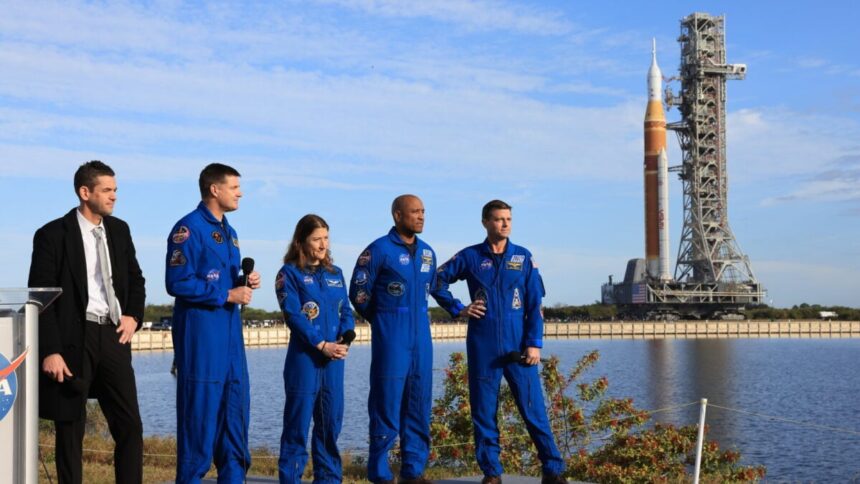
NASA is overhauling its plan to return astronauts to the lunar surface, adding another test flight to prepare for landing on the Moon while attempting to standardize its Space Launch System (SLS) rocket for more frequent launches.
During a press conference on Friday, NASA Administrator Jared Isaacman announced major changes to the agency’s ongoing Artemis program in an attempt to alleviate some risks and kinks. The agency is planning on launching an additional flight in 2027 to attempt a rendezvous of the Orion spacecraft with commercial landers in Earth orbit before using them to land astronauts on the Moon. This will now serve as the Artemis 3 mission, which was supposed to land astronauts on the lunar surface for the first time since 1972.
“I think it should be incredibly obvious you don’t go from one uncrewed launch of Orion and SLS, wait three years, go around the Moon, wait three years, and land on it,” Isaacman said during the press conference. “NASA has been working on these plans, knowing this is not the right approach. There has to be a better way.”
NASA is also canceling planned upgrades to SLS in hopes of accelerating manufacturing of its rocket while increasing its launch rate. According to the new Artemis schedule, NASA will attempt to land astronauts on the Moon in 2028 and possibly even do it twice that same year, for the Artemis 4 and 5 missions, respectively.
Different path, same rocket
NASA has been struggling to get its Artemis 2 mission off the pad. The agency has already delayed the launch of the crewed mission twice due to ongoing issues with SLS, which have plagued the rocket since launch preparations for Artemis 1 in 2022.
“When you are launching every three years, your skills atrophy, you lose muscle memory…This is just not the right pathway forward,” Isaacman said. “And I’d say also, when you are experiencing some of the same issues between launches, you probably got to take a close look at your process for remediation. Are you truly getting the technical root cause, or are you getting close to it?”
Moving forward, NASA wants to standardize its Moon rocket for a smoother ride. Artemis missions 1 through 3 use the SLS rocket’s initial Block 1 configuration, while future launches are supposed to use an upgraded variant (SLS Block 1B) with a larger upper stage.
As part of the newly rewritten Artemis program, NASA is canceling the upgraded version of SLS and keeping the Block 1 configuration to allow for a faster flight rate. “We’ve got issues with low flight rate, and I would say a great way to exasperate that problem further is to start making changes to vehicle configuration,” Isaacman said. “SLS is a very impressive vehicle. We don’t want to turn every one of them into a work of art.”
One more flight
The Artemis 2 mission, currently scheduled for launch in April, is the first crewed flight of the Orion spacecraft and SLS rocket. NASA’s original plan was to follow that up with a crewed landing on the surface of the Moon as part of the Artemis 3 mission.
Now, NASA designated Artemis 3 as a test flight of commercial lunar landers in Earth orbit. That means it won’t be going to the Moon at all. Instead, the third Artemis mission will be similar to Apollo 9, which tested the lunar module in Earth orbit to prepare for landing on the Moon.
SpaceX’s Starship Human Landing System and Blue Origin’s Blue Moon are tasked with transporting astronauts from lunar orbit to the surface of the Moon. Although NASA officials wouldn’t discuss the preparedness of their commercial partners for Artemis 3, those are the two vehicles slated to perform a rendezvous with the Orion spacecraft in Earth orbit in 2027.
Artemis 3 is also designed to test the new spacesuits designed for the Moon missions. “Even just getting an astronaut in a suit in microgravity, we can learn a lot,” Isaacman said. “And take this information back to inform hardware development, whether it’s in the landers or in the suits, before Artemis 4.”
Artemis 4, tentatively scheduled to launch in early 2028, has now become the agency’s first attempt to land astronauts for the first time in more than 50 years. NASA is now also aiming to launch Artemis 5 later that same year, hoping for two lunar touchdowns within 10 months’ time.
The accelerated flight rate will require an expanded workforce, Isaacman pointed out. “We need to rebuild and strengthen the workforce here at NASA,” he said. “We have to rebuild core competencies; the ability to turn around our launch pads and launch with frequency greater than every three years is imperative.”
Read the full article here