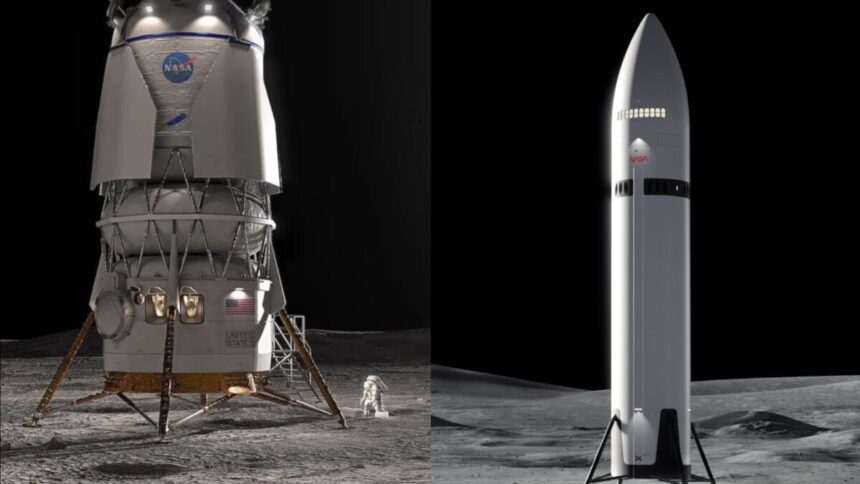
NASA hopes to return astronauts to the Moon by 2028, but building the spacecraft that will take them to the lunar surface is proving to be far more difficult than expected. A new watchdog report warns that the Artemis human lander program is not only facing delays and technical issues but also unresolved crew-safety risks.
The findings, published by NASA’s Office of the Inspector General on Tuesday, reveal critical gaps in testing and crew survival analyses for both prospective landers: SpaceX’s Starship Human Landing System (HLS) and Blue Origin’s Blue Moon Lander. That’s a serious problem because if either lander encounters a catastrophic event, NASA will not be able to rescue the stranded crew from space or the lunar surface.
“Without a rescue capability for the Artemis missions, the crew will be lost should the HLS become disabled on the lunar surface or be unable to dock with the awaiting Orion or Gateway in [lunar orbit],” the report states.
The report comes less than two weeks after NASA overhauled the Artemis program, adding another test flight to prepare for a crewed Moon landing while working to standardize its Space Launch System (SLS) rocket for more frequent launches. According to the new schedule, NASA’s Artemis 4 mission will attempt to return astronauts to the lunar surface in 2028, followed by another crewed landing mission (Artemis 5) potentially that same year.
Crew safety questions must be answered
NASA had hoped to land the first Artemis crew on the Moon by mid-2027 and planned to do so using Starship HLS—a modified version of Starship’s upper stage. But in October, the agency reopened SpaceX’s contract due to significant developmental delays. Blue Origin quickly emerged as the strongest competitor, and now, these two companies are racing against each other to deliver a crew lander on time for a 2028 mission.
According to the OIG’s report, it’s still too early to determine the technical feasibility, financial implications, and schedule impacts of this effort to accelerate lander development. However, the report does raise concerns about the safety of these spacecraft. While the OIG acknowledges that the agency is being proactive about mitigating and preventing hazards associated with both landers, it found gaps in NASA’s risk reduction methodology.
For example, agency officials say the program is following NASA’s “test like you fly” guidance—which dictates that systems should be tested in conditions as close as possible to actual spaceflight conditions—but the report identified missed opportunities to apply these principles to the SpaceX and Blue Origin uncrewed demonstration missions.
What’s more, NASA and SpaceX apparently disagree about whether Starship HLS meets the requirement for manual controls and whether the Artemis crew could take control of the lander if necessary. This is an essential safety feature and a key component of Starship HLS’s human-rated certification, according to the report. As for Blue Moon, it’s still unclear how its manual controls will work.
NASA’s approach to analyzing how a crew might survive a catastrophic event also has shortcomings, according to the report. These “crew survival analyses” are limited by technical constraints and available resources, and because they typically take place during the later stages of lander design, they mostly identify risks rather than helping engineers design systems to reduce those risks. Additionally, the analyses don’t account for extended crew survival beyond the immediate catastrophe.
Where NASA goes from here
The report outlines several steps NASA can take to better manage HLS program funding and enhance crew safety and survival during the Artemis missions. Firstly, the OIG urges NASA to set clear rules for tracking government support to contractors and adjusting costs when that support changes or is added later.
It also recommends updating both the SpaceX and Blue Origin contract language to reflect those new rules, reviewing lessons learned from the Commercial Crew Program regarding manual spacecraft controls, and updating crew survival analyses to include strategies for extended crew survival.
The report states that NASA has agreed to implement most of these recommendations, but the agency did not respond to Gizmodo’s request for comment on the matter.
As NASA takes steps to address the OIG’s concerns, the clock will keep ticking. The agency is under serious pressure to land astronauts on the Moon before China, so overcoming the HLS program’s technical hurdles and answering critical safety concerns must happen expediently.
Read the full article here