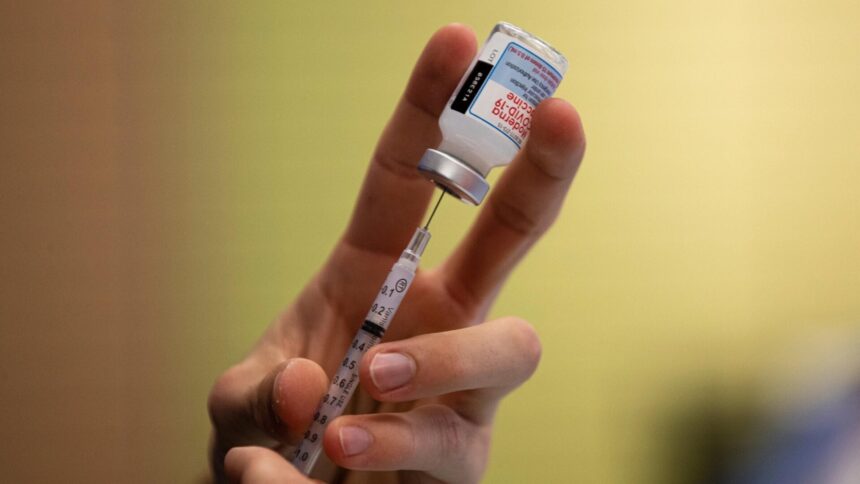
The federal government’s crusade against vaccines seems to have been taken up a notch. In a highly unusual move, the Food and Drug Administration has outright refused to review Moderna’s promising experimental mRNA flu vaccine for potential approval.
Moderna revealed the FDA’s refusal Tuesday evening, posting its rejection letter online. In the letter, signed by senior official Vinay Prasad, the FDA claims that Moderna’s Phase III trial data did not include an adequate control group for comparison. Moderna has stated that it followed all the recommendations previously agreed upon with the agency. Prasad reportedly decided to reject Moderna’s application unilaterally, over the objection of FDA scientists.
The FDA’s decision, “which did not identify any safety or efficacy concerns with our product, does not further our shared goal of enhancing America’s leadership in developing innovative medicines,” said Stéphane Bancel, Moderna CEO, in a statement from the company.
“No safety concerns”
The company published Phase III data on its standalone seasonal flu vaccine, code-named mRNA-1010, last March, collectively involving nearly 10,000 participants. The vaccine appeared to be, at minimum, as safe and effective as a standard flu vaccine for adults under 65 as well as a higher-dose vaccine used for adults over 65. Based on antibody levels, mRNA-1010 might even have provided people greater protection on average than typical egg-based flu shots. The study’s authors also identified “no safety concerns.”
But in Prasad’s letter to Moderna, issued last week, he claims the control groups used by Moderna did not “reflect the best-available standard of care.” The letter does not define what this standard of care should be. And in its response today, Moderna stated that CEBR had given its blessing to the company’s proposed study protocol for its largest phase III trial of mRNA-1010 in 2024. The agency did recommend that Moderna include a comparison group of adults over 65 given a high-dose flu vaccine. The company had conducted separate smaller Phase III trials, one of which included such a comparison, and presented that data in its submission to the FDA last year (this data was included in the study mentioned above).
At no point, the company claims, did the FDA signal it was not satisfied with the quality of Moderna’s data prior to the rejection. And it seems that in normal times, the FDA would have at least considered Moderna’s vaccine for approval. Citing three anonymous FDA officials, Stat News reported Wednesday that Prasad, head of the FDA’s Center for Biologics Evaluation and Research (CBER), overrode his staff in deciding to wholly reject the company’s application.
A grudge against mRNA
The FDA’s rejection is the latest to reflect the government’s newfound animosity toward mRNA technology. It’s a shift that began with the second Trump administration and the installment of Robert F. Kennedy Jr. to head the U.S. Department of Health and Human Services.
Last August, for instance, HHS announced that it was pulling almost $500 million in funding intended for mRNA vaccine research and development. As justification for the move, Kennedy issued misleading statements about mRNA vaccines, claiming they failed to provide effective protection against upper respiratory infections like the flu and covid-19 (while not highly effective against illness, covid-19 vaccines saved millions of lives during the pandemic).
Prasad was appointed head of the CBER last May. He was fired later that July (possibly due to pressure from right-wing voices such as Laura Loomer), only to be rehired less than two weeks later. He has similarly cast doubt on the effectiveness and safety of mRNA covid vaccines. Last November, he told FDA staff members that these vaccines had killed at least 10 children in the U.S., citing an unpublished analysis by the FDA. This data has yet to be released to the public, and an alleged internal memo leaked soon after has indicated that FDA scientists found fewer deaths linked to the vaccines (possibly as few as zero) than Prasad claimed.
Prasad and other officials have also stated that the FDA will require more rigorous evidence to approve vaccines moving forward. That’s a decent idea in theory, but in practice, it could demand placebo-controlled trials for diseases that already have existing vaccines—trials that would be unethical since they would knowingly expose some volunteers to preventable diseases, many experts have argued.
Likely as a result of this increased scrutiny, Moderna delayed its application for a combination mRNA flu/covid vaccine that showed promise last year, citing the need to collect more data. That said, the company’s mRNA-1010 vaccine is being evaluated for approval in other countries, including Canada and the European Union. Moderna stated that it has requested a meeting with CBER to better understand the agency’s decision.
This latest saga, however, might illustrate that trying to play by the current FDA’s rules is a losing battle.
Read the full article here