
The supernova SN 2025wny is hopelessly far, lying approximately 10 billion light-years from Earth. Normally, this would make it impossible for astronomers to detect. But one team got lucky.
While scanning the sky for cosmic transients, an international team of astronomers noticed two galaxies in the foreground of a giant blob of light. Further analysis with other telescopes revealed that the blur was a supernova—a superluminous one at that. Remarkably, the two galaxies were acting as a “cosmic magnifying glass,” boosting the brightness of the energetic, rare type of supernova by a factor of 50.
The researchers describe their findings in a recent paper for The Astrophysical Journal Letters.
“This is nature’s own telescope,” Joel Johansson, study lead author and an astrophysicist at Stockholm University in Sweden, said in a statement. “The magnification lets us study a supernova at a distance where detailed observations would otherwise be impossible.”
Distortions in spacetime
Astronomical observations are limited to the speed of light—that is, the things we “see” from the universe are a product of how far they are in terms of light. So if light bumps into anything along the way, that also shows up in our observations. Many times, that appears as unfortunate noise in the data.
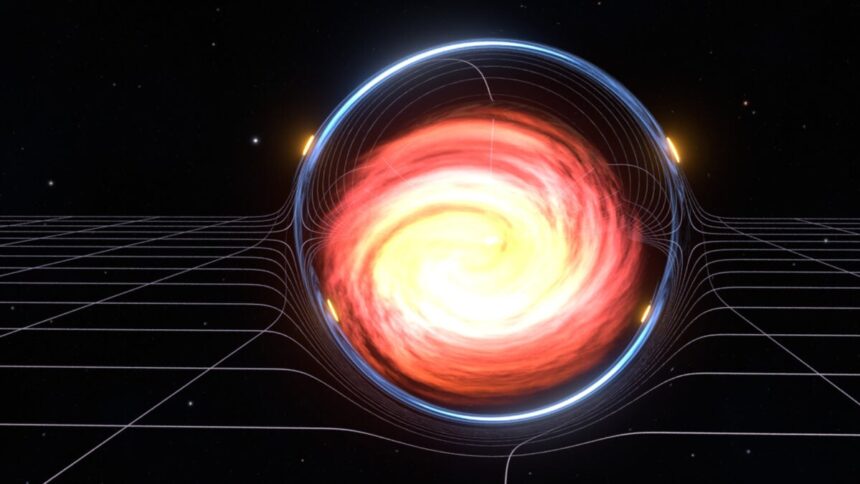
But other times, these obstructions are large enough to bend spacetime with their gravitational pull, subsequently making light travel alongside the newly bent path. From this distortion—a gravitational lens—astronomers can extract valuable information about that section of the universe.
Not a bad signal
In the case of SN 2025wny, the two intervening galaxies magnify and split the light from the supernova. The separated light signals each enter the view of Earthbound telescopes at different times, making the supernova manifest as a weird, spotty image.
“I couldn’t believe my eyes when I saw the data; I thought that it must have been an artifact from the camera,” admitted Jacob Wise, study co-author and a PhD student at Stockholm University, in the release. “However, when I carefully looked at our data from previous nights, I could still clearly see the multiple lensed images of the supernova.”
Wise and his advisor, Dan Perley, quickly sent their observations to the Keck Observatory in Hawaii, which collected and confirmed the spectra of the strange signal. Indeed, the team was looking at an extremely bright supernova sitting impossibly far away.
“It’s always exciting to get a request for a very rapid response to a transient event like this,” commented John O’Meara, chief scientist at Keck, in a statement. “Keck was ready to respond, and we were happy to deliver and participate in this breakthrough.”
New explosions, new questions
SN 2025wny is the first superluminous supernova to be observed by gravitational lensing. That has some important implications. For one, the time differences between the lensed images represent a novel way to determine the universe’s expansion rate, known as the Hubble constant. This constant is at odds with real-life observations, a mismatch referred to as the Hubble tension.
Gravitational lensing of faraway objects could help point to “whether the tension reflects new physics or limitations in existing methods,” the researchers explained in the statement. The team is already conducting follow-up observations with the Hubble and James Webb Space Telescopes, they added.
The discovery is yet another neat example of multi-messenger astronomy, which applies multiple techniques to study a single source. In that sense, the paper concluded, SN 2025wny represents “not only an individual milestone but also a glimpse into a rapidly unfolding era” for astronomy pursuits.
Read the full article here