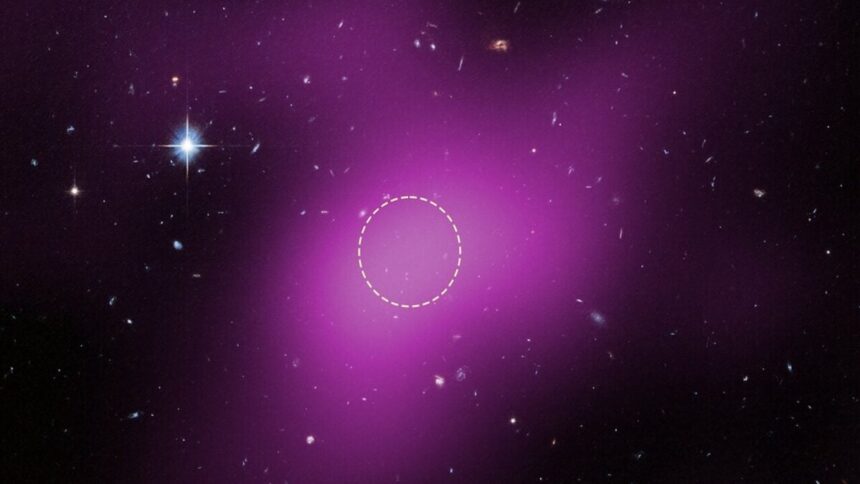
The universe is filled with plenty of wonder and mystery, as well as the occasional flop. A new discovery of a dark-matter cloud reveals the remnants of a failed galaxy that didn’t form any stars, ending up as a fossilized relic from the early days of the cosmos.
A team of astronomers unveiled a new type of celestial object, a starless dark matter cloud rich in gas, an ancient leftover from galaxy formation in the early universe. “This is a tale of a failed galaxy,” Alejandro Benitez-Llambay, an astrophysicist at the Milano-Bicocca University in Milan, Italy, and principal investigator behind the discovery, said in a statement. “In science, we usually learn more from the failures than from the successes.”
“In this case, seeing no stars is what proves the theory right. It tells us that we have found in the local Universe a primordial building block of a galaxy that hasn’t formed,” he added.
On cloud nine
Scientists have long theorized about a phantom astronomical object known as RELHIC, or the Reionization-Limited H I Cloud, with the H I symbolizing neutral hydrogen. They searched across the cosmos for evidence of a cloud rich in gas but without any star formation.
It wasn’t until a team of scientists directed the Hubble Space Telescope toward a cloud located approximately 2,000 light-years away from Earth that the search was finally over. Using the telescope’s extremely sensitive Advanced Camera for Surveys, the scientists were able to confirm that there’s really nothing there.
The object is a dark matter cloud that was not able to accumulate enough gas to form stars. It happened to be the ninth gas cloud identified on the outskirts of a nearby spiral galaxy, Messier 94, and was therefore given the name Cloud-9.
Compared to other clouds, Cloud-9 is smaller, more compact, and highly spherical. The cloud’s core is made up of neutral hydrogen that stretches across 4,900 light-years. The gas is approximately 1 million times the mass of the Sun, while the cloud itself is about 5 billion times the mass of the Sun. The scientists behind the discovery believe that Cloud-9 must be dominated by dark matter, as the pressure of the neutral hydrogen gas appears to be balancing the gravity of the cloud.
A window into the dark universe
“This cloud is a window into the dark Universe,” Andrew Fox, an astronomer at the Space Telescope Science Institute (STScI) for the European Space Agency, and co-author of the new study, said in a statement. “We know from theory that most of the mass in the universe is expected to be dark matter, but it’s difficult to detect this dark material because it doesn’t emit light. Cloud-9 gives us a rare look at a dark-matter-dominated cloud.”
Cloud-9 is a rare discovery, found at a unique sweet spot of galactic formation. If the cloud were bigger, it would have collapsed, formed stars, and become a galaxy. On the other hand, if it were smaller, the gas would have been dispersed and ionized, and there wouldn’t be much left of it.
There may be more objects like it in the universe, which would allow scientists to better understand galaxy formation in the early universe, as well as the nature of dark matter. “Among our galactic neighbors, there might be a few abandoned houses out there,” Rachael Beaton, an observational astronomer at STScI, and a member of the research team, said in a statement.
Read the full article here