

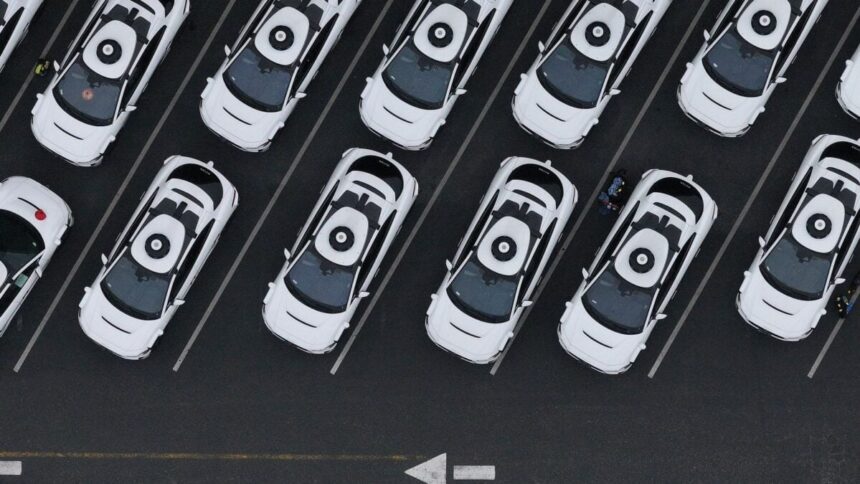
It has become commonly accepted that autonomous vehicles, despite the occasional high-profile crash, are on the whole safer than human drivers. That has led to the expansion of robotaxis like those offered by Waymo and, to a lesser extent, Tesla and Zoox, to take to the roads of major American cities, with expansion happening faster than ever. But actual evidence that these self-driving rides actually are safer than having humans behind the wheel is still pretty limited, as a recent report from Bloomberg points out.
There is certainly data to suggest that autonomous vehicles can cut back on the number of accidents on the road. Waymo in particular has made this information central to its pitch, claiming to have achieved 84% fewer crashes that result in airbag deployment, 73% fewer crash-related injuries, and 48% fewer police-reported crashes compared to human drivers during its first 22 million miles on the road. But much of the data that provides the foundation of these claims comes from the company itself. As Bloomberg notes, much of the research that Waymo highlights on its website has been coauthored by Waymo employees.
Much of that safer driving was also done in safer driving conditions than most human drivers face. It wasn’t until November 2025 that Waymo got the green light to drive on freeways around the San Francisco Bay Area, Phoenix, and Los Angeles. Up until that point, the vast majority of miles were city driving. By comparison, about 25% of all human driving takes place on highways and freeways, according to the Federal Highway Administration, where speeds are much higher, and accidents are often more deadly.
There is also little information about how frequently a teleoperator takes control of a vehicle. Most autonomous vehicle providers, including Waymo and Tesla, have humans serving as remote backup drivers, able to take over control of the vehicle if it gets into an untenable situation. But the companies provide little information as to when an intervention happens or what it means when it does. Per data reported to California’s Department of Motor Vehicles, Waymo cars experienced one disengagement every 9,793 miles, while other providers had more frequent interventions.
The data that we do have shows that autonomous vehicles, in their limited capacity, have been safer than human drivers in ideal conditions. A study published by authors at the Smart and Safe Transportation Lab used a matched case-control design to compare human drivers to autonomous alternatives and found that cars equipped with “Advanced Driving Systems” generally produced fewer accidents than human-driven vehicles. However, researchers found that while driving at dawn and dusk, the accident rate for ADS was 5.25 times higher. In turning scenarios, it was 1.98 times higher.
There’s also the fact that while autonomous vehicles can avoid some human errors like distracted driving, they also tend to make mistakes that people wouldn’t make, like driving directly into a pond or driving through an active fire scene. The marketing around robotaxis, suggesting they are safer, can lull people inside the vehicles into behaving less safely than they otherwise would. Studies have found that people are less likely to wear their seat belt while in an Uber or Lyft, and there’s little reason to believe they wouldn’t do the same in an autonomous vehicle, where part of the pitch is freedom to do what they want while the robot takes the wheel.
Safer roads would be great. So would fewer cars in general. But at this point, it’s not actually as clear as the industry would like to suggest that autonomous vehicles will achieve either of those goals.
Read the full article here